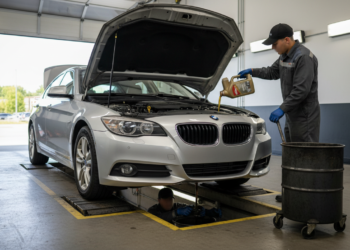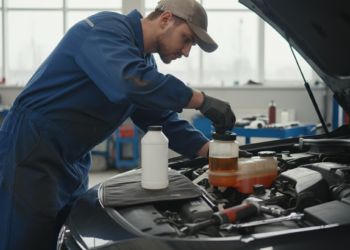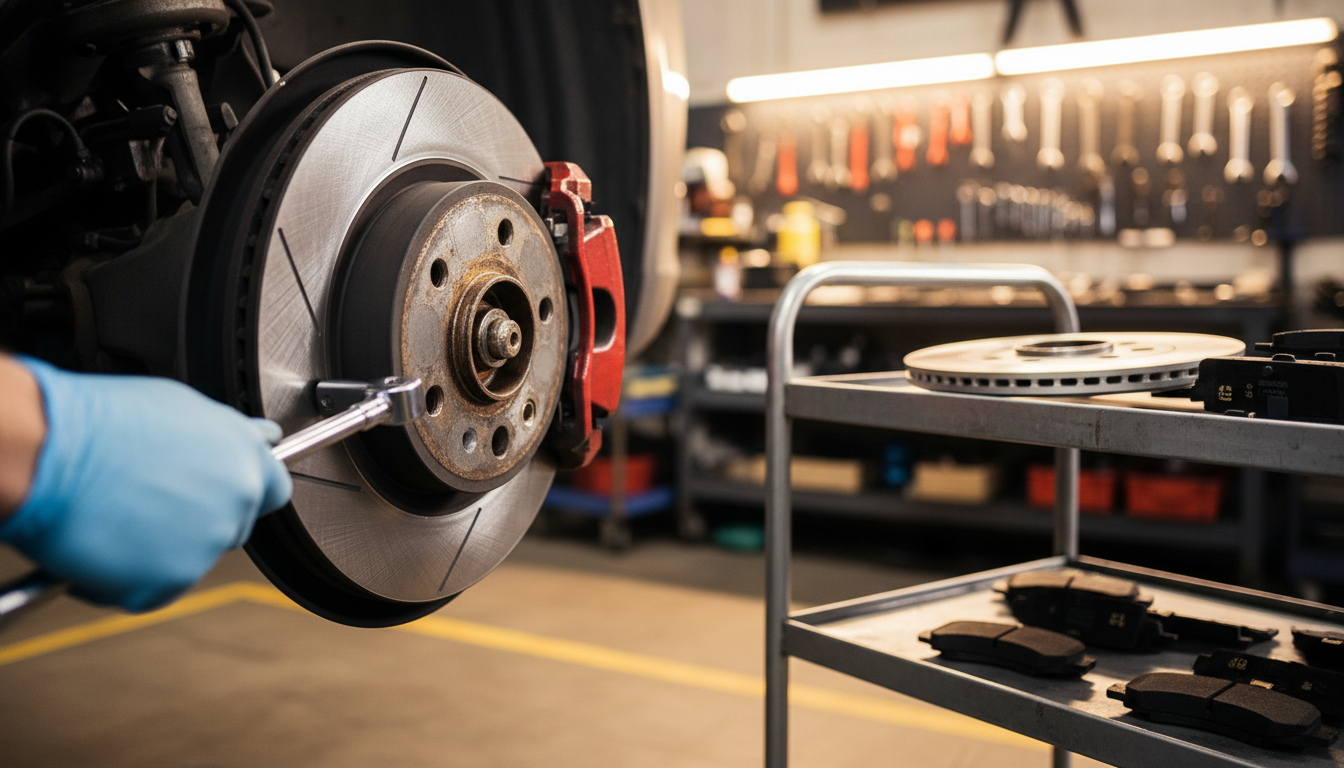
Picture two quotes for the same front axle on the same car: $249 from one shop, $689 from another. Both are probably honest, because the first is a pads-only job and the second adds new rotors, and that one line is the biggest swing in any brake bill. Heading into 2027, an independent shop typically charges $150 to $300 per axle for pads only and $300 to $600 per axle for pads and rotors, while dealers run about $230 to $450 and $450 to $850 for the same work.

So the useful question is not “what do brakes cost?” but “do my rotors actually need replacing, and is the price for that fair?” This guide is built around answering it with measurements instead of a hunch. For other repairs on the same visit, our free car repair cost estimator gives a quick ballpark.
Pads only vs pads and rotors, per axle
Shops price brakes per axle (both front wheels, or both rears), so double these numbers for a four-wheel job. The ranges below are for a typical sedan or small crossover with parts and labor included.
| Job (one axle) | Independent shop | Dealership |
|---|---|---|
| Pads only | $150 to $300 | $230 to $450 |
| Pads and rotors | $300 to $600 | $450 to $850 |
| Pads, rotors and one caliper | $500 to $900 | $750 to $1,300 |
| Pads, rotors, calipers and fluid flush | $600 to $1,200 | $900 to $1,800 |
Parts are a smaller slice than most people think. A front pad set for a typical sedan costs about $50 to $90, a pair of rotors $120 to $260, and a hardware kit with grease $15 to $40. Labor and shop markup make up the rest, which is why the dealer’s rotor job can cost twice an independent’s even with similar parts.
Why “just turn the rotors” rarely happens anymore
Older advice says to resurface (machine, or “turn”) rotors on a lathe and save the cost of new ones. That made sense when rotors were thick, heavy and expensive. Today it usually does not, for reasons that have nothing to do with a shop trying to upsell you:
- New rotors got cheap. Industry trade publication Counterman notes that for common “hat” style rotors, a new set now often costs less than the technician labor to resurface the old ones.
- Modern rotors are thin to begin with. Turning removes roughly 0.015 to 0.020 inch, more on rusty or pitted rotors, and many rotors have little material to spare above their minimum thickness.
- Thin, light rotors are hard to machine well. They vibrate on the lathe, and a poorly turned rotor causes the pulsation you were trying to fix. Shops would rather install new than eat a comeback.
- Some rotors still are worth turning. Heavy hubbed rotors on certain trucks, and pricey performance or European rotors with thickness to spare, can justify a $20 to $40-per-rotor machining charge.
Watch for the reverse in some promotions: low “per axle” specials often include resurfacing, and if your rotors measure too thin to be turned, the price will jump to a rotor job once the car is on the lift. That is not a scam, but it is why the advertised price and the final bill differ.
Three findings that justify new rotors
You do not need new rotors every time you need pads. You need them when the rotor fails a measurement or shows damage. Ask the shop for the numbers, and expect a straight answer:
- Thickness at or near minimum. Every rotor has a minimum (discard) thickness cast or stamped on it and listed in service data. A tech measures with a micrometer in several spots. If it is under spec, or would be after machining, it must go.
- Heat damage or cracks. Blue or purple discoloration, hard spots or any cracks mean the metal has changed and will not brake evenly.
- Deep grooves or pulsation. Score marks you can catch a fingernail in (roughly 1 mm or more deep), or a pedal that pulses when stopping from highway speed, point to rotors that need machining at minimum and often replacement.
Pads are simpler. Most new pads start around 10 to 12 mm of friction material, and many shops recommend replacing them near 3 to 4 mm. A squeal from the metal wear indicator is your early warning. A grinding sound usually means metal is touching metal, and by then the rotors are almost always damaged, turning a $200 job into a $500 one.
Shop-by-shop pricing and the specials worth reading
| Where | What you’ll see | Fine print to check |
|---|---|---|
| Firestone Complete Auto Care | No posted base price; $50 off one axle or $100 off front and rear brake service (late 2026 offer) | 12-month/12,000-mile labor warranty; 24 months/24,000 miles if you add a fluid exchange |
| Tire Discounters | “As low as $224 per axle” standard brake service, offer through Nov. 9, 2026 | Includes pad install and rotor resurfacing or drum turning, lifetime brake pads and a 12-month/12,000-mile warranty; new rotors cost extra |
| Midas, Pep Boys, Meineke | Pads and rotors commonly reported around $350 to $450+ per axle | Franchise pricing varies by store; ask whether the quote is pads-only with resurfacing |
| Independent shop | $300 to $600 per axle, pads and rotors | Ask the pad type and whether hardware is included |
| Dealership | About 30% to 50% above independents | OEM parts; worth it for warranty work or recalls |
“Lifetime brake pads” sounds generous, and it can be. Usually it means free replacement pads for as long as you own the car, but you pay labor each time and the shop often recommends rotors on the next visit. It saves the most for drivers who keep a car for many years and wear through pads quickly in city driving.
What your vehicle adds to a four-wheel job
| Vehicle type | Pads and rotors, all four wheels (independent) |
|---|---|
| Compact sedan | $580 to $870 |
| Midsize sedan | $640 to $960 |
| Compact SUV | $700 to $1,050 |
| Hybrid or EV | $620 to $1,000 |
| Full-size SUV or pickup | $900 to $1,430 |
| European luxury | $1,230 to $2,250 |
Rear brakes on many newer cars carry an electronic parking brake that needs a scan tool to retract the caliper, which adds a little labor. Hybrids and EVs use regenerative braking, so their pads can last far longer, but their rotors often rust from light use; a rotor replaced for corrosion rather than wear is common on these cars.
One front axle, three ways to pay
Hypothetical example for illustration, using midpoints of the national ranges above. It is not a real quote.
A 2019 compact SUV comes in with a squeal up front. The tech measures 3 mm of pad left and rotors 0.5 mm above minimum thickness with light grooving. Turning would take them under spec, so new rotors are justified.
| Line | Independent | Dealer | DIY |
|---|---|---|---|
| Pads (ceramic) | $80 | $130 | $65 |
| Rotors (pair) | $190 | $300 | $150 |
| Hardware kit, grease | $25 | $40 | $20 |
| Labor (2 hours) | $200 | $350 | $0 |
| Tools (jack stands, caliper tool, torque wrench) | n/a | n/a | $75 one time |
| Total | $495 | $820 | $310 |
Had the rotors measured with plenty of thickness and no damage, the independent shop’s bill would drop to roughly $200 to $300 for pads and resurfacing. That gap, close to $250 here, is exactly what the measurements are protecting.
Extras on the estimate: fair or fluff?
- Brake fluid flush ($80 to $150): Fair if your owner’s manual calls for it (many say every two to three years) or the fluid tests high for moisture. Not automatic with every pad job.
- Calipers: Fair if one is seized, leaking or causing uneven pad wear. Replacing both calipers on a car with even wear and no leaks is a common upsell.
- Hardware kit: Fair and cheap. New clips and pins help prevent noise and uneven wear.
- Premium vs economy pads: Ceramic pads cost more but run quieter and cleaner; budget pads on a heavy SUV may wear fast. Ask which brand and grade is quoted.
- “All four wheels now”: Front pads usually wear about twice as fast as rears. If the rears measure fine, they can wait.
Red flags include refusing to show you the old parts, giving no measurements, or a quote that doubles after a “free inspection” without explanation.
Doing it yourself, if you’ve turned a wrench before
A basic pad and rotor swap is one of the more approachable DIY repairs. Expect $80 to $250 in parts per axle plus a one-time $50 to $100 for tools, saving $200 to $400 per axle versus a shop. Skip it if your rotors are pressed onto the hub, your car has an electronic parking brake without a scan tool, or you are not comfortable with torque specs and bleeding brakes. Brakes are not where you learn by guessing.
Brake job prices heading into 2027
No national chain has announced 2027 brake prices. The trend is upward: the government’s consumer price index for motor vehicle maintenance and repair rose 4.9% year over year in January 2026, per the Bureau of Transportation Statistics, and 5.2% in the 12 months through August 2026, as reported by Autobody News. Since labor is most of a brake bill, expect similar or slightly higher prices in 2027, with coupons and per-axle specials continuing to undercut posted rates.
Your quote, checked in five questions
- What is the pad thickness, in millimeters, on each axle?
- What is the rotor thickness compared with its minimum spec, and would resurfacing keep it above spec?
- Is this price pads-only with resurfacing, or pads and new rotors?
- What pad brand and type is included, and is the hardware kit in the price?
- Is the fluid flush or caliper due by my manual or a test, or just recommended?
If the answers back up new rotors, pay for them; a cheap pad slap on bad rotors means noise, pulsation and a second bill. If they do not, a pads-only job is the honest, cheaper fix.
More brake replacement questions
How long do brake pads and rotors last?
Pads commonly last about 30,000 to 70,000 miles depending on driving, vehicle weight and pad type; city driving wears them fastest. Rotors often last through one or two pad changes, sometimes longer, unless they are overheated or rust badly.
Do front and rear brake replacement cost the same?
Rear brakes often cost about the same or slightly less per axle, but cars with drum rears or an electronic parking brake can differ. Fronts do most of the stopping and usually wear out first.
Can I replace brake rotors on just one side?
No. Rotors and pads should be replaced in pairs on the same axle so both sides brake evenly. Replacing only one side can cause the car to pull when braking.
How long does a brake pad and rotor replacement take?
About 1 to 2.5 hours per axle at most shops. A four-wheel job with a fluid flush can take half a day, so ask for a time estimate when you book.
Is it safe to drive with grinding brakes?
It is risky. Grinding usually means the pad material is gone and metal is contacting the rotor, which reduces stopping power and damages rotors and sometimes calipers. Have it inspected as soon as possible.
Related cost guides
- Car repair cost estimator
- Wheel alignment cost: is it alignment or your tires?
- Oil change cost: price per visit vs price per year
- Car battery replacement cost: same battery, 7 prices
- Tesla battery replacement cost: repair, replace or sell?
More related guides: Brake fluid change cost: 6 myths that inflate it
Pricing method: per-axle, vehicle-class, parts and labor ranges from UseCalcPro’s 2026 brake job data; chain ranges from NuBrakes’ brake price comparison; offers and warranty terms from Firestone Complete Auto Care and Tire Discounters websites (October 2026); rotor resurfacing practice from Counterman and Rick’s Free Auto Repair Advice; inflation figures from the Bureau of Transportation Statistics and Autobody News. The worked example is hypothetical. Prices were researched in October 2026 for 2027 planning and may change; get a written quote for your vehicle. See our disclaimer.