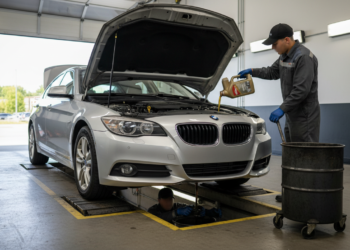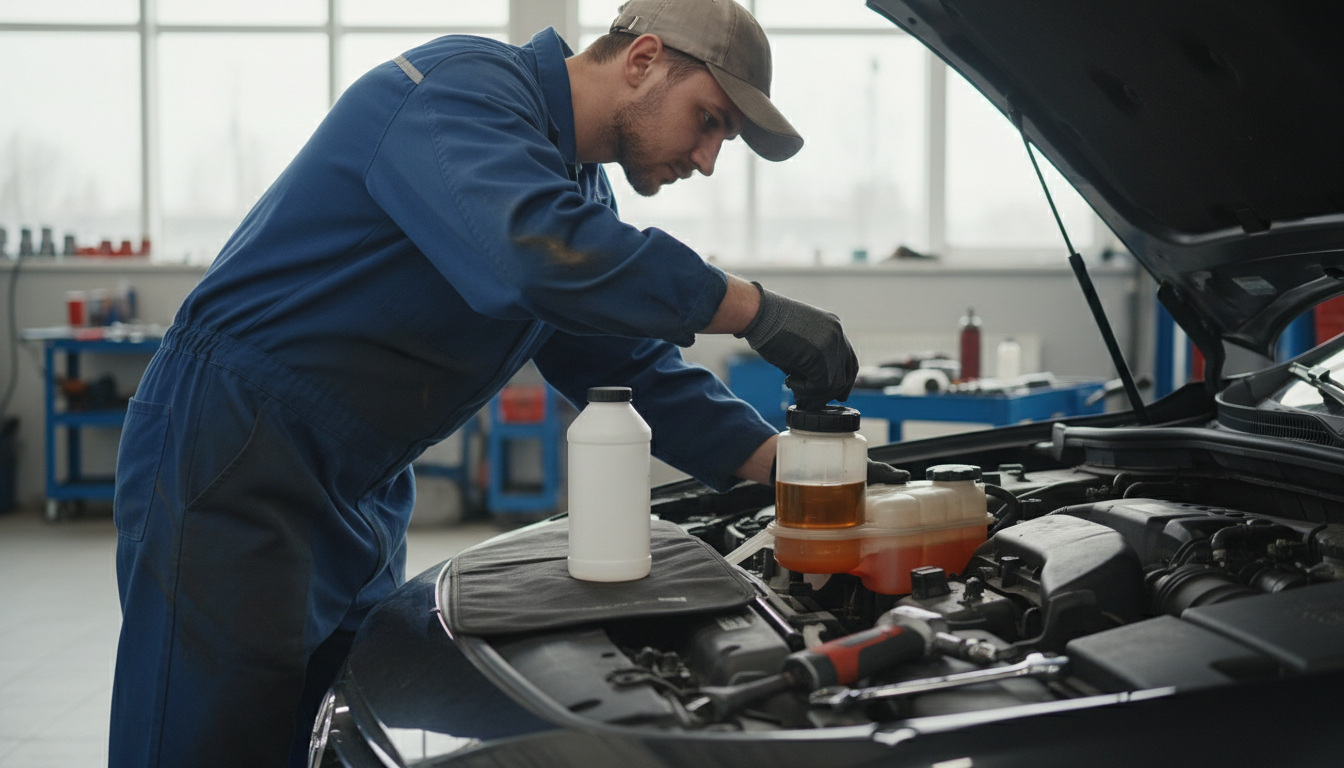
You came in for an oil change. Twenty minutes later the service advisor walks out holding a test strip that has turned purple, says your brake fluid is “failing,” and offers to flush it today for $179. That number is not outrageous. Most shops charge about $100 to $200 for a full brake fluid change, dealers often more, and the fluid itself costs less than lunch. The harder question is whether the job is due today, and the folklore around brake fluid makes that hard to judge in a parking-lot conversation.

Six beliefs drive most of the confusion. Each one either pushes drivers into paying too early or lets them skip a service that protects some of the most expensive parts on the car. For a quick estimate on your own vehicle, try the car repair cost estimator.
What a fair price looks like, shop by shop
| Where the work happens | Typical price | What the number is made of |
|---|---|---|
| Your driveway | About $11 to $40 | A 32-ounce bottle of Prestone DOT 3 lists for $11.24 at Walmart; add a one-person bleeder kit if you lack a helper |
| Chain shop (Pep Boys and similar) | About $145 to $180 | Jerry lists sample quotes of $155 at a Pennsylvania Pep Boys and $143 to $179 at shops in Texas, New Jersey and New York, with $18 in fluid and the rest labor |
| Independent shop | About $150 to $250 | Roughly 0.75 to 1 hour of labor at independent rates near $140 an hour in 2026 |
| Dealer | About $210 to $265 and up | YourMechanic shows dealer and shop quotes of $212 to $263 for a Chevrolet Sonic; dealer labor often tops $200 an hour |
| Cars needing a scan tool to cycle ABS valves | Top of each range | Extra time with diagnostic equipment during the bleed |
Read the table from right to left and the pattern is obvious: you are buying an hour of a technician’s time. That is why the same service costs $143 in San Antonio and $179 in New York, and why dealers, with the highest posted labor rates, land at the top. No shop or industry group has announced 2027 price changes for this service, so these late-2026 figures are the right planning numbers for next year. If your local labor rate rises in January, the flush rises with it.
Myth 1: Dark fluid is bad, amber fluid is fine
Color is the test most drivers trust and the one technicians trust least. Brake & Front End, a trade magazine for repair shops, states plainly that color is not a reliable indicator, and fluid can look clean while carrying enough dissolved copper to signal internal corrosion. Rust or sediment in the reservoir is a different story. That means the fluid is overdue.
The better test is chemical. Firestone Complete Auto Care, for example, dips a strip into the master cylinder reservoir, waits about a minute and compares it to a chart that estimates copper content. The industry threshold is 200 parts per million: above that, the fluid’s protection is depleted and corrosion is speeding up. A good shop shows you the strip next to the chart and retests after the exchange. If the advisor holds up a strip, ask to see the chart too. It takes ten seconds.
Myth 2: Brake fluid lasts the life of the car
Standard DOT 3, DOT 4 and DOT 5.1 fluids are glycol-based, and glycol pulls moisture out of the air through hoses and seals even in a closed system. Water lowers the boiling point. Boiled fluid makes vapor bubbles, and vapor compresses, which is why the pedal goes soft at the bottom of a long mountain descent rather than on the way to the grocery store.
DOT 3 fluid can hold about 2% water after one year and 3% at 18 months. At 3% water, its boiling point drops by roughly 100°F.
Brake & Front End, “Brake Fluid Testing, Bleeding & Flushing”
The federal standard that governs brake fluid, FMVSS No. 116, puts numbers on the slide. New DOT 3 must boil no lower than 401°F; its “wet” rating, measured after the fluid has absorbed a set amount of moisture, is just 284°F. DOT 4 starts at 446°F and falls to a 311°F wet minimum. Over several years DOT 3 can reach 7% to 8% water, well past the point where the wet rating applies. Many maintenance schedules from Ford, Chrysler and Toyota have not listed a fluid change at all, which is where the myth comes from, but “not listed” never meant “never wears out.”
Myth 3: Every car needs it every 30,000 miles
Shops love round mileage numbers. Automakers mostly use time, because moisture builds with months, not miles. A low-mileage car that sits in a humid garage can need fluid sooner than a highway commuter. Here is how a few schedules read:
- Mercedes-Benz: every two years, with a mileage cap of roughly 20,000 to 24,000 miles depending on the source and model.
- Volkswagen: every two years on most models, regardless of mileage.
- Honda: handled by the Maintenance Minder; code 7 means change the brake fluid, which on a 2016 Civic works out to about every three years.
- Tesla: a brake fluid health check every four years, with replacement only if the test calls for it. Regenerative braking means the friction brakes do less work, but the fluid still absorbs water.
In late 2025 a Honda owner’s TikTok went viral after a dealer told her the fluid was due “every two years or every 30,000 miles,” and Motor1 picked up the argument. The lesson is simple: the owner’s manual or the car’s own maintenance reminder outranks the advisor’s laminated menu. Two exceptions shorten any schedule. Towing, mountain driving and hard track use heat the fluid more, and Tesla’s own manual says those conditions may call for more frequent checks. And whenever a caliper, hose, line or master cylinder is replaced, the system is opened, so fresh fluid makes sense then too.
Myth 4: A bleed, a flush and a top-off are the same job
They are three different jobs at three different prices, and the receipt rarely spells out which one you got.
- Top-off: adding fluid to the reservoir. It does nothing about water already in the system, and a falling level usually points to worn pads or a leak, not “used up” fluid.
- Bleed: pushing fluid through one or more wheels to purge air, usually after a repair. Only part of the old fluid leaves.
- Flush or exchange: forcing new fluid through every line until clean fluid comes out at each wheel. Most cars take about a quart. Shops typically use a pressure bleeder at around 15 psi or a vacuum unit.
The cheapest version sold as a “flush” is sometimes just a reservoir suck-and-fill: the tech siphons the master cylinder, refills it and calls it done. That replaces a fraction of the fluid and is worth a fraction of the price. When you get a quote, ask whether they bleed all four wheels and if your car needs the ABS pump cycled with a scan tool. Those two answers tell you whether $150 is a fair price or a lot of money for a turkey baster.
Myth 5: Skipping it is how you save money
Skipping a $150 service looks like a $150 saving until you price what old fluid attacks. Contaminated fluid carries acids, rust and dissolved metal that wear seals and bores, and oxidation byproducts can make the solenoid valves inside the ABS unit stick. RepairPal puts an ABS control module replacement at $1,181 to $1,278 on average, including $1,020 to $1,042 for the part, with a Chevrolet Silverado 1500 reaching $1,539. A caliper or master cylinder replacement adds hundreds more.
The arithmetic is lopsided. At $175 every three years, ten years of brake fluid service costs roughly $580. One ABS module costs about twice that. Old fluid does not guarantee a module failure, and plenty of neglected cars never have one, but the service is cheap insurance against an expensive and avoidable repair.
Myth 6: Pricier fluid is always an upgrade
The fluid line on the invoice is small either way. Jerry prices brake fluid at $5 to $40 for the job, and Jiffy Lube notes that only the less common DOT 5 noticeably raises the cost. The right fluid is the one printed on your reservoir cap. DOT 4 and DOT 5.1 have higher boiling points and are fine in many DOT 3 systems when the manual allows it, but DOT 5 is silicone-based and does not mix with glycol fluids; putting it in a car built for DOT 3 or 4 is a mistake, not an upgrade. If a shop wants to sell you a premium racing fluid for a daily driver, the honest benefit is a higher boiling point you will probably never reach.
Brake flush questions from the service lane
Can I just top off brake fluid instead of paying for a brake fluid change?
Topping off restores the level but leaves the water and contaminants already in the system. A level that keeps dropping usually means worn pads or a leak, so have the brakes inspected rather than adding fluid every few weeks.
How long does a brake fluid flush take?
Most shops book 30 minutes to an hour. Cars that need a scan tool to cycle the ABS valves during the bleed take longer, which is one reason their brake flush cost sits at the top of local price ranges.
Should I change the brake fluid when I replace my brake pads?
It is a sensible time to do it if the fluid is near its scheduled interval or tests poorly, because the technician already has the wheels off. Ask whether the shop prices the two jobs lower together than separately.
Will a brake fluid change fix a soft or spongy pedal?
It can, if the cause is air or moisture-laden fluid. A pedal that slowly sinks while you hold it at a stop can point to a failing master cylinder or a leak, which fresh fluid will not cure. Have the system diagnosed before paying for a flush alone.
Does warranty or insurance pay for a brake fluid flush?
Factory warranties and auto insurance do not cover routine maintenance like fluid changes. Some prepaid maintenance plans include brake fluid service on a set schedule, so check the plan’s service list before paying out of pocket.
Three sentences for the service counter
Next time the strip comes out, you do not need to win an argument. You need three answers, and a good shop will give them without blinking.
- “Can I see the strip next to the chart?” A reading over 200 ppm copper, or a failed moisture or boiling-point test, is a real reason to service it.
- “When does my manual say it’s due?” If the car is past its two- or three-year mark, say yes. If it was done last year, say no thanks.
- “Is that every wheel, with the ABS cycled if my car needs it?” A yes at $100 to $200 is a fair deal. A reservoir-only job at that price is not.
More prices from the same service bay
- Brake pad and rotor replacement cost
- Oil change cost
- Take 5 oil change prices
- Wheel alignment cost
- Alternator replacement cost
- Car repair cost estimator
Pricing method: prices were researched in November 2026 for 2027 planning and may change. Figures come from published estimates by Kelley Blue Book, Jerry, YourMechanic and RepairPal, retailer listings, automaker maintenance guidance and the federal brake fluid standard (FMVSS No. 116). Your vehicle’s manual and a qualified technician have the final word. See our disclaimer.