Zero dollars. That is what an eligible veteran’s family pays the cemetery for the grave, the digging, the headstone and permanent upkeep at a VA national cemetery. For everyone else, the cemetery side of a burial usually runs from about $2,500 for a natural grave to $15,000 or more at an older big-city cemetery, and adding a traditional funeral home service usually puts the full bill anywhere from roughly $11,000 to past $25,000.

That spread is less about taste than about circumstances. Whether someone served, whether the family already owns a plot, which cemetery is nearby and whether a vault is required decide most of it. So start with the situation you are in, find it below, and price only the route that fits.
Find your situation, then your number
| If this describes you | Likely route | Cemetery-side cost, before the funeral home |
|---|---|---|
| Veteran, or a veteran’s spouse or dependent | VA national cemetery | $0 for grave, opening and closing, headstone and care |
| The family already owns a grave | Use the plot you have | About $1,100 to $3,100 to open and close it, plus liner and inscription |
| You want the simplest, greenest option | Natural burial ground | About $2,450 to $3,250 |
| Buying a new grave near a mid-sized city | Municipal cemetery | About $3,450 for residents, $5,150 for non-residents, before liner and marker |
| Buying a new grave in an old urban cemetery | Private or church cemetery | About $8,700 to $15,000+ |
| The family has rural land | Home burial, where local rules allow | Permits often $10 to $30; the rest is labor and approvals |
| The person loved the ocean | Full-body burial at sea | No EPA fee; boat and preparation priced privately |
One national number frames all of this. The National Funeral Directors Association’s most recent price study put the median adult funeral with viewing and burial at about $8,300, or about $9,995 once a vault is added. That figure covers the funeral home and casket. The grave itself, the digging and the stone are billed by the cemetery, and those are the numbers that swing hardest by situation.
A veteran, or married to one: the cemetery bill can disappear
The VA’s National Cemetery Administration provides a gravesite in any national cemetery with space, opening and closing of the grave, perpetual care, a government headstone or marker and a burial flag, all at no cost to the family. Spouses and dependents can be buried in the same grave and have their names inscribed on the veteran’s headstone, also free, and an eligible spouse can be buried there even if they die first.
What the VA does not cover is anything bought from a funeral home: transport, embalming if you choose a viewing, the casket and the service. That is where the burial allowance comes in. For deaths on or after October 1, 2026, the VA lists a maximum burial allowance of $1,032 and a separate plot or interment allowance of $1,032, up from $1,002 a year earlier. For a service-connected death on or after September 11, 2001, the VA lists $2,000. Those amounts apply through most of 2027, until the next October adjustment.
Families who prefer a private cemetery near home can still claim the allowance and request a government headstone or marker. Eligibility depends on discharge status and service, so confirm with the VA or a county veterans service officer before you plan around it.
The plot was bought decades ago: you still owe the digging
Many families discover a deed in a desk drawer and assume the burial is paid for. The grave is, but the work is not. Cemeteries charge an opening and closing fee at the time of burial, and it is often the biggest line on a cemetery invoice after the plot.
- Salt Lake City Cemetery: $1,106 for an adult opening and closing for residents, $1,581 for non-residents, plus a $442 Saturday premium and $412 for work after 4 p.m., on its posted fee schedule.
- Rock Creek Cemetery, Washington, D.C.: $2,209 for a regular-depth interment, $2,577 for double depth and an $850 Saturday fee, on its 2026 price sheet.
- Second burial in a shared grave: double-depth graves cost more to open, and the cemetery will bill a second inscription on the existing stone.
Add a liner if the cemetery requires one (more on that below) and the inscription. Rock Creek charges a $300 base plus $16 per character, so a 30-character inscription comes to $780. An “already paid for” burial can easily reach $3,000 to $5,000 at the cemetery alone. Old deeds can also carry transfer paperwork: Salt Lake City charges $221 to transfer one.
A shroud, a pine box and no vault: the natural burial route
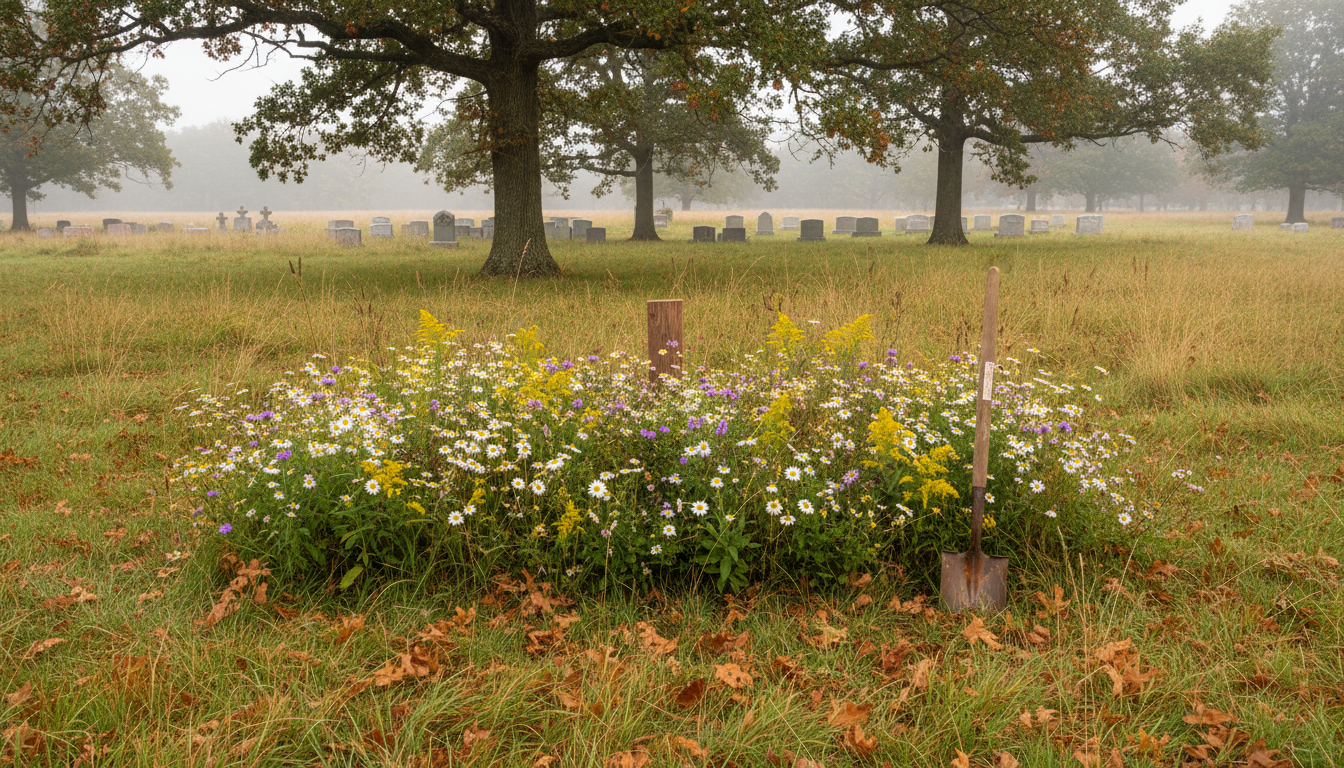
Natural burial grounds skip embalming, concrete vaults and sealed metal caskets, and that removes some of the most expensive lines in a traditional bill. Interest is real: NFDA’s 2025 consumer survey found 61.4% of respondents interested in green funeral options.
Two published price lists show the range. Greensprings Natural Cemetery Preserve in upstate New York charges $1,250 for a full-body burial site, which includes perpetual care and land management, and $1,200 for the burial service, for a total of $2,450. Setting a stone is $225 more. Kokosing Nature Preserve in Ohio lists woodland and prairie sites at $3,000 and $2,500 with a $250 weekday opening and closing ($350 on Saturdays), though buying a site there first requires a tax-deductible membership gift of at least $2,500.
Containers stay modest. After.com, a cremation and planning company, lists shrouds at $100 to $300, pine boxes at $400 to $700 and wicker or bamboo caskets at $800 to $2,100. Embalming is not required by law for routine deaths; the Federal Trade Commission notes that no state requires it, though a funeral home may require it for a public viewing.
A new grave in a big-city cemetery, priced line by line
This is where burial gets expensive, because land is scarce and older cemeteries price sections by location. Rock Creek’s single graves run from $5,239 to $8,957, and the cemetery requires a liner or vault for every interment. Here is a hypothetical Saturday burial built entirely from its February 2026 price sheet, with the NFDA national median added for the funeral home:
| Line | Lower-cost section, weekday | Premium section, Saturday |
|---|---|---|
| Single grave | $5,239 | $8,957 |
| Interment, regular depth | $2,209 | $2,209 |
| Saturday fee | $0 | $850 |
| Concrete grave liner, installed | $1,265 | $1,265 |
| Granite or bronze marker (starting price) | $1,184 | $1,184 |
| Inscription, 30 characters | $780 | $780 |
| Cemetery subtotal | $10,677 | $15,245 |
| Funeral with viewing and burial (NFDA median) | $8,300 | $8,300 |
| Estimated total | $18,977 | $23,545 |
Swap the flat marker for an upright monument, which starts at $3,843.60 on the same sheet, and the premium column passes $26,000. A municipal cemetery is far cheaper: Salt Lake City’s adult grave with perpetual care is $2,343 for residents and $3,564 for non-residents, so the grave plus weekday opening and closing comes to about $3,449 or $5,145.
The concrete box nobody asks for, and when you can refuse it
“Outer burial containers are not required by state law anywhere in the U.S., but many cemeteries require them to prevent the grave from caving in.”
Federal Trade Commission, consumer guidance on funeral shopping
So the requirement, if there is one, comes from the cemetery’s rules, and the cheapest thing that satisfies it is usually a plain grave liner rather than a sealed vault. CostHelper puts basic liners at $400 to $1,500, reinforced concrete vaults at $600 to $4,000 and premium metal vaults at $2,000 to more than $16,000. A sealed vault does not change what a cemetery requires; it changes the invoice.
Grave liner
Open-bottom or simple concrete box that keeps the ground level. Usually the minimum a cemetery accepts. Rock Creek’s installed liner: $1,265.
Burial vault
Lined or sealed container sold as added protection. Rock Creek’s lined water-resistant vault: $1,566; its customized Venetian vault: $3,440.
You can usually buy the liner elsewhere, but check the installation charge first. Rock Creek bills $300 to install one bought outside, which can erase a small saving. Natural burial grounds do not use liners at all.
Family land or open ocean: cheap in fees, heavy in paperwork
Home burial. Burying a family member on private land is legal in much of the country, but the rules are local. Counties and towns may set minimum acreage, require setbacks from wells and waterways and bar burials in floodplains. A death certificate has to be filed before any burial, many states issue a burial or disposition permit (often $10 to $30), and some states require a licensed funeral director for certain steps. Record the grave on the deed or a plat so a future buyer knows it is there. Call the county health department and the zoning office before anything else.
Burial at sea. The Environmental Protection Agency allows full-body burial at least three nautical miles from land in water at least 600 feet deep (1,800 feet in parts of Florida and the Gulf). There is no application and no federal fee; you report the burial through the EPA’s online tool within 30 days. The cost is the boat and the preparation, which charter operators price privately, and the 600-foot rule means a long trip off most of the East Coast.
When there is no money set aside
Help is thinner than most families expect. Social Security pays a one-time $255 death payment to a surviving spouse, or to certain children if there is no spouse. Medicare does not pay for funerals or burial. Some counties run indigent burial programs, but the terms vary widely and many use cremation by default, so ask the county directly.
The bigger savings come from the rules. Under the FTC Funeral Rule, funeral homes must give you an itemized General Price List, cannot force you to buy a package and cannot refuse or charge a fee to handle a casket you bought elsewhere. A city or county cemetery, a weekday burial and a plain liner can take thousands off the cemetery side without changing the service. And burial is now the minority choice: NFDA projected a 31.6% burial rate for 2025, against 63.4% for cremation, so cemeteries and funeral homes are used to families asking about every line.
Questions families ask the cemetery office
How much does a burial cost for cremated remains?
Far less than a casket burial. Salt Lake City lists cremation opening and closing at $553 for residents and $774 for non-residents, Greensprings charges $650 for a cremation site plus $550 for the service, and Rock Creek charges $1,268 to bury cremains. Many cemeteries let you place an urn in an existing family grave.
Do I have to buy the casket from the funeral home?
No. The FTC Funeral Rule lets you supply a casket bought online or from a dealer, and the funeral home cannot refuse it, charge a handling fee or require you to be present when it arrives.
Can you pay the cost of burial ahead of time?
Yes. Most cemeteries sell graves before need, and many accept installments; Salt Lake City asks for 25% down with 6% simple interest on the balance. Opening and closing is often billed at the rate in effect at the time of burial, so ask in writing what a prepaid contract locks in and what happens if you move.
Why do weekend burials cost more?
Cemetery crews earn overtime on Saturdays, and many cemeteries do not bury on Sundays at all. Salt Lake City adds $442 on Saturdays and Rock Creek adds $850, so a weekday service is one of the simplest savings available.
Is burial more expensive than cremation?
Usually, by a wide margin. Direct cremation has a national median of about $2,180 at a funeral home, while a traditional burial adds a casket, grave, opening and closing, liner and marker. A natural burial can come close to cremation once a viewing is added to the cremation.
The one rule that saves the most
Ask for the cemetery’s printed price list before you sit down with the funeral home, not after. The funeral home’s prices are regulated and fairly predictable; the cemetery’s are not, and they decide whether the same service ends up near $11,000 or past $25,000. If the person served, call the VA first. If the family owns a grave, budget for the opening, liner and inscription anyway. If neither applies, compare one municipal cemetery and one natural burial ground before you look at anything with a chapel and a waiting list.
Other bills that arrive with a burial
- The four bills behind an average funeral
- Burial plot prices, from $500 to $15,000
- Headstone prices and cemetery setting fees
- Mausoleum crypts and private family mausoleums
- Cremation costs, read line by line
From pets to funerals: Family Costs in 2027: The Complete Guide
Pricing method: prices were researched in November 2026 for 2027 planning and may change. Cemetery figures come from published price lists at Salt Lake City Cemetery (FY25 schedule), Rock Creek Cemetery (effective February 17, 2026), Greensprings Natural Cemetery Preserve and Kokosing Nature Preserve; benefit amounts come from the VA and Social Security; rules come from the FTC and EPA. Confirm current prices with the cemetery and eligibility with the agency. See our disclaimer.