You pull the washer away from the basement wall to chase a drip and find a gray-green bloom climbing the drywall behind it. Having a professional remove that kind of mold costs most US homeowners $1,200 to $3,750 heading into 2027, about $2,300 on average, but where the mold is growing and how many square feet it covers can push the bill anywhere from $500 to $30,000.

A bathroom ceiling patch is often a $500 job. Mold that has reached the ductwork can top $10,000. Attics, crawl spaces and basements land in between, each with its own access problem and its own hidden repair. So the prices below follow the house one location at a time, then tackle the two decisions that swing the total most: whether you need testing, and whether insurance will pay any of it.
Measure it first: the 10-square-foot line
The EPA’s homeowner guidance draws a simple line. If the moldy area is under about 10 square feet, roughly a 3-by-3-foot patch, most people can clean it themselves. Above that, or whenever there has been a lot of water damage, the agency suggests hiring a contractor with mold cleanup experience. Two situations call for a pro at any size: mold from sewage or other contaminated water, and mold you suspect is inside the heating and cooling system.
A small DIY job costs little more than detergent, an N-95 respirator, gloves and goggles. Scrub hard surfaces with detergent and water and dry them completely. Porous materials such as ceiling tiles and carpet that stay moldy usually have to go. And do not paint or caulk over mold; the EPA warns the coating will simply peel. None of it holds unless you fix the leak or humidity that fed the growth.
Attic, basement, bathroom, ducts: the price of each spot
| Where the mold is | Typical 2026 cost | What pushes it higher |
|---|---|---|
| Bathroom | $500 to $1,000 | Growth behind a tub or vanity can reach $8,000 |
| Crawl space | $500 to $2,000 | Tight access, wet insulation, sealing the space afterward |
| Basement | $500 to $3,000 | Finished walls and carpet, plus waterproofing |
| Attic | $1,000 to $4,000 | Long-running cases near $7,000, plus roof or vent repairs |
| Drywall and wall cavities | About $1,000 for surface mold | Full drywall and backing removal can pass $20,000 |
| Air ducts only | $600 to $2,000 | Lined or flexible duct that must be replaced |
| Full HVAC system | $3,000 to $10,000 | Furnace and air handler $3,000 to $5,000; central AC up to $10,000 |
| Whole house | $10,000 to $30,000 | Usually after a flood or hurricane, before any rebuild |
Attics: the bill includes a ventilation question
Attic mold usually spreads across the underside of the roof sheathing, so the price tracks how many square feet of decking are stained and whether wet insulation has to come out. The cause is often a bathroom fan venting into the attic, blocked soffit vents or a slow roof leak. A bid that cleans the wood but does not reroute the fan or open the vents is selling you a repeat visit in a few winters.
Basements and crawl spaces: cheap to clean, costly to keep dry
The cleanup itself is among the cheaper jobs on the list. The expensive part is stopping groundwater and humidity, and Bob Vila’s guide puts crawl space or basement sealing and waterproofing around $7,000. Many remediators sell encapsulation as a package, so ask for the cleanup and the moisture fix as separate line items. That lets you compare the waterproofing against a waterproofing specialist, or decide a dehumidifier and a working sump pump are enough.
HVAC: turn it off before anyone quotes
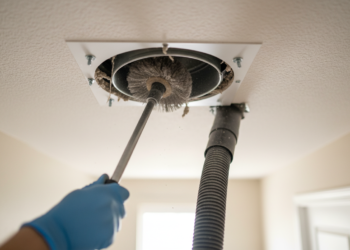
The EPA says not to run a heating or cooling system you know or suspect is contaminated, since it can blow spores through every room. Hard metal ducts can often be cleaned for $600 to $2,000. Insulated duct liner and flexible duct usually cannot be cleaned well and get replaced, which is how duct jobs climb toward the $10,000 end once the air handler and coil are involved.
Square footage sets the floor of every quote
Within any location, remediators price by affected area, commonly $10 to $25 per square foot with about $18 as the middle. Labor is the bigger share, roughly 60 percent of the bill, because containment, careful removal and HEPA cleaning are slow work.
| Affected area | Low ($10/sq ft) | High ($25/sq ft) |
|---|---|---|
| 50 sq ft | $500 | $1,250 |
| 100 sq ft | $1,000 | $2,500 |
| 200 sq ft | $2,000 | $5,000 |
| 500 sq ft | $5,000 | $12,500 |
| 1,000 sq ft | $10,000 | $25,000 |
Measure the visible growth yourself before anyone arrives, and ask each contractor to write their square footage on the bid. If one quote assumes 40 square feet and another assumes 300, you have found the real difference between them.
One leaky washer, priced line by line
Hypothetical example built from the national ranges above, not a real quote. A slow supply-hose leak behind a washer soaked about 80 square feet of drywall and carpet in a finished basement. The owner hires an independent inspector, a remediator and a general contractor for the rebuild.
| Line item | Example cost |
|---|---|
| Fix the leaking hose and valve | $150 |
| Independent inspection with 3 air samples | $550 |
| Remediation: 80 sq ft at $18 | $1,440 |
| Clearance test: $250 visit plus 2 air samples at $85 | $420 |
| New drywall, paint and carpet | $2,500 |
| Total | $5,060 |
The remediation line is under a third of the total. That is typical: rebuild costs, which national guides put anywhere from $2,000 to $20,000 for mold damage repair, often outweigh the cleanup. When you compare bids, check whether “remediation” ends at bare studs or includes putting the room back together.
Mold testing: when it earns its fee, and when it’s a sales pitch
If you can see mold, the EPA’s position is that sampling usually is not necessary; you already know what needs removing. Testing pays off when you smell mold but cannot find it, when a sale or insurance claim needs documentation, and after cleanup to prove the job worked.
| Service | Typical 2026 cost |
|---|---|
| Visual screening with moisture readings, no lab work | $150 to $400 |
| Standard inspection with about 3 air samples | $400 to $750 |
| Comprehensive assessment with surface or HVAC samples | $800 to $1,800 |
| Each extra air sample | $60 to $150 |
| Each surface or swab sample | $80 to $150 |
| Mold add-on to a home purchase inspection | $100 to $200 |
Be cautious with a “free mold inspection.” It is usually a sales visit from the company that wants the cleanup job, and the person measuring the problem has a reason to find a big one. An independent inspector who does not do remediation costs a few hundred dollars and gives you a scope that every bidder has to price. Florida, Texas, New York and Louisiana license mold assessors and remediators separately, and Florida bars the same person from assessing and remediating the same property. Elsewhere, ask the inspector directly whether they or a related company do cleanup work.
What your homeowners policy will actually pay
Standard policies cover mold mainly when it grows out of a covered peril, like a burst pipe or an air conditioner overflow, and even then many cap mold payouts somewhere between $1,000 and $10,000. ValuePenguin reports Allstate’s cap at $5,000 and notes some insurers have dropped mold coverage altogether. Claims are commonly denied in three situations:
- Slow leaks and neglect. A drip you ignored for months reads as a maintenance problem.
- Humidity. Mold from a damp basement with no dehumidifier is generally excluded.
- Flooding. Flood damage is excluded from home policies, so the resulting mold is too, unless you carry flood insurance.
If the cause was sudden, report it fast, photograph everything before tear-out and keep the leaking part. Ask your agent whether the water damage and the mold fall under separate limits; the cost of drying and replacing drywall may be paid under the main dwelling coverage even when the mold sublimit runs out. Mold endorsements that raise the cap exist but can be pricey in humid states such as Florida.
Reading a remediation bid: what should be on the page
National guides put franchise brands in wide bands, about $1,200 to $4,500 for ServiceMaster jobs and $1,500 to $10,000 for Servpro, so the brand name tells you little. The scope does. A sound bid lists:
- The square footage and every room or surface included
- Containment with plastic sheeting and negative air pressure
- HEPA air scrubbers and HEPA vacuuming
- Which porous materials will be removed and bagged
- Moisture readings before and after, and who fixes the water source
- Whether rebuild is included or left for another contractor
- A clearance test by someone independent, and what happens if it fails
Walk away from quotes that rely on “fogging” or spraying alone, offer to paint over stains, or come with pressure to sign during the free inspection.
Who to call first, based on what you found
| What you found | First call | Likely spend |
|---|---|---|
| A spot under 10 sq ft with a known cause | Nobody: fix the leak, then scrub | Cleaner and protective gear |
| A musty smell but no visible mold | An independent mold inspector | $400 to $750 |
| Visible growth over 10 sq ft | Two or three remediators, plus whoever fixes the water source | $1,200 to $3,750 for most jobs |
| Mold after a burst pipe or appliance failure | Your insurer, then a remediator | Deductible, up to your mold limit |
| Mold after sewage backup or a flood | A pro experienced with contaminated water; your flood insurer | Often five figures |
| Suspected mold in ducts or the air handler | Shut the system off, then an HVAC-focused remediator | $600 to $10,000 |
If anyone in the house has asthma, allergies or a weakened immune system, talk with a doctor before starting cleanup, and lean toward hiring out even small jobs.
Other mold questions homeowners ask
Does black mold cost more to remove?
Not much on its own. The EPA does not set different cleanup methods by species, and national cost guides show overlapping ranges, roughly $600 to $8,000 depending on the type. Location, area and what has to be torn out move the price far more than the color or genus of the mold.
How long does mold remediation take?
A small job such as one bathroom wall is often finished in a day or two. Larger basement, attic or crawl space jobs can take several days, and drying, clearance testing and rebuild add more time. Ask each contractor for a schedule in writing.
Can I stay home during mold remediation?
For a contained job in one area, many families stay, because the work zone is sealed with plastic and kept under negative pressure. For whole-house work, HVAC remediation, or anyone with asthma or a weak immune system, plan to stay elsewhere and ask whether your policy pays for temporary housing.
Should I use bleach on mold?
The EPA says detergent and water work for scrubbing mold off hard surfaces, and bleach is not required. If you do use bleach, never mix it with ammonia or other cleaners, since the combination releases toxic gas. Bleach will not fix mold that has grown into drywall or wood.
Do I have to disclose past mold when selling my house?
Disclosure rules vary by state, and many state seller forms ask about mold or water damage. Keeping the inspection report, remediation invoice and clearance test makes a past problem far easier to explain to buyers. A local real estate attorney can confirm what your state requires.
Related cost guides
- Sump pump cost: replace, install new or add a backup
- Bathroom remodel cost: same layout or move the plumbing?
- Air duct cleaning cost: real price vs $99 specials
- Dumpster rental prices: pick the size by your project
- Exterminator cost: one visit or a pest control plan?
- Termite treatment cost: liquid, bait or tent?
- Sewer line replacement cost: camera first, then decide
- Central air conditioner cost: decoding your AC quote
- Dental implants cost: one tooth to full mouth
- Renters insurance cost: what a real policy covers
Pricing method: remediation ranges by location and square foot come from 2026 national cost guides (This Old House using Angi data, Bob Vila); inspection and testing ranges come from 2026 inspector pricing guides; DIY thresholds and cleanup advice come from the EPA; insurance limits and exclusions come from ValuePenguin and insurer disclosures; licensing notes come from state mold licensing summaries. The basement example is our own math from those ranges. Figures are national estimates researched in October 2026 for 2027 planning and may change; they also vary by region and contractor. Confirm coverage with your insurer and health questions with a medical professional. See our disclaimer.