Picture a 2,000-square-foot house in Ohio. The furnace tech just red-tagged an 18-year-old furnace, the AC beside it is 16, and the owner is holding two estimates: a whole-home heat pump at roughly $12,000 to $18,000 installed, or a new furnace and AC at $9,000 to $17,000. EnergySage puts the 2026 national average for a heat pump at about $15,400 before incentives, so the upfront gap is usually a few thousand dollars, not a fortune.

The upfront gap is the easy part. The harder question is what each system costs to run for the next 15 years, and that comes down to one thing most sales pitches skip: what you pay for gas, propane or oil compared with electricity where you live. I ran the numbers with the EIA’s own winter 2026-27 price forecasts, and the answer is not the one either the heat pump fans or the gas loyalists usually give.
Three quotes, three different machines
When both your furnace and AC are near the end, contractors will typically pitch one of these. All assume a 2,000-square-foot home with usable ductwork.
| Option | What gets installed | Typical installed cost |
|---|---|---|
| Standard ducted heat pump | Outdoor heat pump, air handler with backup heat strips | $12,000 to $15,000 |
| Cold-climate ducted heat pump | Variable-speed heat pump rated to hold output near 5°F | $14,000 to $18,000 |
| Gas furnace plus central AC | 96% AFUE furnace and a 16 SEER2 AC, 3 tons | $9,000 to $17,000 |
| Dual fuel (hybrid) | Heat pump paired with a gas furnace that covers the coldest hours | About $10,000 to $14,500 |
| Ductless multi-zone | Two to four wall heads, no ducts | $6,000 to $14,000 |
Carrier quotes a broad $6,000 to $25,000 range for heat pumps in 2026, with geothermal and high-efficiency variable-speed systems at the top. Geothermal is its own conversation at $20,000 to $35,000 or more, so this guide sticks to air-source equipment.
Where a $13,000 heat pump quote turns into $18,000
The box itself is a smaller slice of the bill than people assume. Online, a Goodman 3-ton, 14.3 SEER2 heat pump system (GSZB403610 condenser with an AMST36BU1400 air handler) was listed at $2,875 at an HVAC retailer before it went out of stock. Installed contractor equipment for a 2- to 5-ton home runs closer to $6,000 to $10,000, and labor adds $4,000 to $8,000. The surprises live in the extras below, and they hit heat pump jobs harder than furnace swaps because you are moving heating from gas to electric.
| Add-on | Typical cost | Who gets hit |
|---|---|---|
| Electrical panel upgrade | $1,500 to $3,000 | Older homes on 100-amp service |
| Dedicated circuit and disconnect | $500 to $1,500 | Almost everyone switching from gas heat |
| Duct sealing or section replacement | $1,000 to $5,000 | Leaky or undersized ducts |
| New refrigerant line set | $300 to $800 | Incompatible or damaged existing lines |
| Backup heat strip | $300 to $800 | Standard in cold climates; ask if it is missing |
| Cold-climate equipment premium | $1,000 to $3,000 | Zones 5 to 7 |
| Snow stand or raised pad | $100 to $400 | Anywhere drifts bury the unit |
| Heat pump compatible thermostat | $200 to $500 | Older single-stage thermostats |
A heat pump also lives or dies by its sizing. Ask for a Manual J load calculation, not a “you had 3 tons before, so 3 tons again” swap. An oversized heat pump short-cycles, and an undersized one leans on resistance strips that cost three times as much to run.
What a heat pump really does at 5°F
The number that matters is COP, the heat delivered per unit of electricity. Electric resistance strips run at a COP of 1. A heat pump on a 45°F day can deliver four or more. Then the temperature drops, and so does the COP:
- Standard heat pump at 5°F: COP of about 1.4 to 1.8, with output falling off, so strips kick in more often.
- Cold-climate heat pump at 5°F: COP of about 2.0 to 2.3, and it holds much more of its rated capacity. Look for ENERGY STAR Cold Climate certification or a model on the NEEP cold-climate list.
- Defrost cycles and wind pull the real-world figure down a bit from the lab rating.
So yes, a modern cold-climate unit will keep a Minnesota house warm. Plenty of homeowners on r/heatpumps run them with no gas backup at all. Whether it keeps the house warm cheaply is a separate question, and the next section answers it.
Dual fuel: the hedge for cheap-gas regions
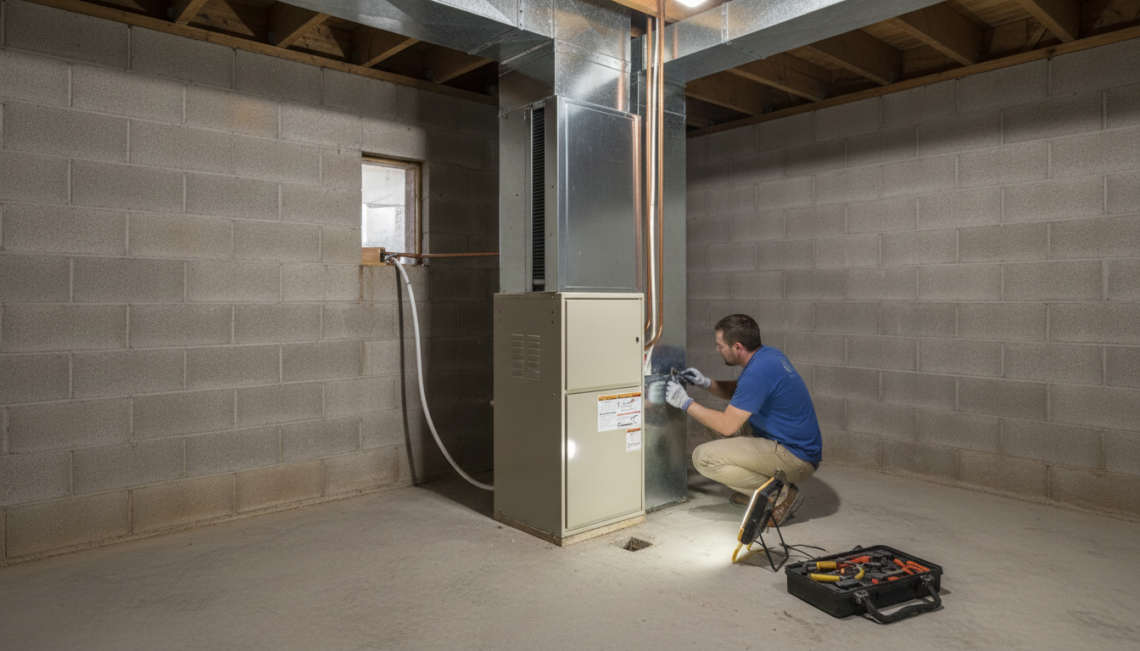
A hybrid system runs the heat pump until the outdoor temperature drops below a set switchover point, then hands off to the furnace. Contractors often default the switchover to about 35°F. That setting should follow your energy prices, not habit. Typical starting points:
- Southeast and Gulf (zones 2 to 3): 30 to 40°F standard, 20 to 30°F with a cold-climate unit
- Mid-Atlantic and Pacific Northwest (zone 4): 25 to 35°F, or 15 to 25°F cold-climate
- Midwest and Northeast (zones 5 to 6): 20 to 30°F, or 5 to 20°F cold-climate
- Northern Plains (zone 7): 15 to 30°F, or 0 to 15°F cold-climate
Start near 30°F, watch two weeks of bills and runtime, and adjust in 3 to 5 degree steps. If you have propane or oil backup instead of gas, push the switchover lower, because the heat pump usually wins against those fuels at nearly every temperature.
Your fuel price is the whole argument
Here is the cost to deliver one therm (100,000 BTU) of heat into the house, using the EIA’s forecast average prices for winter 2026-27. Gas is converted at about 10.37 therms per thousand cubic feet, and the furnace is 95% efficient.
| Region (EIA forecast price) | Gas furnace | Heat pump, COP 2.5 | Heat pump, COP 3.0 | Propane furnace | Resistance strips |
|---|---|---|---|---|---|
| Northeast (26.2¢/kWh, $16.12/Mcf, $3.28/gal) | $1.64 | $3.07 | $2.56 | $3.77 | $7.67 |
| Midwest (16.9¢, $10.38, $2.04) | $1.05 | $1.98 | $1.65 | $2.35 | $4.94 |
| South (15.8¢, $14.13, $3.19) | $1.43 | $1.85 | $1.54 | $3.67 | $4.61 |
| West (20.5¢, $15.10) | $1.53 | $2.40 | $2.00 | n/a | $6.00 |
Read that table plainly. At the EIA’s forecast rates for winter 2026-27, natural gas is cheaper heat than a heat pump in every region, by a lot in the Midwest and Northeast and only slightly in the South. Against propane, heating oil or old electric baseboard, the heat pump wins everywhere. Heating oil at the EIA’s forecast $5.26 a gallon works out to roughly $4.47 per delivered therm in an 85% boiler, about 45% more than a cold-climate heat pump costs in the Northeast.
Run it with your own utility bill
Break-even COP = (electric price per kWh × furnace AFUE × 100,000) ÷ (gas price per therm × 3,412). Use the all-in price from your bills, including delivery charges. Example: at $0.15 per kWh, $1.50 per therm and a 95% furnace, the break-even COP is about 2.8. If your heat pump’s COP at a given outdoor temperature beats that number, the heat pump is the cheaper heat source at that temperature. Manufacturer data sheets list COP by temperature.
Two things can flip the result. Some utilities sell discounted heat pump or time-of-use rates, which can drop your effective price per kWh well below the regional average. And if a heat pump lets you drop gas service entirely, you also stop paying the monthly gas customer charge. Ask your utility about both before you decide.
Fifteen years, four houses
Hypothetical example, not real quotes. Four similar 2,000-square-foot homes are each replacing a furnace and AC at the same time. Assumptions: the Midwest and Northeast homes need about 550 to 600 therms of delivered heat a year and get a $16,000 cold-climate heat pump with a seasonal COP of 2.5. The Southern home needs about 250 therms and gets a $13,500 standard heat pump at COP 3.0. Furnace plus AC costs $13,000 everywhere. Cooling costs are treated as equal because a heat pump and an AC of the same SEER2 rating use about the same power. Maintenance runs $150 a year for the heat pump and $200 for two separate systems. Prices are held flat.
| House | Heating per year: heat pump | Heating per year: furnace | 15-year total: heat pump | 15-year total: furnace + AC |
|---|---|---|---|---|
| Midwest, natural gas | $1,186 | $632 | $36,044 | $25,474 |
| Northeast, natural gas | $1,688 | $897 | $43,573 | $29,461 |
| Northeast, propane | $1,688 | $2,075 | $43,573 | $47,130 |
| South, natural gas | $385 | $358 | $21,525 | $21,368 |
The gas furnace households come out $10,000 to $14,000 ahead in the North. The propane household saves about $3,500 with the heat pump, and roughly $11,500 if it lands an $8,000 income-qualified rebate. In the South, the two options finish within a couple hundred dollars of each other, which is exactly why heat pumps are already the default there. The model checks out against reality, too: the EIA’s average winter gas heating bill is $879 in the Northeast and $613 in the Midwest, close to the furnace figures above.

One more wrinkle: Carrier puts typical heat pump life at 10 to 15 years, because the unit works in both seasons. A gas furnace often outlasts that. Over a long horizon, budget for one more compressor or outdoor unit replacement on the heat pump side.
Money that still exists after the federal credit ended
The federal Section 25C credit, worth 30% up to $2,000, does not apply to heat pumps placed in service after December 31, 2025. If yours went in before that date, you can still claim it on your 2025 return with Form 5695. For installs in 2026 and 2027, the money comes from states and utilities:
- HEAR (also called HEEHRA): up to $8,000 off a heat pump at the point of sale for households at or below 80% of area median income, with partial rebates up to 150% of AMI. It runs through each state, not every state has launched, and some have already used up funds.
- HOMES: rebates tied to measured whole-home energy savings, open to all incomes, with amounts set by each state.
- State programs: Mass Save offers up to $9,000 in Massachusetts, and Colorado gives a $1,500 state tax credit per air-source heat pump.
- Utilities: many pay a few hundred to a few thousand dollars, and some add a discounted heating rate.
Rebates for a furnace, by contrast, usually run $0 to $500. The catch with heat pump money is timing. HEAR is not retroactive, and most programs need pre-approval or a participating contractor. Sign nothing until you know which programs you qualify for and what paperwork the contractor must file.
Five rules for picking your system
- Heating with propane, oil or electric baseboard? Get the heat pump. It is cheaper to run at almost any temperature, and rebates make the upfront cost close to a furnace.
- Cheap natural gas in a cold state? Dual fuel is the safe money choice. You replace the AC with a heat pump anyway, let it carry mild days, and keep the furnace for real cold.
- Mild winter, gas or not? A standard heat pump. The running costs are close to gas, and you skip a second appliance.
- Furnace still healthy, only the AC died? Swap the AC for a heat pump and wire it as dual fuel. Ask for the AC-only price beside it so you can see exactly what the upgrade costs.
- Qualify for HEAR or a big utility rebate? Run the math again with the rebate subtracted. An $8,000 credit can erase most of the long-term gap, even against gas.
Whatever you choose, get at least three quotes priced on the same Manual J size, and make each one spell out the panel, circuit, duct and backup heat line items so the comparison is fair.
Heat pump questions people ask next
What size heat pump does a 2,000 square foot house need?
Often 3 to 3.5 tons, using a rough rule of 1 ton per 600 square feet. Climate, insulation, windows and ceiling height change that, so the final size should come from a Manual J load calculation.
Why does my heat pump blow steam in winter?
That is the defrost cycle. The unit briefly reverses to melt frost off the outdoor coil, and the melting ice gives off vapor. It is normal and usually lasts a few minutes.
Will a heat pump raise my summer electric bill?
Not compared with a central AC of the same SEER2 rating. In cooling mode a heat pump works exactly like an air conditioner, so summer usage is about the same.
Can a heat pump use my existing ductwork?
Usually yes. Heat pumps deliver air at a lower temperature than a gas furnace, though, so undersized or leaky ducts can leave rooms feeling drafty. Have the contractor check static pressure and duct sizing before you sign.
How long does a heat pump installation take?
A straight swap into existing ducts typically takes one to two days. Add time if the job includes a panel upgrade, new circuits or duct changes, and allow extra lead time for permits and rebate pre-approval.
Related cost guides
- Furnace replacement cost: 80% vs 96% by climate
- Central air conditioner cost
- Mini split cost: one room vs the whole house
- Spray foam insulation cost: price it by the inch
- Electrical panel replacement cost: when a heat pump really needs 200 amps
- Cost to rewire a house: what your home’s age says
- Window replacement cost: real savings vs the sales pitch
More related guides: Solar panel cost: cash, loan or lease · Attic insulation cost: top up, seal or tear out
Pricing method: installed ranges come from 2026 national contractor cost surveys (including EnergySage’s state averages), Carrier’s published 2026 range, online equipment listings, and published add-on costs. Operating costs are our own calculations from the EIA’s winter 2026-27 regional fuel price forecasts and typical COP figures; incentive details come from program summaries. Figures are national estimates researched in October 2026 for 2027 planning and may change; they will differ with your rates, climate and contractor. See our disclaimer.