Replacing a broken garage door spring usually costs about $150 to $550 for both springs on a single door heading into 2027, parts and labor included, with most fair quotes landing in the $250 to $450 range. The biggest variable is not the spring itself, which wholesales for well under $150, but who you call in the first hour after it snaps and what else they decide your door “needs.”

A spring failure usually announces itself with a gunshot-loud bang from the garage, then a door that will not lift or that the opener strains against. Because it often happens on a weekday morning with your car trapped inside, it is one of the easiest home repairs to overpay for. Here is how to handle it safely and what a fair bill looks like.
That bang in the garage: confirm it, then stop using the door
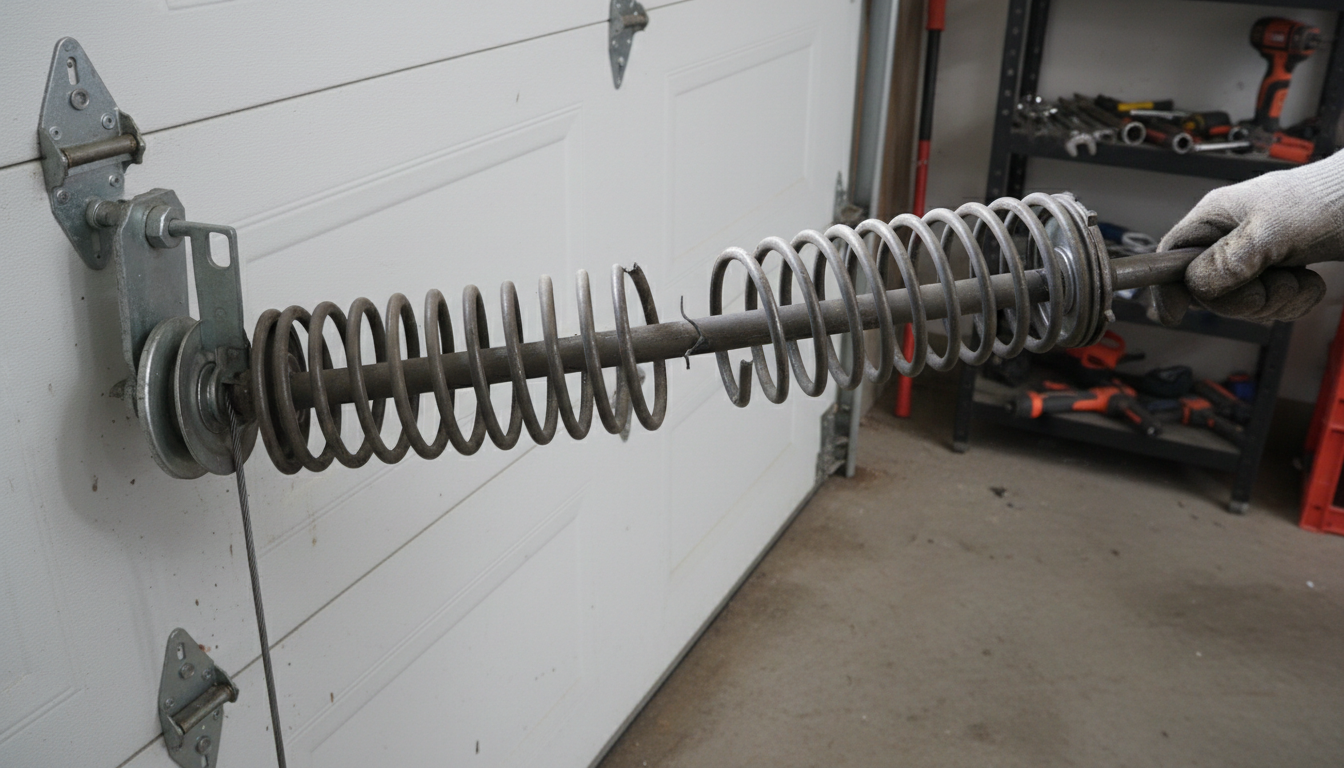
- Look above the closed door. A torsion spring sits on a metal bar across the top of the door. If it broke, you will see a 2 to 3 inch gap between coils.
- Or look along the side tracks. Extension springs run parallel to the horizontal tracks near the ceiling. A broken one hangs loose or is missing.
- Do not run the opener again. The opener is not built to lift the full weight of the door, which can be 150 pounds or more on a double door, and repeated tries can strip its gears or bend the top panel.
- Do not pull the red emergency release on a door that is open. Without spring tension the door can drop fast. If it is closed, leave it closed.
- Keep kids and pets out of the garage until a technician arrives. This Old House’s guidance is blunt: do not try to open a door with one or more broken springs.
If your car must get out today, ask for the earliest weekday slot first. Many companies offer same-day service without charging a weekend or after-hours premium.
Torsion or extension: two systems, two price points
| Torsion springs | Extension springs | |
|---|---|---|
| Where they are | On a bar above the door opening | Along both horizontal tracks |
| Typical doors | Most modern sectional roll-up doors | Older and lighter doors, some tilt-up doors |
| Spring parts only | About $30 to $120 each | About $15 to $60 each |
| Installed, per spring | About $75 to $150 | About $50 to $100 |
| Installed, full set of two | About $150 to $540 | About $100 to $300 |
| Rated lifespan | About 10,000 to 20,000 cycles; 8 to 15 years | About 8,000 to 15,000 cycles; 7 to 12 years |
| DIY realistic? | No; leave it to a trained technician | Possible for experienced owners, with safety cables in place |
One cycle is one open and one close. At three to five cycles a day, a standard 10,000-cycle spring lasts roughly six to ten years, which is why springs tend to fail around the same age on similar houses. When one of a matched pair breaks, the other is close behind. This Old House and HomeAdvisor both recommend replacing both at once, and doing it in one visit costs less labor than two trips.
Price spreads among national guides are wide. HomeAdvisor puts a two-spring single-door job at about $150 to $350, while This Old House lists $300 to $540 installed for torsion. Big metro areas and same-day service sit at the top.
Why the spring above the door is not a weekend project
A torsion spring stores enough energy to balance a door that may weigh several hundred pounds. Winding or unwinding it takes steel winding bars, a precise number of quarter turns, and a firm grip at every step. A slipped bar or the wrong tool, a screwdriver being the classic mistake, can spin back with force that breaks hands and faces. The door industry association DASMA calls spring injury risks well documented and urges owners to leave this repair to a trained door systems technician.
The savings case is weak anyway. A pair of torsion springs and a set of winding bars run roughly $100 to $200 online, against a $250 to $400 professional job that includes the right spring size, balancing the door and a parts warranty. Extension springs are a more reasonable DIY job for experienced owners, but only with the door fully open and clamped, the tension released and a safety cable running through each spring so a break cannot whip across the garage.
A fair bill, line by line
| Line item | Typical 2026 price | Is it reasonable? |
|---|---|---|
| Two torsion springs, installed | $150 to $540 | Yes, the core of the job |
| Service or diagnostic call | $50 to $75, often waived if you approve the repair | Yes, if it was quoted on the phone |
| Weekend, night or holiday premium | A few hundred dollars; can double the bill | Only if you truly cannot wait |
| Lift cables replaced | $75 to $200 | Yes if frayed or kinked; ask to see them |
| Rollers, hinges and other hardware | $5 to $250 | Only if worn, cracked or wobbling |
| Convert extension springs to torsion | $400 to $800 | Optional upgrade, not an emergency |
| Tune-up and balance | $50 to $150 | Should be part of any spring job |
Example: the same Saturday break, two very different invoices
Hypothetical example built from the ranges above, not a real invoice or quote. A two-spring torsion door on a 16-foot double door breaks early on a Saturday. One owner calls a local company with a verifiable address and waits until Monday morning; another calls the first ad in a search result and books a same-day weekend visit.
| Line | Local company, Monday | First search result, Saturday |
|---|---|---|
| Two springs installed | $350 | $650 (sold as “premium high-cycle”) |
| Service call | Waived | $89 |
| Weekend premium | $0 | $150 |
| Cables | $120 (frayed, shown to owner) | $200 |
| Rollers, drums, bearings | $0 (checked, still good) | $480 (“whole kit while we’re here”) |
| Total | $470 | $1,569 |
That gap is not far-fetched. Scripps News reported a homeowner who called the first search result, was quoted $400 for one spring or $500 for a pair, and ended up with a $1,258 bill after the worker added springs, drums, cords and braces, and the door still did not work properly.
Five upsells to question before you sign
- “Your whole door has to go.” A broken spring alone almost never means a new door. Damaged panels might, so ask to see the damage.
- “Lifetime” or high-cycle springs at a big markup. Longer-rated springs can make sense if you use the garage as your main entrance, but ask for the cycle rating in writing and compare it with the price of standard springs.
- A full hardware kit. Rollers, drums and bearings wear out, but rarely all at once. Worn nylon rollers are cheap; seized bearings make grinding noises you have probably heard before.
- A new opener. If the opener ran fine before the spring broke and still works after, it does not need replacing because of the spring.
- A maintenance plan signed on the spot. A yearly lube and balance check is useful, but you can schedule it later on your own terms.
Before anyone drives over: your phone checklist
- Ask for the company’s street address and look it up. Generic names with only a call center number are a warning sign the BBB and local repair shops cite.
- Get a total price on the phone for two springs on your door size, including the service call, and ask what triggers extra charges.
- Ask whether the weekend or after-hours rate is extra, and how much.
- When the tech arrives, expect a marked vehicle and visible ID, and a written estimate before any work starts.
- Ask for the spring warranty in writing and whether it covers labor; manufacturer warranties often cover only the part.
- Pay by card, not cash, so you have a record if the door still does not work.
Garage door spring questions owners also ask
Can I open my garage door manually with a broken spring?
It is not recommended. Without spring tension the full weight of the door rests on you and the hardware, and it can fall quickly. If you must get a car out, wait for a technician, who can lift and clamp the door safely.
Does homeowners insurance cover a broken garage door spring?
Usually not. Springs wear out with normal use, which policies treat as maintenance. Damage from a covered event, such as a car hitting the door or a storm, may be covered depending on your policy, so check with your insurer.
Does a home warranty cover garage door springs?
Many home warranty plans cover the opener but exclude springs, tracks and the door itself. Read your contract’s garage section or call the warranty company before scheduling, since using your own contractor can void a claim.
How can I make new springs last longer?
Lubricate springs, hinges and rollers with a garage door lubricant a couple of times a year, keep the door balanced, and replace worn rollers. A properly balanced door should stay put when lifted halfway by hand with the opener disconnected and the springs intact.
Why did my spring break in cold weather?
Steel springs are under constant stress, and cold makes metal more brittle. Many breaks happen on cold mornings, often to springs that were already near the end of their rated cycles.
Related cost guides
- New garage door cost: build your price choice by choice
- Siding cost: 5 materials go head to head
- Window replacement cost: real savings vs the sales pitch
- Driveway cost: which surface suits your climate
- Fence cost: price per foot and per year by material
- New roof cost: priced by the square, cash vs insurance
- Oil change cost: price per visit vs price per year
Pricing method: per-spring, parts, labor, cable, conversion and tune-up prices come from HomeAdvisor’s garage door spring cost guide; installed torsion and extension totals, lifespans and safety guidance from This Old House’s 2026 spring cost guide; service call, after-hours and hardware ranges from This Old House’s garage door repair cost guide; warranty and cycle figures from ConsumerAffairs; the overbilling case from Scripps News; safety position from DASMA. The two-invoice example is hypothetical. Prices were researched in October 2026 for 2027 planning; they vary by region, door and company and may change. See our disclaimer.