In HomeServe’s repair records, the average water heater repair came to $359, and the average replacement to almost $1,400. That gap is why the word “replace” comes up so fast when a plumber is standing in your basement. For 2027 planning, most repairs on a tank heater land between $150 and $700, according to HomeGuide’s project data, and tankless repairs run $300 to $1,300. A single failed part is usually the whole story.

Homeowners rarely overpay because a part is expensive. They overpay because they pay for the wrong job: a new tank when a $15 element was dead, an emergency rate for a problem that could have waited until Monday, or a $450 valve on a heater that was already on borrowed time. Below are the seven most common ways that happens, each with the price attached.
The price card to keep on the fridge
Installed prices include parts and labor. Part prices are what the component costs on its own at a supply house or home center.
| Repair | Part alone | Installed by a pro |
|---|---|---|
| Heating element (electric) | $15 to $60 | $100 to $350 |
| Thermostat (electric) | About $20 | $100 to $350 |
| Thermocouple (gas) | $10 to $30 | $100 to $325 |
| Pilot light service (gas) | None | $50 to $200 |
| Igniter (gas) | Varies | $75 to $350 |
| Gas control valve | $70 to $200 | $150 to $550 |
| Temperature and pressure relief valve | $10 to $25 | $50 to $300 |
| Anode rod | $20 to $50 | $150 to $350 |
| Dip tube | $10 to $25 | $100 to $300 |
| Expansion tank | Varies | $100 to $400 |
| Tank flush | None | $75 to $250 |
| Tankless descaling | None | $75 to $300 |
| Tankless heat exchanger | Varies | $1,200 to $1,300 |
Labor runs $45 to $150 an hour, and most companies charge a service call or diagnostic fee of $100 to $250 before they touch a wrench. Some credit that fee toward the repair; ask before you book.
1. Buying a new electric heater before anyone tests the element
An electric tank heater has two heating elements and two thermostats, and those four parts cause most of its failures. Lukewarm water that runs out fast usually points to the upper or lower element. No hot water at all, or a reset button that keeps tripping, points to an element or a thermostat. None of these require a new tank.
An element costs $15 to $60 at retail, and a plumber typically charges $200 to $300 to replace one, per Angi and ConsumerAffairs. Compare that with $850 to $1,800 for a replacement. In an October 2026 thread covered by The Cool Down, a cabin owner was told a new heater would be cheaper than replacing the coil; commenters put a full rebuild of both elements and both thermostats at about $70 in parts. Their numbers are unverified, but the arithmetic is not hard to check.
How a plumber, or a careful homeowner, tests an element
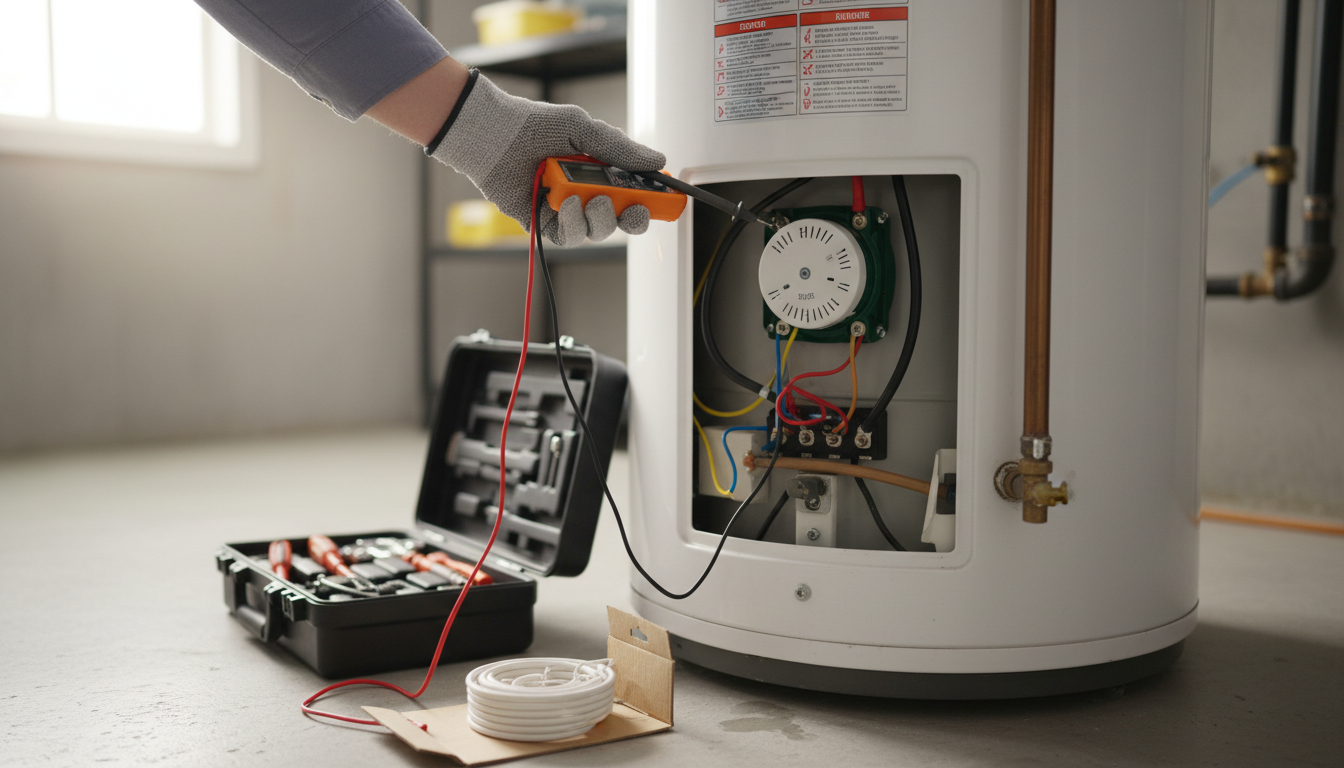
Turn off the breaker first; a 240-volt heater can kill. Remove the access panel and insulation, confirm there is no power with a voltage tester, then disconnect one wire from the element and check it with a multimeter set to ohms. A working element shows a resistance reading; an open circuit means it is dead. A basic meter costs about $10. If you are not comfortable working around 240 volts, the $100 to $250 diagnostic fee is money well spent.
2. Paying for a gas valve when the pilot just needs a thermocouple
On a gas tank, a pilot that lights and then dies when you release the knob is the classic sign of a worn thermocouple, the small sensor that tells the gas valve a flame is present. The part costs $10 to $30. Installed, HomeGuide puts it at $100 to $325, and both Angi and ConsumerAffairs peg a typical job near $150.
The expensive misdiagnosis is jumping straight to the gas control valve, a $150 to $550 job. A valve can fail, but it should be the conclusion after the thermocouple, pilot tube and burner have been checked, not the first guess. Ask the technician what test ruled out the cheaper parts. On newer sealed-combustion heaters, a dirty flame arrestor or intake screen can also starve the burner, which is a cleaning job, not a parts job.
3. Calling a dripping relief valve a leaking tank
Water on the floor makes people assume the worst, and sometimes the worst is right: a tank that weeps from its body or bottom seam cannot be repaired, and replacement runs $750 to $1,300 per Angi. But water often comes from somewhere cheaper. Check where it starts before you agree to anything.
- The temperature and pressure relief valve. A $10 to $25 part, $50 to $300 installed. If it drips because pressure builds when the water heats, the fix may be an expansion tank instead, at $100 to $400.
- The drain valve at the bottom. Plastic drain valves on many tanks can leak at the stem; replacing one is a small job.
- Supply fittings on top. A loose union or corroded nipple drips down the jacket and looks like a tank leak from the floor.
- Condensation. A gas heater refilled with cold water can sweat and drip for a few minutes after a long shower. If it stops once the tank heats, nothing is broken.
Leaks overall run $100 to $1,000 in HomeGuide’s data, and the low end of that range is almost always one of the four items above.
4. Paying full price for a part still under warranty
Most standard tank heaters carry a six-year manufacturer warranty, and some models are covered for up to 12 years, according to ConsumerAffairs. On a heater that is four or five years old, the failed element or gas valve may be free. Labor is the catch: manufacturer coverage typically pays for the part, while labor coverage is often limited to the first year or not included at all.
Before the visit, find the model and serial number on the rating plate. The serial number usually encodes the manufacture date, and the manufacturer’s warranty lookup will tell you what remains. Keep your installation receipt. Angi also warns that skipping maintenance the manual requires can void coverage, which is one reason the annual flush is not just a sales pitch.
5. Booking the Sunday night emergency rate for a problem that can wait
After-hours and weekend calls add a 25% to 50% surcharge, ConsumerAffairs reports. On a $300 element job, that is $75 to $150 for the privilege of a hot shower a day sooner. A cold tank is unpleasant; it is not an emergency. Water spraying from a fitting, or the smell of gas, is. For the first, close the cold supply valve and shut off power or gas, then book a weekday slot. For the second, leave the house and call the gas utility.
Where you live moves the bill too. HomeServe’s state averages for its repair calls show how wide the spread runs:
| State | Average diagnosis | Average repair |
|---|---|---|
| Iowa | $85 | $261 |
| Texas | $95 | $282 |
| Washington | $104 | $306 |
| New York | $95 | $326 |
| Illinois | $91 | $341 |
| California | $107 | $360 |
| Georgia | $104 | $404 |
| Massachusetts | $69 | $439 |
| Utah | $124 | $455 |
| Tennessee | $101 | $479 |
| Florida | $112 | $506 |
6. Treating a tankless error code as a dead heat exchanger
Tankless units throw error codes for scale buildup, ignition trouble and venting problems long before anything major fails. In hard-water areas, the most common fix is descaling, a $75 to $300 service in HomeGuide’s data. The heat exchanger is the expensive part: $600 to $700 in labor alone and $1,200 to $1,300 with the part. That is also the part with the longest warranty, typically 5 to 12 years on the part depending on the brand, with about a year of labor.
Look up the code in the owner’s manual before the technician arrives, and ask whether the unit has been descaled on the schedule the manufacturer requires. A heat exchanger that failed from scale on a never-flushed unit can be the one warranty claim a manufacturer turns down.
7. Putting $450 into an 11-year-old tank
The opposite mistake costs money too. HomeGuide’s rule is to consider replacing a heater over 10 years old, or any heater when the repair costs more than half of a replacement. Tank heaters typically last 8 to 15 years, and Bob Vila’s guide puts it bluntly: past 10 years, a repair might only buy time.
The average water heater repair cost $359, down 27% since 2021. The average replacement cost almost $1,400.
HomeServe repair data, 2025
Take a hypothetical example. An 11-year-old 50-gallon gas tank needs a new gas control valve, quoted at $450. Replacement is about $1,400. The repair passes the 50% test at roughly a third of the cost, but if the tank lasts two more years, you have paid $225 a year for hot water, versus about $117 a year for a new heater spread over 12 years. Unless the tank shows no rust and the anode rod has been replaced, the new heater is the better buy.
If you replace, timing matters a little more than usual. The Department of Energy’s 2024 efficiency rule takes effect in 2029 and will effectively require most electric tanks from 35 to 120 gallons to be heat pump models. Nothing changes for repairs or purchases in 2027, but a standard electric tank bought next year will be among the last of its kind, and its parts should stay available for years. Our guide to water heater replacement prices covers the full install.
Water heater repair questions people ask after the visit
How long does a water heater repair take?
Most single-part repairs take one to three hours, according to ConsumerAffairs. A tank must often be partly drained to replace an element or anode rod, which adds time.
Does homeowners insurance pay for water heater repair?
Generally not. Homeowners policies usually exclude wear and tear, so the heater itself is rarely covered, though many policies help with sudden water damage a failed heater causes to the home. Read your policy and ask your agent, since terms vary.
How often should a tank water heater be flushed?
Angi recommends once or twice a year, and up to four times a year with very hard water. A professional flush costs about $75 to $250; many homeowners do it themselves with a garden hose.
How often should the anode rod be replaced?
Every three to five years is the common guidance, sooner with softened or hard water. The rod costs $20 to $50, and a plumber typically charges $150 to $350 installed. A replaced rod is the cheapest way to extend a tank’s life.
Do I need a permit for a water heater repair?
Simple part swaps usually do not, but work on gas lines, venting or wiring may. ConsumerAffairs puts permits at $25 to $300 where required. Check with your local building department.
More plumbing and hot water prices
- What a new water heater costs, installed
- Tankless water heater prices and install costs
- What plumbers charge for common fixes
- Water softener cost, shelf unit vs dealer system
- Sump pump replacement and backup costs
Every project in the house: Home Improvement Costs in 2027: A Complete Price Guide
Repair or replace: three questions, in order
- Is the tank itself leaking? If water comes from the tank body or seam, replace it. Nothing else on this list matters.
- Is the heater over 10 years old? If yes, repair only cheap parts (an element, thermostat, thermocouple or relief valve, roughly $100 to $350) and start pricing a replacement.
- Does the repair cost more than half of a new heater? If yes, replace. If no, and the heater is under 10 years old, repair it, and check the warranty first.
Pricing method: prices were researched in November 2026 for 2027 planning and may change. Installed ranges come from HomeGuide project data; part prices and surcharges from Angi (2025 data) and ConsumerAffairs (updated September 2026); state averages from HomeServe (September 2025). Your quote will depend on your heater, your local labor rates and what the technician finds. See our disclaimer.