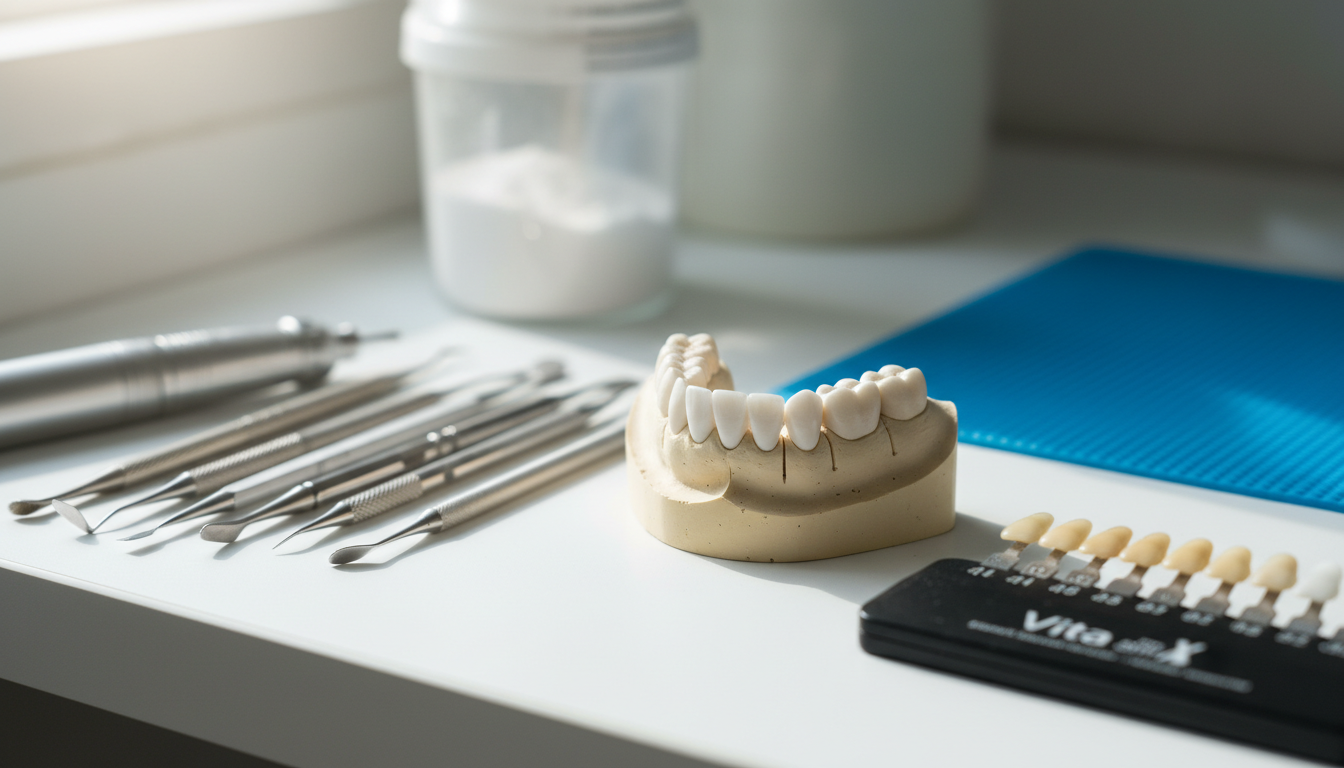
A dentist points at the gap on your X-ray, slides a treatment plan across the desk, and the line that says “bridge” carries a four-figure number. For most people that number lands between $1,500 and $5,000 for a standard bridge replacing one tooth, and Delta Dental puts the average out-of-network fee for a three-unit bridge at $3,600. Bonded front-tooth bridges can come in near $1,000; bridges anchored on implants run $4,000 to $15,000 or more.

What you personally pay depends less on the dentist’s fee than on two other facts: which kind of bridge your mouth needs and what, if anything, is paying alongside you. So instead of one average, we priced four patients with four different setups. If you want to run your own numbers first, our medical and dental cost estimator is a quick start.
Four patients, one missing-tooth problem
These are hypothetical examples built from published price ranges, not real patients or real invoices. Each one shows a different force acting on the final bill.
| Patient | Situation | Bridge | Dentist’s fee | Patient pays |
|---|---|---|---|---|
| Dana, 52 | Employer PPO, lost a lower molar | Traditional 3-unit | $3,600 | About $2,100 |
| Marcus, 34 | No insurance, lost a front tooth | Maryland (bonded) | $2,000 | About $1,600 plus a plan fee |
| Ruth, 68 | Original Medicare only, two molars gone | Traditional 4-unit | About $4,800 | All of it |
| Kevin, 45 | Three teeth in a row missing | Implant-supported | $5,000 to $15,000 | Depends on plan |
Case 1: The insured molar, and the annual maximum that runs out first
Dana has a lower first molar that cracked past saving. Her dentist proposes the classic fix: crown the teeth on each side and hang a false tooth (the pontic) between them. That is three units, and at Delta Dental’s $3,600 average it is a fair stand-in for her fee.
Her plan looks like most employer plans. Delta Dental describes the usual structure as 100% for preventive care, 80% for basic work like fillings and 50% for major work, which includes crowns and bridges. Assume a $50 deductible she has not met yet. Half of the remaining $3,550 would be $1,775, but her plan caps what it pays each year at $1,500. The cap wins.
| Line | Amount |
|---|---|
| Dentist’s fee, 3-unit bridge | $3,600 |
| Plan’s 50% share after a $50 deductible | $1,775 |
| Plan actually pays (annual maximum) | $1,500 |
| Dana pays | $2,100 |
“Only 2% to 4% of Americans typically exceed their annual maximums.”
Delta Dental, plan basics guide
Bridges are one of the ways people land in that small group. Three things can move Dana’s number:
- Staying in network. The $3,600 figure is an out-of-network average. An in-network dentist bills a contracted fee, which is usually lower, and the 50% applies to that smaller number. Ask the office for the contracted fee in writing.
- Timing across plan years. If she also needs a crown elsewhere, splitting the work so one lands in late 2026 and the other in 2027 can give her two annual maximums instead of one. Many plans date a bridge to the day it is cemented, so ask how yours counts it.
- The missing tooth clause. Delta Dental notes that some policies do not cover pre-existing conditions such as missing teeth. If the tooth came out before she joined the plan, the bridge could be excluded entirely. A pre-treatment estimate settles it before anyone picks up a drill.
Case 2: A front tooth, no insurance and a bonded wing bridge
Marcus lost an upper side incisor in a pickup basketball game. His neighboring teeth are healthy, and he does not love the idea of grinding them down for crowns. That makes him a textbook candidate for a Maryland bridge: a false tooth with thin metal or ceramic wings bonded to the backs of the neighbors, with little or no drilling.
MySpecialtyDentist puts Maryland bridges at $1,000 to $2,500, and Humana’s range is $1,500 to $2,500. Animated-Teeth’s per-unit fees show why it is cheaper: a cast metal retainer runs $406 to $865 and a porcelain-fused-to-metal pontic $759 to $1,530, against up to $2,370 per unit for a conventional crown. Say Marcus is quoted $2,000.
With no insurance, his best lever is a dental discount plan. These are not insurance; you pay a membership fee and get reduced fees at participating dentists, which MySpecialtyDentist estimates at 15% to 40% off bridge costs. At a 20% discount, the $2,000 bridge becomes $1,600 plus the membership fee. Unlike insurance, there is typically no annual maximum to hit and no waiting period, which matters when the gap is in your smile.
The trade-off: Animated-Teeth notes that traditional bridges “tend to provide longer, more predictable service” than bonded ones. Wings can debond, and a Maryland bridge is generally a poor match for back teeth that take heavy chewing force. For a front tooth with healthy neighbors, though, it is often the most sensible money in this article.
Case 3: Original Medicare and a four-unit bridge
Ruth, 68, is missing two lower molars next to each other. Bridging two missing teeth takes four units: two crowned anchors and two pontics. Animated-Teeth prices conventional units at $850 to $2,120 each for porcelain fused to base metal and $965 to $2,265 for all-ceramic, and uses $1,200 per unit as its worked example. Four units at that rate is $4,800.
Medicare.gov is blunt: in most cases Original Medicare does not cover dental services, and you pay all costs for services it does not cover. The exceptions are narrow, such as dental care tied to certain covered medical treatment like a heart valve replacement or head and neck cancer care. A bridge for missing molars is not one of them. Nothing announced for 2027 changes that.
Ruth’s realistic options are a Medicare Advantage plan or standalone dental policy that includes major services, which she can shop during an enrollment window, or paying directly. If she goes the second way, two moves cut the bill: ask whether a porcelain-fused-to-base-metal bridge is acceptable for molars nobody sees (it sits at the bottom of the per-unit ranges), and ask about in-house payment plans, which MySpecialtyDentist says commonly run 6 to 12 months. Medical credit cards such as CareCredit also finance dental work; read the deferred-interest terms before signing up.
Case 4: Three teeth gone, and implants doing the holding
Kevin has three missing teeth in a row. A traditional bridge would need a five-unit span hanging off two natural anchors, and that is a lot of chewing load on two teeth. His dentist suggests placing two implants at the ends and attaching a bridge across them. Humana prices a bridge on two implants spanning three or four teeth at $5,000 to $15,000; MySpecialtyDentist gives $4,000 to $10,000 for a three-unit implant-supported bridge.
His three paths, side by side, using the published ranges:
| Option for three missing teeth | Published price | Touches healthy teeth? |
|---|---|---|
| Traditional 5-unit bridge | About $6,000 at a $1,200 unit fee | Yes, two crowned anchors |
| Bridge on two implants | $4,000 to $15,000 | No |
| Three single implants with crowns | $9,000 to $15,000 ($3,000 to $5,000 each) | No |
The implant-supported bridge saves one implant compared with replacing each tooth, which is why it often wins on cost for a run of missing teeth. Insurance is the wild card: Healthline notes that many plans now cover implants as well as bridges, but the 50% major-service rate and the annual maximum still apply, so expect a large share of the bill to stay with you. Our dental implant price guide breaks down the implant side in detail.
Price by bridge type and material
| Bridge type | Typical total | Best suited to |
|---|---|---|
| Traditional, 3 units | $1,500 to $5,000 | One missing tooth with crown-worthy neighbors |
| Cantilever, 2 units | $1,500 to $4,000 | A gap with an anchor tooth on one side only |
| Maryland (resin-bonded) | $1,000 to $2,500 | Front teeth with healthy neighbors |
| Implant-supported | $4,000 to $15,000+ | Several missing teeth in a row |
Material moves the per-unit fee more than most patients expect. Animated-Teeth’s ranges put all-metal base-alloy units at $665 to $1,470, while gold or noble-metal units run $910 to $2,230. Its figures also show how much of the fee is the dentist’s time and overhead: the lab typically charges the dentist $112 to $230 per unit. Location matters too, with urban and coastal practices generally charging more than rural ones.
The second bill most patients forget
A bridge is not a one-time purchase. Humana and MySpecialtyDentist both put typical lifespan at 5 to 15 years, and MySpecialtyDentist says some well-kept bridges last 20 years or more. The most common way they fail is quiet: decay at the edges of the anchor crowns. The bridge itself cannot decay, but the natural tooth under each crown still can, and food packs under a pontic if you do not clean there.
That gives a bridge a hidden running cost. If Dana’s $3,600 bridge lasts 12 years and she then replaces it at a similar fee, she has paid for two bridges in 24 years, and a failed anchor tooth can turn bridge number two into an implant case. Some plans also refuse to pay for a replacement until a set number of years have passed since the original, so ask about that limit at the same time you ask about the maximum.
Bridge questions patients raise after seeing the treatment plan
What is the dental bridge cost with insurance for a typical PPO plan?
Most PPO plans treat bridges as major work and pay about 50% after the deductible, up to the annual maximum. On a $3,600 three-unit bridge with a $1,500 maximum, the patient typically pays around $2,100. An in-network contracted fee lowers both shares.
How long does it take to get a dental bridge?
A traditional bridge usually takes two visits: one to shape the anchor teeth and take impressions, then a second, after the lab makes the bridge, to cement it. You wear a temporary in between. Implant-supported bridges take months because the implants must heal first.
Can a loose dental bridge be re-cemented instead of replaced?
Often, yes, if the anchor teeth are still healthy. Cement can break down over time, and a dentist may be able to clean and re-cement the bridge. If decay has reached the anchor teeth, replacement is more likely. Call promptly, since a loose bridge lets decay advance.
How do you clean under a dental bridge?
Use a floss threader, super floss or a water flosser to reach under the false tooth and around the anchor crowns every day. Decay at the crown margins is one of the most common reasons bridges fail, so this habit protects the money you spent.
Is the cost of a dental bridge tax-deductible?
Dental work to replace missing teeth can count as a medical expense on Schedule A if you itemize and your total medical costs exceed the IRS threshold. You can also pay with HSA or FSA funds. Confirm the details with a tax professional.
Four numbers to get in writing before the first prep visit
- The fee per unit and the number of units, with the material named. A “bridge” line with one total can hide all-ceramic pricing on teeth where base metal would do.
- Your plan’s pre-treatment estimate, which should show the allowed fee, your coinsurance and whether a missing tooth clause applies.
- How much of this year’s annual maximum is left, and the date the plan resets.
- The price of the alternative. Ask what a Maryland bridge or an implant would cost for the same gap, so you are choosing a fix rather than accepting the first one offered.
Prices vary by dentist, region and case, and this is general cost information rather than dental or insurance advice. Your dentist decides which bridge is clinically right; your plan administrator confirms what it pays.
Keep comparing: more dental and health prices
- Healthcare costs in 2027: the complete guide
- What a dental crown costs, by material and plan
- Dental implant prices, from one tooth to a full mouth
- Root canal cost, front tooth to molar
- Wisdom teeth removal, priced line by line
- Veneers cost per tooth and per smile
- Medical and dental cost estimator
Pricing method: prices were researched in November 2026 for 2027 planning and may change. Figures come from Delta Dental (2025 internal data, published July 2026), Humana (February 2026), MySpecialtyDentist (April and May 2026), Animated-Teeth (May 2025), Healthline and Medicare.gov. Patient cases are hypothetical. See our disclaimer.