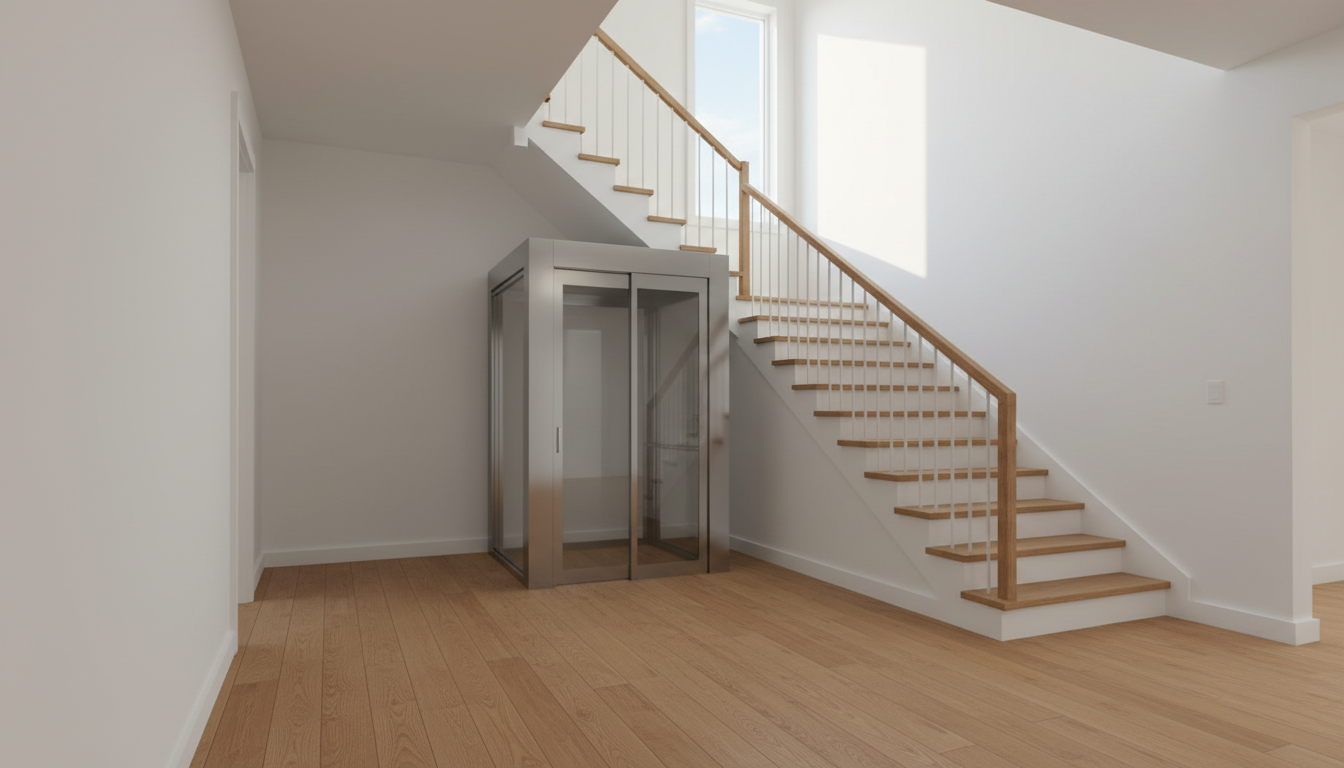
A two-stop home elevator and a well-equipped new pickup land in roughly the same price bracket, and like the truck, the trim level does most of the damage. For 2027 planning, a through-floor lift that needs no shaft averages about $22,000 installed, according to Angi, while a shafted hydraulic, chain or traction car typically runs $25,000 to $60,000, and custom builds reach $100,000. The cheapest stair lift, for comparison, is about $3,000 to $5,000.

Between those numbers sit five distinct kinds of machine, each with its own construction bill and upkeep. Climb the ladder below one rung at a time and stop at the first one that carries the person who will actually ride it, in the wheelchair or walker they may need in ten years, not the one they use today.
Six rungs, from a chair on a rail to a quiet traction car
| Rung | What you get | Typical installed price | Wheelchair? |
|---|---|---|---|
| 1. Stair lift | A seat on a rail along your existing stairs | $3,000 to $5,000 (straight runs) | No |
| 2. Vertical platform lift | An open or enclosed platform, usually for a porch or a few feet of rise | $5,000 to $20,000 | Yes |
| 3. Through-floor (shaftless) lift | A small cab that rides rails through a hole cut in the ceiling | About $19,000 to $33,000 | Larger models only |
| 4. Pneumatic vacuum elevator | A clear tube that moves the cab with air pressure | $35,000 to $60,000 | Largest model only |
| 5. Shafted hydraulic, cable or chain | A conventional cab in a framed hoistway | $15,000 to $62,000 for the unit, plus the shaft | Yes |
| 6. Traction and custom cabs | Smoother, quieter ride, premium finishes | $29,000 to $55,000; custom $55,000 to $100,000 | Yes |
Rungs 1 and 2: when you do not need an elevator at all
If the rider can still transfer to a seat, a stair lift does the job for a fraction of the money. Fixr puts typical installs at around $3,000 to $5,000; curved staircases push some quotes toward $14,000, per Retirement Living. Our stair lift cost guide compares renting, used and new units.
A vertical platform lift, the kind you see beside a porch, costs $5,000 to $20,000 according to Bob Vila. Savaria’s V-1504, a common residential model, carries 750 pounds, enough for a power chair and a helper, but most platform lifts climb only one short level. They solve a front step, not a second story.
Rung 3: through-floor lifts, the cheapest true second-floor ride
Shaftless lifts plug into a dedicated 220-volt outlet, run on rails fixed to a wall and travel through a trapdoor-style opening in the ceiling. No pit, no machine room, and Fixr says installation takes one to three days. Angi’s normal range is $19,250 to $24,750, with the unit itself at $15,000 to $25,000 and labor at $1,500 to $2,500.
Brand prices bear that out. Stiltz says its two-person Duo Classic starts at about $25,000 on average and its wheelchair-capable Trio Alta runs approximately $33,000 installed. Easy Climber falls lower at $12,000 to $16,000, per Fixr. The trade-off is size: most of these cabs carry one or two standing adults, and the small home elevator cost advantage disappears once you need a chair-sized model.
Rung 4: vacuum tubes cost more for what they save in construction
Pneumatic vacuum elevators, sold mainly under the PVE name, are the ones that look like a glass tube in the corner of the living room. They need no pit or hoistway, and Stiltz says they install in two to three days. Fixr and Bob Vila both put them at $35,000 to $60,000; Angi’s average is about $45,000.
- PVE30: 30-inch cabin, one rider, up to 350 pounds. The low end of the range.
- PVE37: two riders, about 450 pounds.
- PVE52: 52-inch cabin, 525 pounds, the only model in the line that takes a wheelchair. The most expensive.
The PVE30 is a narrow ride. Anyone who might use a walker should stand inside a showroom model before paying for it.
Rung 5: shafted cars, where the unit price is half the story
This is what most people picture: a cab with real doors in a framed shaft. Fixr’s installed ranges are $15,000 to $35,000 for cable drive, $22,000 to $53,000 for hydraulic and $27,000 to $62,000 for chain drive. Savaria’s Telecab averages $28,000 and Inclinator runs $25,000 to $35,000, both per Fixr. Chains, Stiltz notes, can last about 20 years, against roughly five for cables.
Those are cab prices. In an existing house, someone has to frame a hoistway through two floors, and hydraulic units may need a pit. Fixr says a hydraulic retrofit starts at about $40,000, and in-home elevator cost in a new build is lower because the shaft is framed with the house: about $25,000 for cable and $40,000 for hydraulic. If you are still drawing plans, see our cost to build a house guide and frame the shaft now, even if the cab comes later.
Rung 6: traction and custom cabs buy quiet, not access
Gearless traction runs $29,000 to $55,000 installed, per Fixr, and Otis residential units fall at $40,000 to $50,000. Machine-room-less designs average about $45,000 and use roughly 30% to 40% less energy than machine-room units, Fixr says. Above that, custom cabs run $55,000 to $100,000, concealing the shaft can add as much as $27,000, and Bob Vila reports decorative doors alone reaching $25,000.
Nothing on this rung moves a person between floors better than rung 5 does. It is a design purchase, and a reasonable one in a house where the elevator sits in the front hall. In a back hallway, it is money spent on wood paneling.
The quote is not the bill: shaft, wiring and a phone line
Many dealers quote the elevator and leave the construction to you or your contractor. Mobility123, an installer that sells turnkey jobs, illustrates the gap with a hypothetical $30,000 two-stop quote that grows to $49,700 once a carpenter ($7,500), structural work ($2,800), an electrician ($2,200), architect, permits and inspections ($2,800) and change orders ($4,400) are added. It is a sales example, but each line matches what independent sources report.
| Line item a cab quote may leave out | Typical range | Source |
|---|---|---|
| Shaft framing | $7,000 to $15,000 | Mobility123 |
| Electrical: dedicated circuit, often a panel upgrade | $1,500 to $3,500 | Mobility123 |
| Architect or engineer for a retrofit | $1,800 to $5,500 | Mobility123 |
| Building permit | $200 to $2,000 | Bob Vila |
| Acceptance inspection | From $75; median about $300 | Fixr, Retirement Living |
| Emergency phone line in the cab | Usually wired by your electrician | Mobility123 |
Mobility123 says about a quarter of homes need a panel upgrade. Ask every bidder for a written list of what the homeowner must supply, then price those items before comparing quotes.
What each rung costs to keep running
Service contracts are where the cheaper rungs pull further ahead. Retirement Living’s annual maintenance ranges by type: pneumatic $200 to $700, shaftless $300 to $800, traction $300 to $900 and hydraulic $300 to $1,000. Angi puts the national average at $510. Contracts can run seven to 25 years and often renew automatically unless you give notice three to four months ahead, so read the term before signing.
Repairs are the wild card. Retirement Living puts the average at $7,500, with a range from $100 to more than $15,000, and Fixr notes cable systems need cables replaced about every five years. Some states also require periodic inspections, annually in New York, Wisconsin and Washington and every five years in Maryland, Texas, Kansas and Massachusetts, typically $75 to $1,500 a visit.
Rough 10-year upkeep, using midpoints: about $5,000 for a shaftless lift ($550 a year) and about $6,500 for a hydraulic car ($650 a year), before any major repair or state inspection fees. That gap is small next to the $20,000 or more separating them on day one.
The four-inch gap, the tax break and the resale math
Safety retrofit. The Consumer Product Safety Commission links residential elevators to 4,600 injuries and 22 deaths from 1981 through 2019, many involving children caught between the hallway door and the cab gate. Its rule of thumb: no gap deeper than four inches, measured under ASME A17.1-2016. If you are buying a house with an older elevator, budget for space guards or an electronic monitor and have it inspected before closing. CPSC has listed recalls by Otis, ThyssenKrupp Access and others.
Taxes. When an elevator is installed mainly for medical care, the IRS lets you count the cost as a medical expense, minus any amount it adds to your home’s value. Nolo’s example: an $8,000 lift that raises the appraisal by $4,400 leaves $3,600 deductible. Electricity and maintenance count in full, but only if you itemize, and only the share of total medical costs above 7.5% of adjusted gross income. Confirm with a tax professional; IRS Publication 502 has the rules.
Resale. Fixr says you may recoup at least 50% of the cost when you sell. We found no announced federal or national price change for 2027; the prices above are researched current figures for 2027 planning.
Still pricing one out? Five more questions
How much does a small home elevator cost?
A small one- or two-person through-floor lift typically costs about $19,000 to $25,000 installed, per Angi, and budget models such as Easy Climber list at $12,000 to $16,000 on Fixr. A compact pneumatic tube like the PVE30 sits higher, at the low end of the $35,000 to $60,000 range.
Does Medicare pay for a home elevator?
Original Medicare generally does not pay for home modifications such as elevators. Retirement Living notes most insurance plans do not cover installation, though an FSA, HSA or HRA may cover some costs with a letter of medical necessity. Check with your plan administrator.
Can I add an elevator to a house that was not built for one?
Yes. Through-floor and pneumatic models are designed for retrofits and need no pit or shaft. A shafted hydraulic retrofit is possible too, but Fixr says it starts around $40,000 and can reach $100,000 when the shaft is hidden behind finished walls.
How long does installation take?
Shaftless lifts take one to three days, per Fixr, and pneumatic units two to three days, per Stiltz. A shafted elevator with a machine room can take three to four weeks of installation, plus the time to frame the hoistway and pass inspection.
What happens to a home elevator in a power outage?
Many residential models have a battery backup meant to bring the cab to a landing when the power fails. Angi lists battery backup tests or replacement at $75 to $300, so ask if your service contract includes the battery.
Pricing the rest of an aging-in-place plan
- Home improvement costs: the complete 2027 guide
- Stair lift cost: rent, used or new
- Walk-in shower cost myths, checked against prices
- Walk-in tub cost: dealer quote vs retail tub
- In-home care cost by weekly hours
- Foundation repair cost, read from the crack
Where the ladder stops paying off
For most two-story houses, value peaks at rung 3 or rung 5. A through-floor lift is the best buy for one or two people who walk, and a shafted hydraulic or chain car is the right call once a wheelchair is likely, because it is the cheapest way to get a full-size cab. Vacuum tubes earn their premium only when you cannot give up floor space for a shaft, and traction or custom cabs buy finish, not function. Get two turnkey quotes and one cab-only quote with the construction priced separately, and you will know within a week which rung your house can afford.
Pricing method: prices were researched in November 2026 for 2027 planning and may change. Figures come from Fixr, Angi, Bob Vila, Retirement Living, Stiltz, Mobility123, Nolo and the U.S. Consumer Product Safety Commission. Installed prices vary by house, region and dealer. See our disclaimer.