The usual mistake with asphalt bids is comparing the totals. Two numbers at the bottom of two pages tell you almost nothing, because the cheapest way to pave a driveway is to skimp on the parts that disappear under the blacktop. For 2027 planning, HomeGuide’s member-reported costs put a new asphalt driveway at $3 to $7 per square foot and a tear-out and replacement at $4 to $10 when a new gravel base goes in. Angi and Fixr, whose figures include more grading and date from 2022, put full installs at $7 to $15.

On a common 24-by-24-foot two-car driveway, that works out to roughly $1,700 to $4,000 on HomeGuide’s numbers and $4,000 to $5,800 on Fixr’s. Rather than average those, we built one sample quote and walked through it line by line. If you are still deciding between surfaces, our driveway cost comparison by climate and the concrete slab cost calculator will price the concrete alternative.
The sample bid: tearing out and repaving 576 square feet
Hypothetical example, built from published per-square-foot ranges, not a real contractor’s invoice. The job: remove a cracked two-car driveway, rebuild the stone base and lay 3 inches of compacted hot mix. Each line uses a figure inside the ranges HomeGuide, Angi and Fixr publish.
| Line on the quote | Rate used | Amount | Published range |
|---|---|---|---|
| Driveway permit | Flat fee | $100 | $50 to $150 (HomeGuide); $50 to $200 (Angi) |
| Remove and haul old asphalt | $2.00/sq ft | $1,152 | $1 to $3/sq ft (HomeGuide); about $2 (Fixr) |
| Grade, add and compact stone base | $1.75/sq ft | $1,008 | $1 to $3/sq ft for gravel base (HomeGuide) |
| Hot mix, about 10.5 tons, placed and rolled at 3 in. | $3.00/sq ft | $1,728 | $2 to $4/sq ft installed (HomeGuide) |
| Total | $6.92/sq ft | $3,988 | $4 to $10/sq ft for replacement with new base (HomeGuide) |
That last point is the whole argument of this article. More than half of a fair repave bid pays for digging and stone, and that is exactly where a low bid finds its savings.
Removal and hauling: a line that should track thickness
HomeGuide prices demolition and haul-off at $1 to $3 per square foot “depending on the thickness,” and Fixr’s average sits near $2. A thin, decades-old driveway sits at the low end. A thick one, or one with concrete underneath, sits at the top, and a contractor who discovers that mid-job may come back with a change order.
Fair: a stated price per square foot with a written note about what happens if they hit concrete or buried stone. Padding: a vague “demo and disposal” lump sum with no area attached. Old asphalt is widely recycled, so ask whether the hauling charge reflects that; some crews grind it into reclaimed base, which Angi prices at just $0.20 to $0.75 per square foot as a material.
The stone base, where cheap bids quietly save money
Every paver will tell you the base matters, and the published specs agree on roughly how much of it you need. HomeGuide calls for 3 to 5 inches of asphalt over 4 to 8 inches of rock base and says the crew should compact the base with a vibratory roller. Municipal codes say much the same. Shaker Heights, Ohio, for example, accepts 2 inches of surface asphalt over 6 inches of aggregate base, or a full-depth design with 4.75 inches of asphalt, and requires an inspection before paving.
HomeGuide notes that a new sub-base is not always required. If your old base is sound and drains well, reusing it is legitimate and drops replacement into its $3 to $7 per square foot range. The problem is a bid that reuses it without saying so. Three things should appear in writing:
- Base depth after compaction, in inches, not “as needed.”
- Stone type, usually crushed aggregate rather than rounded gravel, which shifts under load.
- How soft spots are handled, with a unit price for digging out and replacing them so a surprise does not become an open-ended bill.
Checking the tonnage with a pencil
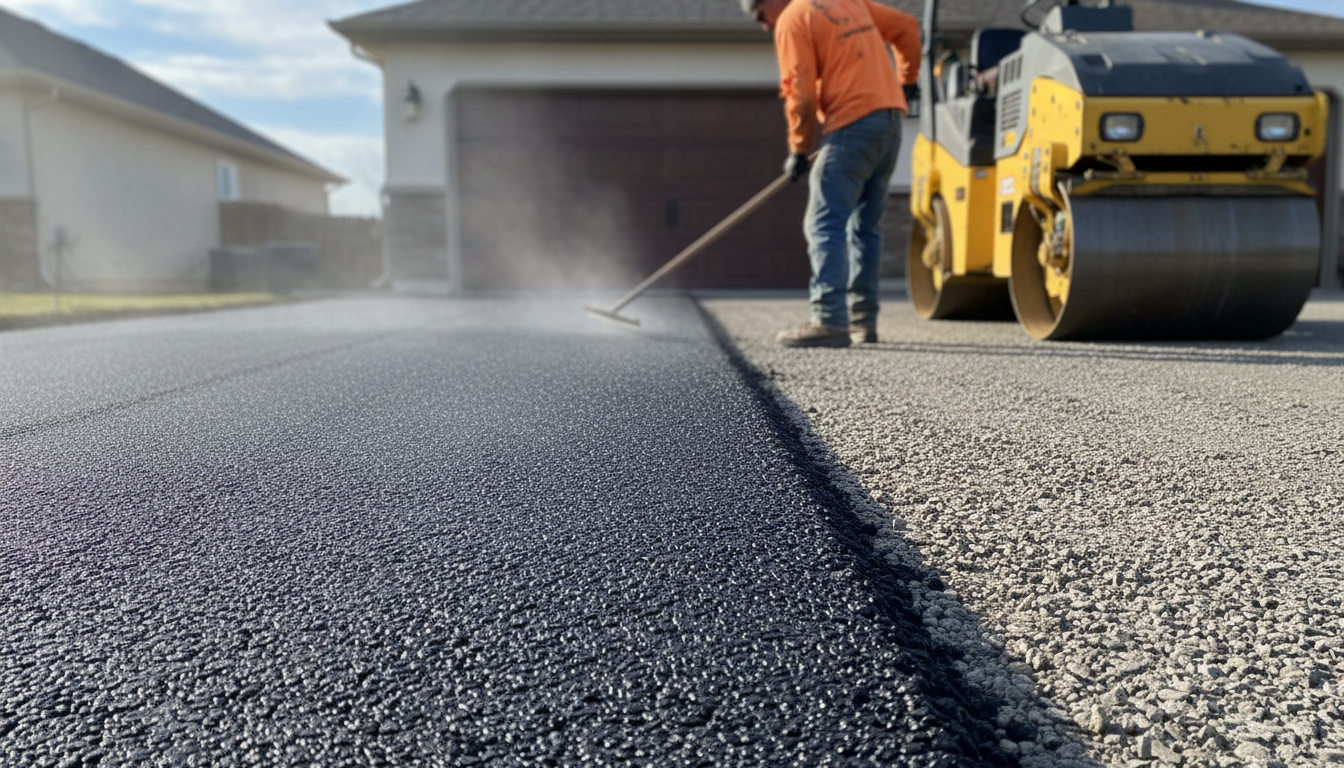
Hot mix is sold by the ton, and per-ton prices are all over the map: $40 to $80 plus delivery on HomeGuide, $70 to $140 on LawnStarter and $100 to $150 on Fixr. Do not try to audit the per-ton price; the plant price you could get as a homeowner is not what a contractor pays, and the paving labor is rolled into it. Audit the tons instead, because thickness is the easiest thing to shave.
A standard rule: compacted hot mix weighs about 145 pounds per cubic foot. Multiply your square footage by the thickness in inches, divide by 12, multiply by 145 and divide by 2,000. For our 576 square feet at 3 inches, that is about 10.4 tons. Angi’s shortcut lands in the same place: one ton covers about 80 square feet at 2 inches and 40 square feet at 4 inches.
If a bid for a two-car driveway lists 6 or 7 tons, you are being quoted a 2-inch surface whatever the sales pitch says. HomeGuide puts the saving from a 2-inch driveway at $0.50 to $1 per square foot and notes that contractors generally will not warranty it. On 576 square feet, that is $288 to $576 saved on a job meant to last two decades.
Permit, curbing and drainage: short lines, long consequences
Permit fees are small: $50 to $150 per HomeGuide, $50 to $200 per Angi and $60 to $280 per LawnStarter. Who pulls the permit is the bigger question. If the contractor does, the inspector sees the base before it is buried, which protects you. If the bid says “permit by owner,” budget the fee and the scheduling hassle yourself.
Curbing is cheap to add during the job: HomeGuide lists asphalt curbing at $3 to $6 per linear foot, or $120 to $240 on a 400-square-foot driveway. Drainage is the line that is cheap to skip and expensive to regret. A trench or channel drain runs $400 to $2,400 per driveway on HomeGuide’s figures, and a driveway that sheds water toward the garage will cost far more than that in repairs. Some cities require it outright; Shaker Heights requires the finished surface to carry water to a catch basin or the street and to stay below door thresholds and window wells.
What a complete asphalt driveway quote should state
- Total square footage and the price per square foot
- Removal method and how the old material is disposed of
- Base stone type and compacted depth in inches
- Asphalt thickness after compaction and estimated tons
- Who obtains the permit and pays for it
- Drainage, edging and apron work, each priced separately
- Warranty length and what it covers
- Payment schedule, with the balance due after completion
The line that should not be there yet: sealing a brand-new driveway
A new driveway needs time to cure before it is sealed. HomeGuide says to wait 3 to 6 months, and Fixr recommends sealing after roughly 6 months, then every few years. A quote that bundles sealcoating into installation day is either charging you for a coat that should not go on yet or planning to come back, in which case it belongs on a separate, dated line.
When the time comes, sealing is not a big bill. HomeGuide puts professional sealcoating at $1 to $2 per square foot, or $580 to $1,200 for a 576-square-foot driveway, and says to reseal every 2 to 10 years depending on the product and climate. Doing it yourself costs a fraction of that in materials; HomeGuide lists asphalt emulsion sealer at $0.08 to $0.15 per square foot.
The quote that arrives on your doorstep
State consumer agencies warn about the same pitch every warm season. Wisconsin’s Department of Agriculture, Trade and Consumer Protection describes crews claiming leftover asphalt “that needs to be used before it goes to waste,” offering a low price, collecting cash upfront, then demanding a much larger final payment or skipping the top coat they charged for. Tennessee’s Department of Commerce and Insurance and the BBB put it bluntly: reputable asphalt contractors do not sell leftover product door to door.
Tennessee’s advice doubles as a quote standard: get a written contract listing the work and the agreed total price, “not just price per square foot,” and never hire someone on the spot. Wisconsin adds: gather several bids and never pay the full price upfront.
Why spring 2027 bids may run above these ranges
No national price change has been announced for 2027, and paving is priced job by job. But the producer price data that contractors watch has moved. The Associated General Contractors of America’s October 2026 tables, built on Bureau of Labor Statistics data, show the following 12-month changes to September 2026:
Paving mixtures and blocks: up 7.1%. Asphalt at the refinery: up 17.7%. No. 2 diesel fuel: up 115.2%.
AGC producer price index tables, updated October 15, 2026
Diesel runs the plant, the trucks and the rollers, so expect early-2027 quotes to carry some of that. Most of the cost ranges above were published before these increases, so treat their upper halves as the safer budget. The good news is timing: paving crews book up in spring and summer, so asking for bids in late winter gives you room to compare before the season starts.
Asphalt questions that come up after the first bid
Is there a simple asphalt driveway cost calculator I can do myself?
Yes. Multiply your square footage by a per-square-foot rate: about $3 to $7 for a new driveway on prepared ground or $4 to $10 for a tear-out with a new base, per HomeGuide. To check tonnage, multiply square feet by thickness in inches, divide by 12, multiply by 145 and divide by 2,000.
Can asphalt be laid over an old concrete driveway?
Sometimes. HomeGuide prices an asphalt overlay on concrete at $1 to $3 per square foot, but cracks and joints in the slab tend to reflect through the new surface, and some towns ban it. Shaker Heights, Ohio, for example, prohibits paving over existing concrete with asphalt. Check local rules first.
How long does an asphalt driveway last?
HomeGuide puts the lifespan at 15 to 30 years, and Fixr says about 20 to 30 years when well maintained but closer to 15 without care. Base quality, drainage and regular sealing make most of the difference.
Is recycled asphalt a cheaper way to pave?
It can be. Angi’s 2022 figures put recycled asphalt driveways at $6.20 to $8.75 per square foot installed and reclaimed asphalt material at $0.20 to $0.75 per square foot. It suits rural or long driveways well but usually lacks the smooth finish of fresh hot mix.
What does tar and chip cost compared with asphalt?
HomeGuide prices tar and chip at $2 to $5 per square foot with a lifespan of 7 to 10 years. It costs less upfront than hot mix asphalt, has a rougher gravel texture and needs redoing sooner, so it fits long rural driveways better than short suburban ones.
After the roller leaves: the first year of ownership
The cheapest asphalt driveway is the one you only pay for once. Fixr says you can walk on new asphalt in 24 to 48 hours and drive on it in 3 to 5 days, and that it takes up to a year to fully settle and cure. During that year, keep heavy trucks off it, avoid turning the steering wheel while parked, and do not put jack stands or trailer tongues on bare spots in summer heat. Pay the final balance only after you have walked the whole surface and checked for puddles. Book the first sealcoat for six months out, and fill hairline cracks each fall before water gets under them.
Other outdoor projects you may be pricing
- Home improvement costs: the complete 2027 guide
- Asphalt, concrete or gravel: driveway cost by climate
- Heated driveway cost, from tire tracks to a full slab
- Dumpster rental prices by project size
- Stump grinding cost before you pave
- Land survey cost, for driveways near a property line
- Concrete slab cost calculator
Pricing method: prices were researched in November 2026 for 2027 planning and may change. Figures come from HomeGuide, Angi, Fixr, LawnStarter, the Associated General Contractors of America’s producer price tables, the City of Shaker Heights driveway requirements and consumer alerts from Wisconsin DATCP and the Tennessee Department of Commerce and Insurance. The sample quote is a hypothetical example. See our disclaimer.