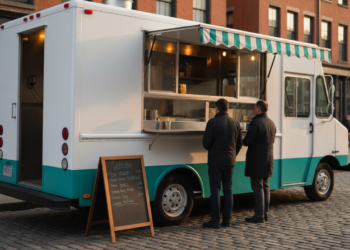
On July 1, 2026, Texas tore up the old patchwork. A taco truck that once carried separate permits for Houston, Austin and San Antonio now needs a single license from the Texas Department of State Health Services, and for a full-cooking truck it costs $1,376 at application. Elsewhere the government’s share stays smaller and more scattered: Florida charges $397 for a first-year state license, and Chicago charges $1,000 for a two-year license. In most of the places we checked, the permit fees for one truck land between about $400 and $1,400 in year one.

The fees are the easy part to find. What trips up new owners is the order they arrive in, and the monthly costs that come attached to the paperwork. So this guide follows the food truck permit bill on a calendar, from the phone call you make before buying a truck to the renewal notice a year later.
The short answer: budget roughly $400 to $1,600 for the health permit, plan review and fire inspection on one truck, plus $150 to $600 for business registration and food safety certificates. Then add the cost that permits quietly require: a commissary, which DoorDash’s 2026 merchant guide puts at $400 to $1,500 a month.
Month zero: the plan review that should happen before you own a truck
Many health departments want to approve the layout of a mobile kitchen before it is built or bought: sinks, water tank sizes, the hood, the propane setup. Buy a used truck that fails that review and the fix can cost far more than any fee in this article. The review itself is usually cheap, and sometimes free.
- Florida: plan review costs $0. The state’s Division of Hotels and Restaurants does it at no charge.
- Maricopa County, Arizona (Phoenix area): under the county’s new fee summary, plan review runs $306 for a Type II unit and $300 for a Type III unit, which cooks on board. Expedited review costs double.
- Chicago: the city offers a free mobile food vehicle assessment before you apply.
- Texas: the new state license works through a pre-licensing inspection rather than a separate plan review fee; that inspection fee is folded into the application cost.
If you are shopping for a used truck, ask the seller for its last health inspection report and the jurisdiction that issued it. A truck that passed in Florida was built to a standard; it was not necessarily built to yours.
Week one: the business paperwork and the people certificates
Before the truck can be permitted, the business behind it usually has to exist on paper, and someone on board has to prove they know food safety. These charges are small one by one. DoorDash’s September 2026 guide to food truck licenses lists these typical ranges:
- Employer Identification Number: free from the IRS.
- General business license: $50 to $400, depending on the city or county.
- Seller’s permit for sales tax: free to $100, and some states ask for a security deposit.
- Food manager certification, such as ServSafe: $100 to $200 for the person in charge.
- Food handler cards: $10 to $50 per worker.
New York City has its own version: the Mobile Food Vendor Food Protection Course costs $53, paid separately from the permit. If you plan to form an LLC first, that filing is its own line; our guide to LLC costs by state covers it.
Weeks two to six: the health permit, priced in six places
This is the document people mean when they ask how much a food truck license costs. The fee usually depends on how much cooking happens on the truck: prepackaged snacks pay least, a full kitchen pays most. The official fee schedules read like this in fall 2026.
| Where | Truck that cooks on board | Lower-risk truck | Term |
|---|---|---|---|
| Texas, statewide (DSHS, since July 1, 2026) | $876 application + $500 pre-licensing = $1,376 (Type III) | $309 (Type I); $1,018 for Type II, such as coffee or hot dogs | 1 year from pre-licensing inspection |
| Florida (DBPR) | $347 license + $50 new application = $397 | Same fee | Annual; $178.50 half-year rate late in the cycle |
| Maricopa County, AZ | $610 permit + $300 plan review (Type III) | $290 (Type I); $341 (Type II) | 1 year |
| Chicago | $1,000 Mobile Food Preparer license | $700 Mobile Food Dispenser license | 2 years |
| New York City | $200 permit for on-site prep | $75 for prepackaged food | 2 years; seasonal permits $35 and $15 |
| Houston (city medallion, before the state took over) | $258 fee + $112.57 inspection + $33.56 admin | Same fee | 1 year; replaced by the Texas license |
Two rows need a warning label. New York’s $200 permit is cheap because it is scarce: a full-term permit is issued only when the Health Department calls your name from a waiting list, and it requires a supervisory license. The city began issuing 2,200 new supervisory licenses a year on July 1, 2026, for five years, which should shorten that line through 2027 and beyond. And Chicago’s price looks high until you divide by two years, at which point $500 a year is middle of the pack.
Florida and Texas share a feature that matters more than the fee: state law preempts local health licensing. Florida’s statute bars cities and counties from charging their own license fees for mobile food dispensing vehicles, and Texas’s new law preempts local power to regulate mobile vendors. In most other states, a truck that crosses a county line can need a second permit.
Inspection day: the fire marshal and the price of failing once
A truck with a generator, propane or a commercial hood usually needs a fire safety inspection on top of the health inspection, and fire is the one thing the new Texas law leaves to local officials. Houston’s health department says plainly that its fire marshal still inspects trucks operating in the city. DoorDash’s guide puts a typical fire permit at $50 to $500.
Austin publishes its numbers. Its fiscal 2026 schedule, effective October 1, 2025, lists a $222 Austin Fire Department inspection, $592 for an on-site fire inspection and $296 for a subsequent inspection, billed at a two-hour minimum. Failing is where budgets slip:
- Houston’s old medallion charged $101.06 plus a $29.72 admin fee for each health re-inspection.
- Austin’s schedule lists a $134 mobile vendor re-inspection.
- Under the Texas state license, a complaint or compliance inspection costs $300 for Type I, $400 for Type II and $500 for Type III.
What inspectors most often want to see on a cooking truck
Requirements vary, but health and fire checklists commonly include a hand sink with hot water, a three-compartment sink for washing utensils, fresh and waste water tanks sized to local rules, a working hood with a fire suppression system over fryers and griddles, a portable fire extinguisher of the right class, secured and inspected propane tanks, and a certified food manager on board. Ask your inspector for the local checklist before inspection day; most departments will share it.
Every month after that: the commissary your permit depends on
This is the line that makes the permit fee look like pocket change. Most health departments require a truck to operate from an approved base, often called a commissary or central preparation facility, where it fills water, dumps waste, stores food and gets cleaned. Houston, for example, requires trucks to report to an approved servicing area daily, and its health department counted 16 such sites in its jurisdiction in 2026. Austin charges $150 just to register a central preparation facility.
DoorDash’s guide puts a commissary agreement at $400 to $1,500 a month. Over a year, that is $4,800 to $18,000, or several times the permit stack. Some owners trim it by sharing a restaurant kitchen after hours, but the arrangement still has to be approved, and a handshake deal will not satisfy an inspector. In Maricopa County the commissary itself pays a $511 county health permit, a cost that tends to show up in the rent.
Your first festival season: event permits stack up
Festivals, fairs and farmers markets often bring their own permits, and they can add up for a truck that works most weekends. DoorDash’s range is $50 to $300 per event, and published government fees fit inside it:
| Event permit | Fee | Note |
|---|---|---|
| Florida temporary event, 1 to 3 days | $91 | Licensed mobile food vehicles can work 1 to 3 day events without this fee |
| Florida temporary event, 4 to 30 days | $105 | Annual vendor option: $456 |
| Maricopa County temporary food establishment, 14 days | $249 | Permitted mobile units can work events within their permit’s limits |
| Maricopa County seasonal establishment, up to 180 days | $193 to $312 | Depends on class |
The pattern worth noticing: a full mobile license often covers short events that would otherwise need a temporary permit. Before you pay an organizer’s permit fee, check whether your license already counts. Event organizers usually charge their own vendor fee as well, and some ask for proof of liability insurance; our business insurance cost guide prices that policy.
Month twelve: the renewal, and what changes for 2027
Most health permits last one year, so the same fees come back on the anniversary, minus the plan review and new-application charges. Chicago and New York run two-year terms. Florida renews by district on fixed dates between October and June, which is why its half-year rate of $178.50 exists: apply within six months of your district’s renewal date and you pay half.
For 2027 planning, the two biggest changes are already on the books. Texas operators renew with the state one year after their pre-licensing inspection, and DSHS lists a $500 routine inspection fee for Type III trucks and $400 for Type II among the additional fees that may apply. New York’s expanded supervisory license issuance continues through 2027. We found no announced 2027 fee changes in Florida, Chicago or Maricopa County as of early November 2026. Maricopa’s new schedule, which raised Type I permits from $120 to $290, is the most recent increase we saw.
One Texas taco truck, first-year ledger
To put the calendar together, take an example, not a real business: a Type III taco truck starting in Austin in early 2027, using published fees and the commissary range above.
| When | Cost | Amount |
|---|---|---|
| Week 1 | Food manager certification | $100 to $200 |
| Weeks 2 to 6 | Texas DSHS Type III license (application + pre-licensing) | $1,376 |
| Inspection week | Austin Fire Department inspection | $222 |
| Monthly, 12 months | Commissary agreement | $4,800 to $18,000 |
| Year one, permits and certificates only | About $1,700 to $1,800 | |
| Year one, with commissary | About $6,500 to $19,800 | |
The ledger leaves out the truck, insurance and any re-inspection, and it assumes the truck passes the first time. Our food truck cost guide covers the vehicle and first-year operating budget.
The bottom line on food truck permits
Permit fees for one truck are rarely the obstacle; in most places they total less than a month of commissary rent. The money is lost in the sequence: buying a truck that fails plan review, paying for a second inspection, or signing a commissary deal the health department will not accept. Call the health department before you buy, line up an approved commissary before you apply, and book the fire inspection only when the suppression system is certified. Do those three things in that order and the permit bill is the most predictable number in your startup budget.
Food truck license questions we hear after the first application
How long does it take to get a food truck permit?
Plan on several weeks once your truck is ready. Houston’s permitting center listed processing of up to 15 business days for its old medallion, and that clock starts only after plan review and inspection are scheduled. Waiting lists, as in New York City, can stretch the timeline much further.
If I buy a used food truck, does the seller’s permit transfer to me?
Usually not. Health permits are generally tied to the operator as well as the vehicle, so a new owner applies again. Florida charges a $50 application fee on a change of ownership, and Maricopa County lists a $385 new-owner permit for mobile food establishments. Confirm with your health department before closing the sale.
Does a food trailer need the same permit as a food truck?
In most places a trailer is permitted as a mobile food unit, with the same health and fire rules as a truck. The fee tier depends on what you cook, not on whether the kitchen has its own engine. Check your state or county’s definitions before you apply.
Is a coffee or hot dog truck cheaper to permit?
Often, yes, because lower-risk menus fall into lower fee tiers. In Texas, a Type II truck such as a coffee or hot dog vendor pays $618 plus a $400 pre-licensing fee, against $1,376 total for a full-cooking Type III truck. In Chicago, a dispenser license is $700 for two years versus $1,000 for a preparer license.
Do I need a parking or vending permit too?
Many cities regulate where trucks may park and sell, separately from the health permit. DoorDash’s 2026 guide puts parking permits at $100 to $1,000 where they apply. Private lots and events usually need the property owner’s written permission instead, and some cities require a restroom agreement with a nearby business.
Keep building the food business budget
- Small business startup costs in 2027: the complete guide
- Food truck cost: first-year budget and break-even
- Cost to rent a food truck by the event, day or month
- LLC cost by state over five years
- Business insurance cost and what your paperwork requires
- Cost to open a coffee shop
Pricing method: prices were researched in November 2026 for 2027 planning and may change. Figures come from the Texas Department of State Health Services mobile food vendor page and 2026 guide, the Florida DBPR food fee schedule, Maricopa County’s fee summary ES-2025-004, City of Chicago and NYC licensing pages, Austin Public Health’s FY2026 fee schedule, the Houston Permitting Center and DoorDash’s September 2026 merchant guide. Fees vary by jurisdiction; confirm current amounts with your health department and fire marshal. See our disclaimer.