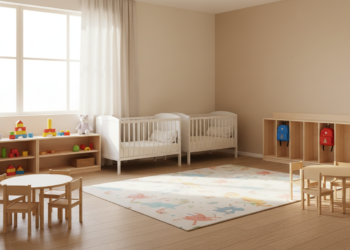
The four-month checkup is going fine until the pediatrician runs a hand over the back of your son’s head, pauses, and asks how he usually sleeps. A flat spot, she says. Probably positional. Let’s see how it looks in two months. If it does come to a helmet, the device and its fittings typically cost $1,300 to $4,000, according to the Marine Corps-Law Enforcement Foundation, and UCLA Health warns it can reach $4,000 or more. Most families never pay any of it, because most flat spots never need a helmet.

What you will pay in 2027 comes down to three facts you can find out in a week: how old your baby is, how far the measurements are off, and what your plan says about code S1040. Start with the row below that matches your baby, then jump to the section that row points to. For a rough read on your own copays and deductible, our medical and dental cost estimator helps.
Find your baby’s row: age, severity and the likely bill
The neurosurgeons who wrote the national treatment guidelines put the order of care plainly. The Congress of Neurological Surgeons guideline summary recommends helmets for moderate to severe flattening that persists after repositioning or physical therapy, and finds them more effective than conservative care mainly for babies around 6 months who have not responded, or those older than about 8 months.
| Your situation | Usual next step | Likely out-of-pocket |
|---|---|---|
| Under 4 months, mild flat spot, neck turns freely both ways | Repositioning and tummy time at home | $0 |
| Baby always turns one way or the neck seems tight | Physical therapy referral for torticollis | Your plan’s therapy copays or coinsurance per visit |
| About 6 months, moderate to severe, little change after 2 or more months of repositioning or therapy | Helmet evaluation; a helmet is often prescribed | $0 to $4,000+, depending on coverage |
| Older than 8 months, moderate to severe | Helmet more likely to help than repositioning alone | $0 to $4,000+; move fast, since growth slows |
| Mild asymmetry your plan calls cosmetic | Usually denied; skip it or pay cash | $1,300 to $4,000+ |
| Ridged seams or an unusual shape the doctor suspects is craniosynostosis | Specialist and imaging; surgery first, helmet after | Billed as part of surgical care under most plans |
Under 4 months with a mild flat spot: the fixes that cost nothing
Flattening is common enough that pediatricians see it every week. UCLA Health says about one in four babies who sleep on their backs develop it, which is the price of a safe-sleep rule nobody should break. The first response is free: alternate which end of the crib your baby’s head goes, carry and feed from both sides, put toys on the side your baby ignores, and cut down on hours spent in car seats, swings and bouncers. UCLA suggests building up to about 20 minutes of supervised tummy time a day by 3 to 4 months.
The guideline authors call repositioning effective and say it matters most for babies 4 months or younger, while the skull is still soft and growing quickly. That timing is the whole game. Two months of honest effort now is what keeps the later bill at zero, and, if a helmet is needed anyway, it is also the paper trail many insurers demand before they pay.

A tight neck changes the plan: torticollis and physical therapy
If your baby always looks over the same shoulder, the flat spot may be a symptom rather than the problem. A tight neck muscle, called torticollis, keeps the head resting on one side no matter how you rearrange the crib. Here the guideline is unusually firm: it found strong evidence that physical therapy beats repositioning education alone, and that therapy helps more than repositioning in severe cases.
Therapy is billed like any outpatient visit, so the cost is your plan’s copay or coinsurance times the number of sessions. It is also the cheapest way to shrink the chance of a helmet later, and Medicaid programs such as Missouri’s require that torticollis treatment be documented before they approve a helmet when the neck is the cause.
Repositioning and therapy
- Best before about 4 months
- Cost: $0 at home, plus therapy copays if needed
- Works on mild to moderate cases
- Builds the record insurers ask for
Cranial helmet
- Usually started between 4 and 6 months
- Cost: $1,300 to $4,000+ before insurance
- Meant for moderate to severe, persistent cases
- Worn 23 hours a day for a few months
Five to eight months and still flat: what the helmet path involves
If the shape has not improved by the next checkup, you will be referred to an orthotist, the clinician who makes and adjusts the helmet. Cranial Technologies, a national chain of helmet clinics, says on its helmet therapy page that treatment typically lasts two to six months. The process looks like this:
- Evaluation and scan. Large providers advertise a free first visit with no commitment. The clinician measures the asymmetry, which becomes the number your insurer reads.
- Prescription and insurance review. A doctor’s prescription is required, and the clinic checks your benefits before ordering.
- Fitting. The custom helmet arrives in about two weeks.
- Wearing it. About 23 hours a day, off only for bathing and cleaning.
- Adjustments. Check-ins every two to four weeks, usually included in the price.
That bundle, the scan, the device and all the adjustments, is billed under a single code, S1040. A second helmet is a separate charge, and the most common reason for one is a baby who started late and outgrew the first before the shape finished correcting.
What insurers actually pay for code S1040
Sticker prices matter less than the negotiated rate. When you use an in-network provider, your deductible and coinsurance are generally applied to the rate your plan agreed to, not the clinic’s list price. Price-transparency data compiled by PayerPrice’s S1040 fee schedule page shows how far those rates spread:
| Payer | Average reimbursement for one helmet (S1040) |
|---|---|
| Cigna | $2,635.37 |
| Medicaid (median of 6 states sampled) | $2,583.55 |
| Blue Cross Blue Shield / Anthem | $1,984.50 |
| UnitedHealthcare | $1,392.84 |
| Aetna | $1,298.92 |
Here is how that plays out, in a hypothetical example. A family on a high-deductible plan that has met none of its deductible gets an approved helmet from an in-network clinic whose contracted rate is about $1,400. They owe roughly that $1,400, not the $3,500 they might have seen as a cash price. A family with the deductible already met might owe only its coinsurance share, a few hundred dollars. And a family whose plan excludes cranial bands entirely owes the full cash price. One family in a FOX 5 investigation of helmet denials faced exactly that: a $4,000 helmet after their plan said cranial bands were expressly not included.
The measurement that gets a helmet approved or denied
Insurers that cover helmets do not cover all of them. Policies separate a medically necessary deformity from a cosmetic one with a ruler. A typical example is the Texas Medicaid and CHIP standard, which took effect September 1, 2026 under a 2025 state law and is spelled out in Community Health Choice’s benefit update: the baby must be 3 through 18 months old, show a right-to-left skull difference greater than six millimeters or a head-shape index two standard deviations from the mean, and for brachycephaly have tried at least two months of conservative therapy. It covers one helmet per lifetime unless growth requires another.
Other programs set the bar higher or lower. Missouri’s Medicaid criteria, for instance, ask for a cranial vault difference greater than 12 millimeters for a severe flat side. Ask the orthotist for the exact numbers from the scan, then ask your insurer for the written policy. If the measurement clears the line and the chart shows the months of repositioning or therapy, a denial is worth appealing.

Coverage is still widening. Nebraska’s Health Plan Advisory 26-04 added fee-for-service Medicaid coverage for cranial helmets on July 1, 2026, for craniosynostosis surgery or severe plagiocephaly in babies 3 to 18 months, so families there enter 2027 with a benefit they lacked a year ago. Military families have the opposite problem: MC-LEF notes that TRICARE pays for a cranial helmet only after craniosynostosis surgery, not for positional flattening.
Paying for it yourself without wrecking the budget
If your plan says no, you still have choices. Cranial Technologies’ financing page lists CareCredit and Affirm, with terms up to 48 months and 0% APR for qualified applicants; Affirm’s minimum financed amount is $250. At 0% over 48 months, a $3,000 helmet works out to $62.50 a month, by our arithmetic. Read the promotional terms closely, since deferred-interest cards can charge back interest if a balance remains when the promotion ends. The same page notes that HSA money and in-house payment plans can also be used.
Before you pay cash, ask the clinic two questions: whether the quoted price includes every adjustment visit through the end of treatment, and what a replacement costs if your baby outgrows the helmet early. A low quote that bills adjustments separately can end up costing more than a higher all-in price.
Your checklist before the insurance call
- Your baby’s age today and on the expected fitting date
- The scan measurements in millimeters, with the type of asymmetry named
- Dates and notes showing at least two months of repositioning, tummy time or physical therapy
- The prescription and the diagnosis code the clinic will use (Q67.3 is the most common for plagiocephaly, per Cranial Technologies)
- The procedure code, S1040, so the insurer checks the right benefit
- Whether the clinic is in network, and its contracted rate if you have not met your deductible
- Your insurer’s written medical policy for cranial remolding orthoses
Flat-head helmet questions parents ask next
Is the first helmet evaluation free?
At large providers, usually yes. Cranial Technologies says its evaluations are free and carry no commitment to treatment. Ask any clinic in advance whether the scan is billed to insurance.
Can I use HSA or FSA money for a baby helmet?
A prescribed cranial orthosis is a medical device, and Cranial Technologies lists HSA funds among accepted payment methods. Confirm eligibility with your account administrator before you pay.
Does TRICARE cover a helmet for a flat head?
Not for positional flattening. TRICARE covers a molding helmet only for babies 3 to 18 months old who have had craniosynostosis surgery and still have a misshapen skull.
Will insurance pay for a second helmet?
Sometimes. Texas Medicaid allows one device per lifetime unless the first worked but the baby’s growth requires a new one before correction is complete. Commercial plans set their own limits, so check the written policy.
Which billing codes should I give my insurer?
The helmet itself is billed as S1040, which includes fitting and adjustments. Q67.3 is the diagnosis code most often used for plagiocephaly, according to Cranial Technologies.
This guide is general information, not medical or insurance advice. Ask your pediatrician if your baby’s head shape needs treatment, and confirm coverage and costs with your insurer and the orthotic provider.
Price and policy sources
- Understanding Helmet Molding Therapy and Its Cost for Civilian and US Military Families, Marine Corps-Law Enforcement Foundation
- Does Your Baby Need Helmet Therapy? 5 Facts About Flat Head Syndrome, UCLA Health
- Summary: Evidence Based Guidelines for the Treatment of Pediatric Positional Plagiocephaly, Congress of Neurological Surgeons
- HCPCS Code S1040: Description and Fee Schedule 2026, PayerPrice
- Update to Cranial Remolding Orthosis Benefit Criteria Effective Sept. 1, 2026, Community Health Choice (August 10, 2026)
- Health Plan Advisory 26-04: Nebraska Medicaid FFS Coverage for Cranial Helmets, Nebraska Department of Health and Human Services (May 1, 2026)
- Flexible Payment Plans, Cranial Technologies
- Investigation: Insurance companies denying cranial helmets for infants with flat head syndrome, FOX 5 New York (August 1, 2018)
More first-year baby costs
- Family costs in 2027: the complete guide
- What having a baby costs after insurance
- Baby formula prices, month by month
- What diapers cost before potty training
- Daycare cost after tax breaks
- Nuna stroller prices by model
- Medical and dental cost estimator
Pricing method: prices were researched in November 2026 for 2027 planning and may change. Helmet prices are ranges reported by the sources above; reimbursement averages are third-party estimates, and your plan’s rate and coverage rules may differ. See our disclaimer.