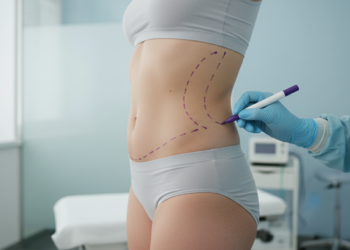
The most common budgeting mistake with a tummy tuck is treating the surgeon’s fee as the price. The American Society of Plastic Surgeons puts that fee at about $8,000 to $13,500 for 2024, but once anesthesia, the operating room, garments and medication are added, a full tummy tuck usually lands around $9,000 to $16,000 in cost data published in late 2026, the latest available as you budget for 2027, and above $20,000 with top surgeons in expensive metros. Then there is the cost no quote lists: two to six weeks when you cannot work normally.

So the real number has three parts: the operation you need, every line on the surgical quote, and the income or paid leave your recovery uses up. Price all three before you pay a deposit.
Comparing this with other procedures? Our free medical and dental cost estimator gives a quick ballpark for your area.
Mini, full or extended: three different operations
The type of tummy tuck is set by your anatomy, not your budget. A surgeon decides it at the exam based on how much loose skin you have, where it sits, and whether the abdominal muscles have separated (diastasis recti) after pregnancy or weight loss.
| Type | What it treats | Typical all-in cost, 2026 | Usual recovery before desk work |
|---|---|---|---|
| Mini | Loose skin below the belly button only; shorter scar; belly button usually untouched | About $4,000 to $8,000; patient-reported averages run higher, near $10,000 | About 1 to 2 weeks |
| Full (standard) | Skin above and below the navel, muscle repair, belly button repositioned | About $9,000 to $16,000; $20,000+ in premium markets | About 2 weeks |
| Extended | Full tummy tuck plus excess skin on the hips and flanks; longer scar | About $10,000 to $20,000+ | 2 to 3 weeks or longer |
| Full with liposuction | Adds contouring of the flanks or waist | About $11,000 to $19,000 | About 2 weeks or longer |
| Circumferential (lower body lift) | Skin all the way around the torso, common after major weight loss | About $15,000 to $25,000+ | Several weeks |
The mini looks like the bargain, but it only fixes the lower belly. Many people who ask for one are told they need a full procedure because their muscles are separated or there is loose skin above the navel. A mini on the wrong candidate can leave a bulge above the scar, and a revision costs more than doing the full version once. Patient-review data also shows the gap between the two can shrink to a few hundred dollars at the same practice, since anesthesia and facility time are similar.
Unbundling the surgical quote, line by line
National averages mostly track the surgeon’s fee. The Aesthetic Society notes its own average excludes anesthesia, tests, prescriptions and garments. A real quote should show every one of these:
| Line item | Typical 2026 range | What moves it |
|---|---|---|
| Surgeon’s fee | $8,000 to $13,500 (ASPS 2024 average range) | Experience, city, extent of muscle repair and skin removal |
| Anesthesia | $1,000 to $2,500 | Hours under general anesthesia; anesthesiologist vs nurse anesthetist |
| Facility or operating room | $800 to $2,500 | Office suite or surgery center vs hospital; overnight stay |
| Compression garments | $50 to $200 | Second garment for washing; staged sizes |
| Prescriptions | $50 to $150 | Pain medication, antibiotics, anti-nausea and blood-clot prevention |
| Pre-op labs and medical clearance | Varies | Age and health history; may go through your own doctor |
| Drain supplies, follow-up visits, scar care | Often included; ask | Some practices bill post-op care or scar products separately |
Self-pay patients whose quote covered only the surgeon and facility report surprise charges of roughly $500 to $1,500 afterward. Ask for an “all-inclusive” written quote and check which of the lines above are in it. Location matters too: published regional data puts typical totals around $6,600 in Mississippi and over $18,000 in San Francisco, and prices can vary two- to three-fold inside a single metro area.
The weeks off work belong in your budget
University of Utah Health tells patients they may return to a desk job and drive in about two weeks, once they are off prescription pain medication and cleared by the surgeon. Jobs with heavy lifting need four to six weeks, because lifting over 10 pounds is off-limits for that long. Strenuous exercise usually waits until around three months.
| Your work | Typical time away | What usually limits you |
|---|---|---|
| Remote desk job | About 1 to 2 weeks | Pain medication, drains, fatigue |
| Office job with a commute | About 2 weeks | Driving clearance; sitting upright for hours |
| On your feet (retail, nursing, teaching) | About 3 to 4 weeks | Standing hunched forward while the incision heals |
| Lifting or physical labor | About 4 to 6 weeks | The 10-pound lifting limit |
| Parent of a toddler | Plan help for 2+ weeks | You cannot lift the child |
How that time gets paid is where people get caught out:
- FMLA usually won’t protect it. Federal rules (29 CFR 825.113) say conditions treated with plastic surgery are not “serious health conditions” unless you need inpatient hospital care or complications develop. Your job may not be protected for an uncomplicated recovery.
- Short-term disability often excludes it. Many policies exclude elective cosmetic surgery, and denied claims for tummy tuck recoveries have been upheld. Read your policy’s exclusions before booking.
- PTO is the usual answer. Most people use vacation or sick days, or schedule surgery around a holiday or slow season. If you have no paid time left, the lost pay is a direct cost.
- Help at home costs money too. You will need someone with you for at least the first day or two, and longer if you have small children.
Same surgery, two jobs: the full-cost math
Hypothetical example for illustration, built from the ranges above. Not a real quote or invoice. Two patients book the same full tummy tuck with the same surgeon. One works an office job and takes two weeks unpaid. The other works in a warehouse, earns less per week, and needs six weeks before lifting again.
| Cost | Patient A: office job | Patient B: warehouse job |
|---|---|---|
| Surgeon’s fee | $9,500 | $9,500 |
| Anesthesia (about 3 hours) | $1,800 | $1,800 |
| Surgery center | $1,800 | $1,800 |
| Garments and prescriptions | $300 | $300 |
| Pre-op labs (assumed) | $200 | $200 |
| Surgical total | $13,600 | $13,600 |
| Unpaid time off (assumed take-home pay) | 2 weeks × $1,200 = $2,400 | 6 weeks × $900 = $5,400 |
| Real cost of the tummy tuck | $16,000 | $19,000 |
Patient B pays less per week of wages but loses $3,000 more to recovery, which pushes the real cost 40% above the surgical quote. If Patient B could save four weeks of PTO first, or move to light duty for a month, the gap mostly disappears. That planning is often worth more than shopping surgeons for a $1,000 discount.
When insurance pays for part of it
Health insurance, Medicare and Medicaid treat a tummy tuck as cosmetic and generally do not pay. Two related situations are different:
- Panniculectomy. Removing a hanging apron of skin that causes documented rashes, infections or trouble walking can be approved as medically necessary, often after major weight loss. It does not include muscle tightening. Approved patients typically pay about $1,500 to $5,000 after deductibles and coinsurance. Expect insurers to ask for photos and records of failed treatment.
- Hernia repair. A true hernia repaired in the same operation may be billed to insurance for that portion, while the cosmetic portion stays self-pay. Diastasis recti alone is usually treated as cosmetic.
Don’t plan on tax help either. IRS rules generally exclude cosmetic surgery from deductible medical expenses and from HSA or FSA spending, with narrow exceptions for deformities caused by a congenital condition, injury or disfiguring disease. Ask your surgeon’s billing office and your insurer for a written answer before assuming any coverage.
Financing that turns $13,600 into much more
Medical credit cards are the most common way surgery gets financed, and the promotional terms are easy to misread. CareCredit’s deferred-interest offers run 6, 12, 18 or 24 months, and its standard rate is 32.99% APR. If any balance remains when the promo ends, interest is charged on the full original amount, back to the date of surgery.
Example: put the $13,600 surgical total on a 12-month promo and you need about $1,134 a month to clear it. Pay $1,000 a month instead and you still owe $1,600 at month 12, which can trigger roughly $2,500 in back-dated interest. The card’s reduced-rate plans, recently around 17.90% to 19.90% APR over 24 to 48 months, cost more on paper but carry no cliff. A personal loan with a fixed rate is another option for borrowers with good credit. Some surgeons also take a deposit to hold your date; ask whether it is refundable if you are not medically cleared.
Your tummy tuck money timeline, from consult to month three
- Three to six months out: book consults with two or three board-certified plastic surgeons. Ask whether consult fees are credited toward surgery, and get an all-inclusive written quote from each.
- Once you have a quote: read your short-term disability policy, check your PTO balance, and ask HR how an elective procedure is handled.
- Two months out: line up home help for the first week and child care if needed. Pay your deposit only after confirming its refund terms.
- Two to four weeks out: pay the balance (many surgeons want it before surgery), fill prescriptions and buy a spare compression garment.
- Weeks one to six after surgery: keep a cushion for follow-up surprises such as a seroma that needs draining. Ask in advance what the practice charges if a revision is needed.
- Around three months: full activity usually resumes. Scar treatment, if you want it, comes after that.
Prices, recovery and candidacy vary by surgeon, location and your health. A board-certified plastic surgeon who has examined you is the right person to confirm which procedure fits and what it will cost.
More tummy tuck cost questions
Should I wait until I’m done having children?
Most surgeons recommend it. A later pregnancy can stretch the skin and separate the repaired muscles again, which could mean paying for a second procedure.
Is it cheaper to combine a tummy tuck with other surgery?
Often, per procedure. Combining a tummy tuck with liposuction or breast surgery (a mommy makeover) shares one anesthesia and facility booking and one recovery period, though the total bill and operating time are larger. Your surgeon decides whether combining is safe for you.
Will a tummy tuck remove stretch marks?
Only the stretch marks on the skin that is removed, usually those below the belly button. Marks higher on the abdomen may be pulled lower but remain.
How long do tummy tuck results last?
The removed skin and fat do not come back, and the muscle repair is generally long-lasting. Significant weight gain, pregnancy and aging can still change how the abdomen looks over time.
How much weight should I lose before a tummy tuck?
Surgeons generally want you close to a stable goal weight first. A tummy tuck is not a weight-loss operation, and losing a lot of weight afterward can bring back loose skin.
Related cost guides
- Laser hair removal cost, priced to finish
- Lip filler cost, the real yearly bill
- Veneers cost per tooth, per smile and per year
- LASIK cost, the advertised price vs the real one
- Medical and dental cost estimator
More related guides: Gym membership cost: the real price per workout · Liposuction cost: count your zones before the consult
Complete guide: Healthcare Costs in 2027: A Complete Guide to What You’ll Pay
Pricing method: surgeon fee range from the American Society of Plastic Surgeons 2024 average cost statistics; anesthesia, facility, garment, prescription and all-in ranges by procedure type, panniculectomy out-of-pocket and surprise-charge figures from a 2026 published tummy tuck cost breakdown; mini tummy tuck average from RealSelf patient reviews; regional totals from SuperMoney; exclusions note from The Aesthetic Society; recovery timelines from University of Utah Health; FMLA rule from 29 CFR 825.113(d); CareCredit terms from NerdWallet’s review (June 2026). Worked examples are our own hypothetical calculations. This site is not affiliated with any surgeon, lender or brand, and this is not medical, legal or financial advice. Prices were researched in October 2026 for 2027 planning and may change; they vary by provider and location, so confirm with a board-certified plastic surgeon. See our disclaimer.