What will it cost to send this box? Every carrier calculator answers that question the same way, with three inputs: weight, dimensions and distance. At USPS’s regular retail prices, a 1-pound Ground Advantage parcel runs $9.55 to a nearby ZIP code and $12.90 across the country, while a 20-pound box going coast to coast costs $69.40. Most of what lies between those numbers is decided before you reach the counter, by the box you choose and the service you price first.

So start from the package, not the carrier. Find the description below that matches what you are sending, and you will know which label to quote first and roughly what it should cost. If the shipment is part of a household move, the moving cost calculator handles the bigger picture.
The math behind every shipping cost estimator
Knowing how to calculate shipping costs by hand takes about two minutes and protects you from the most expensive surprise in parcel pricing: being billed for air.
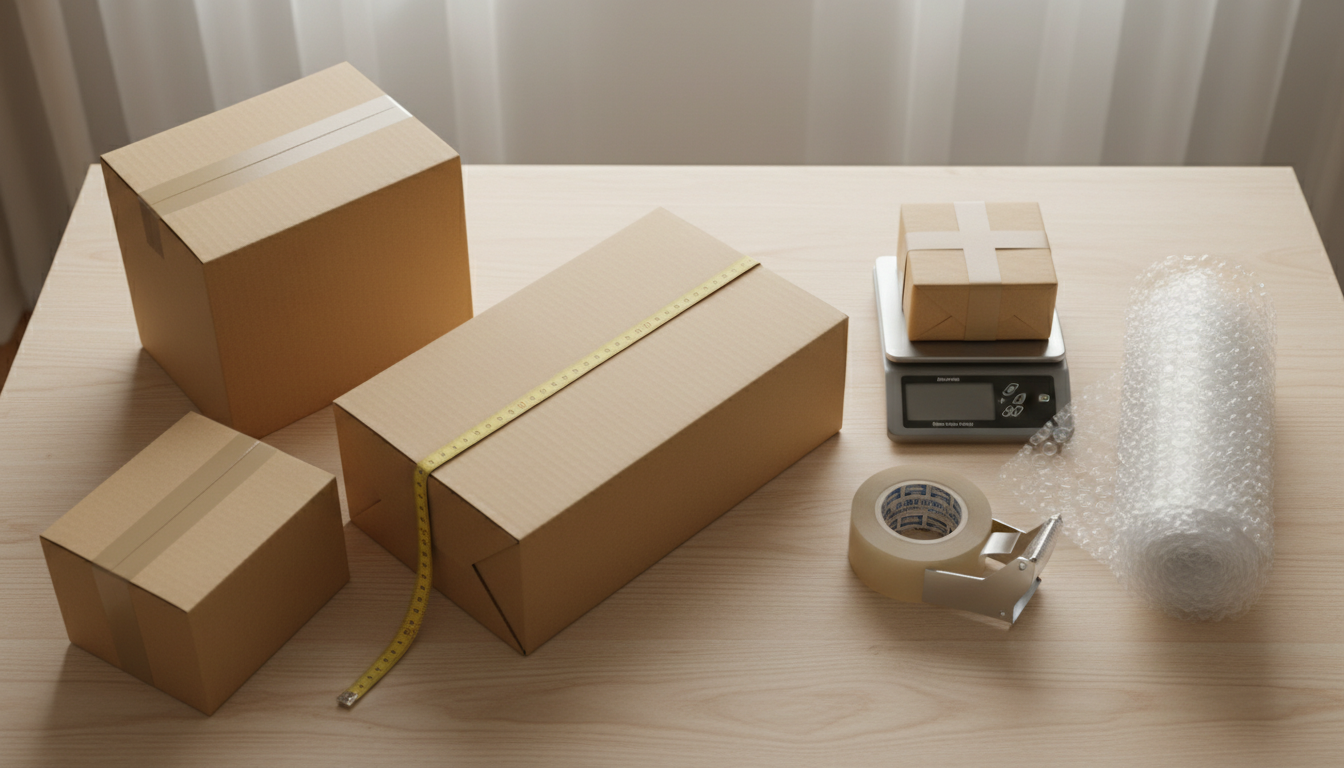
- Weigh the packed box and round up to the next pound. A kitchen scale works for small parcels; a bathroom scale works for big ones if you weigh yourself with and without the box.
- Measure length, width and height in inches, rounding each up. Multiply them for cubic inches.
- Find the dimensional weight. Divide the cubic inches by 139 and round up. USPS adopted the 139 divisor on July 12, 2026, matching what UPS and FedEx use on their daily rates. USPS applies it only to parcels larger than 1 cubic foot (1,728 cubic inches).
- Take the larger of the two weights. That is your billable weight.
- Find the zone. Zones run from 1 (local) to 8 or 9 (across the country or to U.S. territories), based on the first three digits of the origin and destination ZIP codes.
A worked example: an 18-by-14-by-12-inch box holds 3,024 cubic inches. Divided by 139, that is 21.8, so it bills as 22 pounds even if the sweaters inside weigh 6. On USPS retail Ground Advantage to Zone 8, that is the difference between paying from $26.05 (the 5-pound row) and paying more than the $69.40 charged at 20 pounds.
Match your package to the label worth pricing first
Prices below are USPS retail rates from the July 12, 2026 price list (Notice 123), which return on January 18, 2027 once the holiday increase ends. Buying online usually costs less, as the next sections show.
| What you are sending | Price this first | Retail price range |
|---|---|---|
| Under a pound (jewelry, a phone case, a paperback) | USPS Ground Advantage | $7.90 to $9.45 (8 oz, Zones 1 to 8) |
| 1 to 5 pounds, normal box | USPS Ground Advantage, then UPS or FedEx Ground | $9.55 to $26.05 |
| Small but dense, 10 pounds or more | Priority Mail Flat Rate | $24.80 medium, $34.00 large |
| Big box, light contents | Smallest box that fits, then compare all three carriers | Set by dimensional weight |
| 20 pounds and up, long distance | Flat rate if it fits, otherwise UPS or FedEx Ground | $35.15 (Zone 5) to $69.40 (Zone 8) at 20 lb on Ground Advantage |
Light parcels: where Ground Advantage is hard to beat
For anything under about 5 pounds in a modest box, USPS Ground Advantage is usually the cheapest tracked option. Retail starts at $7.90 for a 4- or 8-ounce parcel to Zone 1, and a 1-pound parcel costs $9.95 to Zone 2 and $10.95 to Zone 5. Delivery takes about 2 to 5 business days, and the service includes tracking and up to $100 of insurance.
UPS and FedEx struggle at this weight. The UPS Ground minimum charge on daily rates rises from $11.99 to $12.70 on December 21, 2026, according to TransImpact’s analysis of the new rate guide, and that is before a residential surcharge. Priority Mail, at $11.00 retail for 1 pound to Zone 1, earns its premium only when you need 1 to 3 business days instead of 2 to 5.
Heavy and compact: the flat rate box loophole
Flat rate pricing ignores weight (up to 70 pounds) and distance. That makes it a poor deal for a light shirt and an excellent one for tools, books, cast iron or anything dense going far. A 20-pound box to Zone 8 costs $69.40 on retail Ground Advantage; if it fits in a Large Flat Rate Box, it ships Priority Mail for $34.00 at regular retail prices, about half as much and faster.
The catch is the box. Flat rate applies only to USPS’s own flat rate packaging, which is free at the post office or online. The Medium box is $24.80 retail and the Small box $13.65. Run the comparison both ways: to a nearby zone, Ground Advantage often wins even at 10 pounds ($16.30 to Zone 2, against $24.80 for the Medium box).
Big and light: when the box costs more than the contents weigh
Pillows, lampshades, kids’ toys and anything packed with too much bubble wrap fall into this trap. With USPS now on the same 139 divisor as UPS and FedEx, there is no longer a carrier that quietly forgives oversized boxes, so the fix is in the packing.
- Shrink the box. Cutting 2 inches off each side of that 18x14x12 box (to 16x12x10) drops the dimensional weight from 22 pounds to 14.
- Use a poly mailer for soft goods. Squeezable items that need no box can stay under the 1-cubic-foot line where USPS charges by actual weight.
- Watch the length. USPS Ground Advantage adds $4.50 when a parcel is longer than 22 inches and $10.00 past 30 inches, plus $21.00 when it exceeds 2 cubic feet.
Over 50 pounds or oddly shaped: surcharge territory
Past a certain size, surcharges matter more than the base rate. From December 21, 2026, UPS applies a minimum billable weight of 50 pounds (up from 40) to packages that trigger its Additional Handling charge, and its commercial Large Package Surcharge rises from $254.50 to $290. FedEx’s weight-based Additional Handling charge for Zone 2 goes from $46.00 to $49.50 on January 4, 2027. A couch cushion or a bike box can carry more in surcharges than in postage.
For furniture, appliances or a whole room of belongings, parcel carriers stop being the right tool. Freight, a portable container or a truck rental is usually cheaper per pound; see the moving guides linked at the end.
The post office counter charges a convenience premium
The same package costs less when the label is bought online at commercial prices, which USPS offers through Click-N-Ship and which most shipping software passes along. The gap on USPS’s own published rates:
| USPS service (July 2026 prices) | Retail, at the counter | Commercial, online | You save |
|---|---|---|---|
| Ground Advantage, 1 lb, Zone 1 | $9.55 | $7.61 | $1.94 |
| Ground Advantage, 5 lb, Zone 1 | $12.95 | $9.70 | $3.25 |
| Priority Mail, 1 lb, Zone 1 | $11.00 | $9.04 | $1.96 |
| Medium Flat Rate Box | $24.80 | $21.17 | $3.63 |
| Large Flat Rate Box | $34.00 | $31.00 | $3.00 |
For a household that ships a few gifts a year, that is pocket change. For a small online seller sending 100 parcels a month, $2 to $3 a label adds up to several thousand dollars a year.
What the carriers have already announced for 2027
Your estimated shipping costs for next year depend on which carrier you use and when you ship. Here is what is confirmed as of early November 2026.
USPS: holiday prices end January 17, and a fuel surcharge arrives
USPS’s temporary increases on Priority Mail Express, Priority Mail, Ground Advantage and Parcel Select run through January 17, 2027. During the holiday window, retail Ground Advantage starts at $8.40 and Priority Mail at $11.50. USPS has said it will not raise market-dominant mail prices (stamps and First-Class Mail) in January 2027. Starting in January 2027, it plans a fuel surcharge on domestic Ground Advantage, Priority Mail, Priority Mail Express and Parcel Select, set as a percentage of postage and updated weekly from federal fuel price data. The percentage had not been published as of early November.
UPS: 5.9% average increase on December 21, 2026
UPS daily rates rise an average 5.9% on December 21, 2026, the fourth straight year at that figure. Light Ground packages of 1 to 5 pounds rise a bit more, about 6.1%, and the residential surcharge goes from $6.75 to $7.35. Surcharges overall are climbing faster than base rates.
FedEx: 5.9% average increase on January 4, 2027
FedEx’s standard U.S. package rates rise 5.9% on average on January 4, 2027, according to Supply Chain Dive. Its residential delivery charge goes from $6.95 to $7.35 and its residential delivery area surcharge from $6.60 to $7.00.
The practical upshot: a gift or return mailed in the first half of January may cost a little more at FedEx and UPS than it did in the fall, while USPS’s package prices could dip back to regular rates on January 18 before the fuel surcharge is added on top.
Shipping questions the rate chart leaves out
How do I find my shipping zone?
Zones are based on the distance between the first three digits of the sending and receiving ZIP codes. USPS publishes a zone lookup tool on its Postal Explorer site, and UPS and FedEx show the zone in their online quotes. Zone 1 is local; Zone 8 is roughly coast to coast.
Can I use my own box for flat rate shipping?
No. Flat rate prices apply only to USPS flat rate envelopes and boxes, which are free at post offices and online. If you pack the same items in your own box, the package is priced by weight, size and zone.
Do online shipping calculators include fuel surcharges?
UPS and FedEx quotes generally include their weekly fuel surcharge. USPS has not charged one on packages, but it plans to add a weekly fuel surcharge to Ground Advantage, Priority Mail, Priority Mail Express and Parcel Select starting in January 2027, so check that your quote reflects it once it begins.
Is it cheaper to ship to a business address than a home?
With UPS and FedEx, usually yes, because home deliveries carry a residential surcharge of $7.35 per package on 2027 daily rates. USPS does not charge a residential surcharge, which is one reason it often wins for light packages going to homes.
Is extra shipping insurance worth buying?
USPS Ground Advantage and Priority Mail include up to $100 of insurance, and UPS and FedEx include declared value coverage up to $100. Buy more only when the item is worth more than that, and keep proof of value and photos of how you packed it in case you need to file a claim.
Your next three moves
Weigh and measure at home. Five minutes with a scale and a tape measure tells you whether you are paying for weight or for space, and the 139 rule now applies at all three big carriers.
Price two services, not one. Under 5 pounds, compare Ground Advantage with Priority Mail. Over 10 pounds and going far, check whether it fits a flat rate box before you quote anything else.
Buy the label online. Commercial pricing saves roughly $2 to $4 a package on USPS, and you can still drop the box at the counter.
Other moving and shipping bills worth checking
- Moving cost calculator
- How movers bill you, by the hour or by weight
- PODS container moves and the 30-day clock
- U-Haul per-mile charges, leg by leg
- Shopify plans for small online stores
- Printing costs by quantity
The wider view: The Complete 2027 Guide to Travel and Moving Costs
Pricing method: prices were researched in November 2026 for 2027 planning and may change. USPS prices come from the July 12, 2026 Notice 123 retail and commercial price lists as summarized by Pitney Bowes and Postal Guidance; UPS 2027 changes from TransImpact’s analysis of the UPS rate guide; FedEx 2027 changes from Supply Chain Dive’s reporting on FedEx’s published rate changes. Carrier quotes, fuel surcharges and negotiated rates vary. See our disclaimer.