The cleaning is done, the dentist taps a lower molar on your x-ray, and the question comes before you have even sat up: silver or tooth-colored? Without insurance, Delta Dental’s filling cost guide puts a composite (white) filling on a back tooth at $165 to $530 and a silver amalgam at $110 to $455, depending on how many surfaces are involved. On a single tooth the gap is usually less than $100. The bigger money hides in two places most patients never check: the fine print of their dental plan, and how many years the filling survives before it has to be redone.

Short answer: on a back tooth, silver amalgam is cheaper on day one (a national average of $139 against $226 for composite) and has historically lasted longer, which widens its lead over ten years. White composite is the sensible pick for front teeth, for small cavities, and for the patients the FDA advises to avoid amalgam. If you have insurance, ask if your plan pays for back-tooth composites at the amalgam rate before you choose, because that clause can more than triple your share.
To run your own numbers for a filling, crown or extraction, try our medical and dental cost estimator.
Five filling materials, five price tags
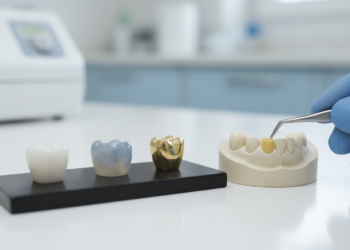
Silver and white are the two choices most patients hear about, but dentists can fill a cavity with three other materials. The averages below come from a 2024 study of national prices published by CareCredit, along with the typical lifespan the same guide gives for each material. They describe what a patient without coverage would pay per tooth.
| Filling material | Average per tooth | Typical range | Typical lifespan |
|---|---|---|---|
| Silver amalgam | $139 | $108 to $256 | 10 to 15 years |
| Composite resin (white) | $226 | $173 to $439 | 5 to 7 years |
| Glass ionomer | $152 | $116 to $285 | About 5 years |
| Gold | $466 | $361 to $817 | 10 to 30 years |
| Porcelain ceramic inlay or onlay | $976 | $755 to $1,774 | Up to 10 years |
Source: CareCredit, How Much Do Dental Fillings Cost? (January 2025), citing a 2024 Synchrony study of national average prices. Lifespans are the guide’s typical figures, not guarantees.
Pearl, which builds its estimates from ADA fee survey data, puts the national average for a cavity filling at $260, inside a typical band of $170 to $450. That figure blends every size of tooth-colored filling, which is why it sits above the single-tooth composite average.
Count the surfaces before you compare quotes
Dentists bill fillings by the number of tooth surfaces the decay reaches, and by whether the tooth is in front or in back. A small pit on the chewing surface of a molar is a one-surface filling. Decay that wraps around the side where two teeth touch can make it two or three. Each surface adds roughly $55 to $60 in the price list Humana publishes from its dental pricing tool for Orlando, Florida:
- Composite, one surface, front tooth: $199
- Composite, one surface, back tooth: $217
- Composite, two surfaces, back tooth: $274
- Composite, three surfaces, back tooth: $333
- Amalgam, two surfaces: $229
Line up the two-surface prices and the white filling costs $45 more in that market. That matches the national pattern: silver is cheaper, but not by a dramatic amount on any single tooth. The Humana list is one city’s prices, so treat it as a guide to the steps between surfaces rather than a quote for your area.

When two offices quote very different prices, ask each for the procedure codes. Dentists use standard CDT codes that spell out material and surface count (amalgam codes start at D2140, posterior composites at D2391), so you can confirm both quotes describe the same work.
The plan clause that turns a $12 filling into a $42 one
Delta Dental says most plans cover 50% to 80% of basic procedures, fillings included. That percentage applies to a price your plan chooses, which is not always the filling you received. Many policies carry what the American Dental Association calls a least expensive alternative treatment clause: when more than one treatment would work, the plan pays only for the cheaper one. The ADA names composite fillings paid at the amalgam rate as the most frequently cited example.
The ADA’s own worked example shows how this lands on a patient with 80% coverage:
| Back-tooth filling | Silver amalgam | White composite, downgraded |
|---|---|---|
| Fee the plan allows | $60 | $90 |
| Plan pays (80% of the amalgam fee) | $48 | $48 |
| Your copay on the amalgam fee | $12 | $12 |
| Difference between the two fees | $0 | $30 |
| You pay | $12 | $42 |
Source: American Dental Association, Least Expensive Alternative Treatment Clause. Fees are the ADA’s illustrative figures, not a national price.
Thirty dollars is not a crisis on one tooth. Across four or five fillings in a bad year, it adds up, and many patients only discover the clause when the bill arrives. The ADA describes the downgrade on back teeth, where amalgam is a workable alternative. Your plan’s benefit summary or a pre-treatment estimate from the office will tell you which rule applies.
Ten years on, which filling has cost less
Price per tooth is only half the comparison. A filling that fails sooner gets drilled out and replaced, often a little larger each time. An Austrian health technology assessment that reviewed the research on amalgam versus composite longevity concluded that amalgam fillings last longer. One longitudinal study in that review found a median survival of 12.8 years for amalgam and 7.8 years for composite.
The evidence is not one-sided. Another study in the same review found composite fillings slightly ahead at ten years, 82.2% still in place against 79.2% for amalgam, and the authors warned that rapidly improving composites and bonding agents would make their conclusions need revisiting. The review dates from 2008, so today’s composites may well close more of the gap. Still, the typical lifespans CareCredit gives, 10 to 15 years for amalgam against 5 to 7 for composite, point the same way.
Here is how that plays out for an uninsured patient over one decade, using the national averages above. This is our estimate, not a quote:
- Silver that lasts the decade: $139, paid once.
- White that lasts the decade: $226, paid once, an $87 premium for the look.
- White that needs redoing once: about $452, more than three times the silver filling, and more if the replacement grows by a surface.

Lifespan depends heavily on where the filling sits and how hard you bite. Composites on heavy chewing surfaces wear faster, while a small composite on a low-stress spot can last for many years. Ask your dentist which situation your tooth is in; that answer matters more than any average.
Who should skip silver regardless of price
Amalgam contains mercury, and in September 2020 the FDA recommended that certain high-risk groups avoid it whenever possible and appropriate. The list includes pregnant women, women planning a pregnancy, nursing mothers, children (especially under six), people with neurological diseases such as multiple sclerosis, Alzheimer’s or Parkinson’s, people with impaired kidney function, and anyone with a known sensitivity to mercury or other amalgam components. The agency names composite resin and glass ionomer as alternatives. For anyone in those groups, the cost comparison above is moot.
Silver is also on a long international countdown. In November 2025, parties to the Minamata Convention on Mercury agreed to 2034 as the global phase-out date after which dental amalgam may no longer be manufactured, imported or exported, according to the FDI World Dental Federation. The decision keeps an exception for cases where a dentist considers amalgam necessary for the patient, and the next conference of the parties is set for June 2027. Nothing announced so far changes what a filling costs in 2027, and amalgam remains available, but expect more offices to stop placing it well before the deadline.
Gold, porcelain and glass ionomer: niche picks with niche math
Gold averages $466 per tooth, more than three times amalgam, yet CareCredit gives it the longest life of any filling at 10 to 30 years. For a patient who wants to fill a heavily used molar once and forget it, that math can hold up. Not every office places gold, so ask before you count on it.
Porcelain inlays and onlays average $976 and are made to fit larger cavities that are too big for a simple filling but may not yet need a full crown. If your dentist suggests one, compare it with the price of a dental crown on the same tooth.
Glass ionomer averages $152 and releases fluoride, but the guide gives it the shortest life, around five years. It is mostly used for small fillings near the gumline, baby teeth and temporary repairs.
Your zip code can move a white filling by $177
Geography matters as much as material. In CareCredit’s state data, the average composite filling ranged from $188 in Oklahoma to $365 in Hawaii, a $177 spread for the same procedure. Delta Dental’s ranges also show back teeth costing more than front teeth for composite, $165 to $530 against $145 to $480, because molars are harder to reach and take more chewing force. If you are uninsured and live near a state line or a cheaper metro area, a second quote can save more than the choice of material.
Our decision rule for a single cavity
Lean toward silver when
- The cavity is on a back molar that takes heavy chewing
- Your plan pays composites at the amalgam rate
- You are paying cash and want the lowest ten-year cost
- You are not in one of the FDA’s high-risk groups
Lean toward white when
- The tooth shows when you smile or talk
- The cavity is small and on a low-stress surface
- You are pregnant, nursing, choosing for a young child or otherwise on the FDA’s list
- Your plan pays composite at its own rate, so the gap is small
If you land in both columns, the tiebreaker is the pre-treatment estimate. Ask the office for your share of each option in writing, then pick the one you can live with for a decade, not just the next appointment. Your dentist knows your bite and your tooth; use these numbers to ask better questions, not to overrule a clinical recommendation.
Filling cost questions patients ask next
Does dental insurance cover a cavity filling in full?
Usually not. Delta Dental says most plans cover 50% to 80% of basic procedures, a category that includes fillings, so you pay the rest plus any deductible. If your plan downgrades back-tooth composites to the amalgam rate, you also pay the difference between the two fees.
Should I replace my old silver fillings with white ones?
The FDA has said it does not recommend removing or replacing amalgam fillings that are in good condition unless it is considered medically necessary, noting that removal can temporarily increase mercury vapor exposure. Replacing sound fillings for looks alone means paying for a new composite filling on each tooth.
Can I still ask for an amalgam filling in 2027?
In most offices, yes. The Minamata Convention’s 2034 phase-out date applies to manufacturing, import and export, and it keeps an exception when a dentist considers amalgam necessary. Some practices have already stopped offering it, so ask when you book.
Why is a filling on a back tooth more expensive than one in front?
Back teeth are harder to reach and take more chewing force, and their cavities often span more surfaces. Delta Dental puts uninsured composite fillings at $165 to $530 for back teeth and $145 to $480 for front teeth.
How much does a cavity filling cost without insurance for several teeth?
Multiply by the number of teeth and surfaces. At CareCredit’s national averages, three composite fillings would be about $678 and three amalgam fillings about $417. Ask the office whether it offers a cash discount or an in-house membership plan before treatment.
Where these filling prices come from
- Tooth fillings cost and insurance: What you need to know, Delta Dental Plans Association (based on 2024 Delta Dental data)
- How Much Do Dental Fillings Cost? Pricing and Procedure Guide, CareCredit (January 10, 2025)
- Cost of common dental procedures, Humana (updated June 2026)
- Cavity Filling: National Cost, Pearl (updated May 2026)
- Least Expensive Alternative Treatment Clause, American Dental Association
- Longevity of dental amalgam in comparison to composite materials, GMS Health Technology Assessment (2008)
- FDA Issues Recommendations for Certain High-Risk Groups Regarding Mercury-Containing Dental Amalgam, U.S. Food and Drug Administration (September 24, 2020)
- COP6 decision on dental amalgam secures an equity-focused, patient-centred approach, FDI World Dental Federation (November 7, 2025)
Other dental bills worth pricing for 2027
- Healthcare costs in 2027: the complete guide to medical, dental and beauty prices
- Root canal cost, from front tooth to molar
- How much a dental crown costs, by material
- Dental cleaning prices without insurance
- What each kind of tooth extraction costs
- Dentures cost over ten years
- Medical and dental cost estimator
Pricing method: prices were researched in November 2026 for 2027 planning and may change. Ten-year comparisons are our estimates built from the published averages cited above, and fees vary by dentist, region and plan, so confirm your costs with your dentist and insurer. This article is general information, not dental advice. See our disclaimer.