
The most common way to misjudge a front yard is to compare installation quotes and stop there. Converting 1,000 square feet of lawn to gravel and drought-tolerant plants costs $5,000 to $20,000, according to HomeAdvisor, while the lawn looks free because it is already in the ground. Paying a crew to keep that grass runs roughly $1,400 to $2,700 a year by our math, before a single gallon of water. Stretch the timeline to ten years and the free option is often the one with the big bill.

For a broader yard makeover that mixes beds, shrubs and some hardscaping, LawnStarter puts professional landscaping at $4.50 to $14.50 per square foot, or $4,500 to $14,500 for the same 1,000 square feet. Which plan wins depends on four numbers you can find for your own house: the install quote, the crew invoice, the summer water bill and any rebate.
Ten years, one 1,000-square-foot front yard, three plans
We priced a typical suburban front yard of 1,000 square feet three ways. Install figures are published ranges; upkeep is our estimate built from the per-visit and hourly rates cited below. Water is left out of every row because it varies too much by city, and we show you how to measure yours further down.
| Plan | To install | Yearly upkeep (our estimate) | Ten-year total, before water |
|---|---|---|---|
| Keep the lawn, hire a crew | $0 (already there) | $1,400 to $2,700 | $14,000 to $27,200 |
| Xeriscape: gravel, drought-tolerant plants, drip line | $5,000 to $20,000 | $400 to $1,200 | $9,000 to $32,000 |
| Artificial turf | $6,000 to $22,000 | Small; no published rate | $6,000 to $22,000 plus upkeep |
Source: xeriscape install range from HomeAdvisor’s xeriscaping cost data; artificial turf at $6 to $22 per square foot from Angi; lawn care rates from LawnStarter. Ten-year totals are our math.
Read the table as overlapping ranges, not a verdict. A modest xeriscape replacing a lawn that a crew services all season pays for itself well inside ten years. A lavish one replacing a lawn you mow yourself on Saturday mornings may never earn its money back in cash.
Where a hired-out lawn spends its money
The lawn number is mostly mowing. LawnStarter’s 2026 lawn care survey prices a mowing visit at $42 to $68. We assume 28 cuts a year, roughly weekly from April through October; lawns in the South and Southwest grow longer and cost more. That alone is $1,176 to $1,904 a year.
Every week in season
Mowing at $42 to $68 a visit. Many services fold edging and blowing into the same price, and crews charge by the visit, not the square foot.
Once or twice a year
Fertilization at $67 to $405, weed control at $50 to $210 and core aeration at $107 to $202, with a national average of $154 for aeration, all per LawnStarter.
Add the low ends and you reach about $1,400 a year; the high ends land near $2,700. LawnStarter’s separate monthly figure, $100 to $410 for ongoing maintenance, lands in the same zone once you multiply it across a seven- or eight-month season.
One detail changes the whole calculation: per-visit pricing. If you rip out the front lawn but keep grass out back, the crew still comes every week and the minimum charge barely moves. The mowing savings only show up when the last patch of turf goes, or when the remaining lawn is small enough for you to cut yourself in fifteen minutes.

The water line no contractor puts on a quote
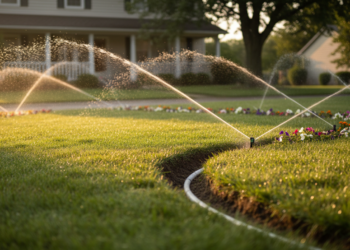
Turf is thirsty. The EPA’s WaterSense program says outdoor use accounts for more than 30 percent of household water on average and as much as 60 percent in arid regions. It also estimates that up to half of outdoor water is lost to wind, evaporation and runoff from inefficient sprinklers, and that a poorly maintained automatic system can waste up to 25,000 gallons a year.
Rates differ so much between utilities that a national dollar figure would mislead you. Your own bills, however, make a serviceable landscaping cost calculator for the water piece:
- Pull your three lowest winter water bills. With sprinklers off, that average is your indoor baseline.
- Pull your summer bills from the same year and subtract the baseline from each.
- Add up the differences. That is roughly what the yard drinks each year, and most of it is the lawn.
- If your utility uses tiered rates, note which tier the summer bills hit. Lawn water is often billed at the most expensive tier.
Drought-tolerant plantings on drip irrigation still need water, especially in the first year or two while roots establish. Count on most of the summer difference shrinking rather than vanishing.
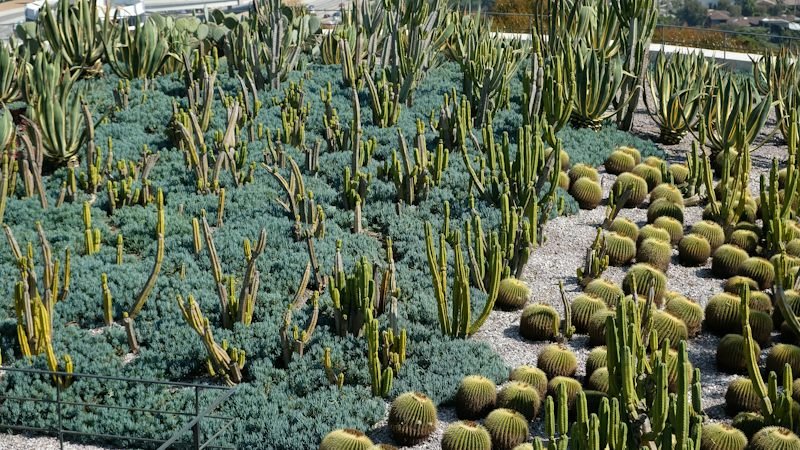
What $5,000 to $20,000 of xeriscaping pays for
HomeAdvisor and Angi both put xeriscaping at $5 to $20 per square foot, with a national average of $17,000 and most projects between $5,000 and $24,000. Angi’s breakdown of the line items shows why the spread is so wide:
- Design: $500 to $8,000 for plans and consultations. A simple gravel-and-shrub front yard rarely needs the top of that range.
- Removing the lawn and digging: excavation runs $1,600 to $6,700, plus $200 to $500 to haul debris.
- Low-flow irrigation: $1,800 to $2,500 for drip. Ask whether a quote includes it, because it can be priced separately.
- Plants: flowers at $3 to $20, shrubs at $25 to $50, trees at $100 to $300 each.
- Ground cover: pea gravel at $25 to $80 per cubic yard, mulch at $35 to $170, and decorative boulders and stone from $250 to $2,500.
Style matters less than square footage and site work. Angi lists desert-style designs at $8,000 to $18,500 and modern ones at $8,500 to $15,000. A flat yard with sandy soil sits at the low end; a sloped one that needs regrading, which HomeAdvisor prices at $1,000 to $3,300, moves up fast.
Low maintenance still means some maintenance
The most frequent complaint from people who converted to rock is weeds. Seeds blow into gravel, find the dust between stones and sprout, and weed-barrier fabric slows them down without stopping them. Plants also need pruning, mulch thins out, and drip emitters clog.
Angi puts a professional at $50 to $100 an hour for xeriscape upkeep and drip repairs at $100 to $500. We budget 8 to 12 hours of weeding and pruning a year, which is how we got $400 to $1,200 in the table. Do it yourself with a hoe and a free afternoon each month and the cash cost drops close to zero, which is the real appeal of low maintenance front yard landscaping: the work becomes optional instead of weekly.
Artificial turf: the priciest way to stop mowing
Synthetic grass keeps the green look without water or a mower, and at $6 to $22 per square foot it costs about the same to install as a mid-range xeriscape. The catch is what it does not do. It does not cool the ground the way plants do, it gets hot underfoot in full sun, and some cities that pay rebates for removing lawn will not pay for replacing it with plastic. Check before you count on a rebate.
Rebates, and Southern Nevada’s January 2027 grass deadline
A Nevada law passed in 2021 bans irrigating nonfunctional, decorative grass with Colorado River water starting Jan. 1, 2027, on properties not zoned exclusively for single-family homes. The Southern Nevada Water Authority confirms that single-family yards are exempt, so homeowners are not forced to remove their front lawns. HOA common areas, apartment complexes and businesses are covered.
Enforcement is getting teeth. The Las Vegas Valley Water District has proposed fines that double with each violation, reaching $5,120 for the largest meters, with a public hearing set for Dec. 1, 2026, FOX5 Las Vegas reported. Homeowners in affected HOAs may see the cost of converting common areas show up in association budgets.
For covered properties, the Las Vegas Review-Journal reports that SNWA pays $2 per square foot for the first 10,000 square feet of grass replaced with drip-irrigated plants and $1 per square foot after that. At the $2 rate, a 1,000-square-foot conversion would earn $2,000. SNWA also offers single-family owners a cash incentive but does not post that amount on its rules page, so confirm the current residential rate with the agency before you budget around it. Outside Nevada, many water utilities in the West run their own turf-removal rebates, and they can cut years off the payback.
The break-even test for your own yard
Everything above boils down to one division. Run it with your own quote, your crew’s invoice and your summer water bills:
Years to pay back = (installation quote − any rebate) ÷ (what the lawn costs you each year, water included − what the new yard will cost each year). Under 7 years, convert. Between 7 and 12, decide on time, looks and water rules. Over 12, keep the grass and fix the sprinklers.
Here is the test with middle-of-the-road numbers, as an example: a $12,000 xeriscape against a lawn that costs $2,000 a year to maintain and a new yard costing $800 a year takes 10 years to break even on upkeep alone. Add $300 a year in summer water savings and it drops to about 8. Someone who mows their own lawn and spends perhaps a few hundred dollars a year on it may never break even in cash, and should judge the project on time, water and curb appeal instead.
Front yard questions readers ask next
How much does a garden designer charge for a front yard?
LawnStarter puts landscaping design at $1,390 to $6,850, while HomeAdvisor’s range for xeriscape planning runs from $500 for a simple consultation to $14,000 for a full custom plan. Many installers fold a basic design into the job if you hire them to build it.
Is there a quick landscaping cost calculator by yard size?
LawnStarter’s all-in professional ranges work as one: about $900 to $2,900 for 200 square feet, $2,250 to $7,250 for 500 square feet and $9,000 to $29,000 for 2,000 square feet. Multiply your area by $4.50 to $14.50 per square foot for anything in between.
What is the cheapest low maintenance front yard landscaping?
Mulched beds with a few tough shrubs usually cost least. Angi lists shrubs at $25 to $50 each and mulch at $35 to $170 per cubic yard, and pea gravel runs $25 to $80 per cubic yard. Doing the planting yourself removes most of the labor.
How much is a yard of mulch delivered and spread?
LawnStarter lists bulk mulch at about $77 to $94 per cubic yard, while professional installation including delivery and labor runs $192 to $402 per cubic yard.
Is sod cheaper than xeriscaping?
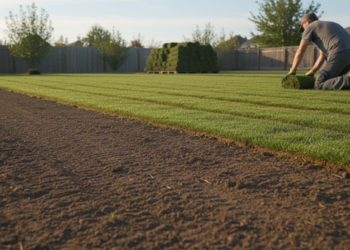
Up front, yes. LawnStarter puts sodding at $0.60 to $1.65 per square foot against $5 to $20 per square foot for xeriscaping. A new lawn then needs the same mowing, feeding and watering as the old one, so the gap narrows each year.
Where the yard numbers come from
- How Much Does Landscaping Cost in 2026?, LawnStarter (updated October 5, 2026)
- How Much Does Lawn Care Cost in 2026?, LawnStarter (updated October 5, 2026)
- How Much Does Xeriscaping Cost in 2026?, HomeAdvisor (2026)
- Xeriscaping cost guide, Angi (2026)
- Statistics and Facts, U.S. EPA WaterSense (updated March 11, 2026)
- Laws and ordinances, Southern Nevada Water Authority
- Las Vegas Valley Water District proposes fines, strict rules on non-functional turf, FOX5 Las Vegas (September 30, 2026)
- Deadline for businesses, HOAs to replace decorative grass is approaching, Las Vegas Review-Journal
More yard and outdoor price guides
- What new sod costs, and the soil prep under it
- Sprinkler system installation and upkeep costs
- Retaining wall prices and the mistakes that raise them
- Concrete patio costs from broom finish to stamped
- Tree removal cost by size and site
- Our complete home improvement cost guide
Pricing method: prices were researched in November 2026 for 2027 planning and may change. Ranges come from the sources cited; yearly upkeep, ten-year totals and the payback example are our estimates built from those ranges, and local quotes will differ. See our disclaimer.