Per square foot, a tiny house is one of the most expensive homes you can buy. Rocket Mortgage’s tiny home cost guide puts construction at $300 to $400 a square foot, about double the $150 it cites for a traditional house, because a 200-square-foot box still needs a kitchen, a bathroom, a roof and wiring. The total check is smaller, of course. Our four example budgets below run from about $19,000 for the leanest DIY trailer build to $121,000 or more for a factory-made model or a finished house on its own acre. Where you land depends less on the house than on where it will sit.

That is the part first-time buyers tend to get backward. They shop floor plans first and learn later that the lot, the hookups and the loan shape the budget. So instead of one national average, we priced four buyers from first dollar to move-in. If you are weighing something larger, our house and barndominium cost calculator handles full-size homes, ADUs and additions.
Four buyers, four very different checks
The line items come from HomeGuide’s tiny house cost breakdown, which prices everything from trailers to sewer lines. The totals are our estimates, built by adding those published ranges, not quotes from any builder.
| Buyer | What the money buys | Upfront, our estimate | Recurring costs |
|---|---|---|---|
| 1. DIY on a trailer | Trailer, materials, appliances; parked at an RV park | $19,000 to $69,800 | Lot rent $250 to $1,500 a month, insurance $35 to $125 a month |
| 2. Factory-built on wheels | Finished house from a builder, delivered | From $120,959, plus a tow vehicle if you move it yourself | Lot rent, insurance, loan payment |
| 3. Foundation on rural land | One acre, site work, finished house, utilities, permits | $46,200 to $121,400 | Insurance, property tax, maintenance |
| 4. Backyard cottage | Finished prefab behind a home you already own | $30,850 to $102,300 | Added to existing household bills |
Source: line-item ranges from HomeGuide, with materials from Angi, appliances from Rocket Mortgage and permits for the backyard build from Angi. Buyer two’s price is Tumbleweed’s published starting price for its Cypress model.
Buyer one: the weekend builder with a trailer and a lot lease
The cheapest way into a tiny house is to build it yourself on wheels. HomeGuide prices a bare trailer at $4,500 to $11,000. Angi’s tiny home price guide puts materials alone at $14,100 to $54,800, and Rocket Mortgage lists appliances at $400 to $4,000. Because a house on a trailer is usually treated more like a vehicle than a building, Bob Vila’s cost guide notes that it generally needs no building permit.
- Trailer: $8,000
- Lumber, windows, roofing, wiring, plumbing and finishes: $30,000
- Apartment-size appliances: $3,000
- Example total: about $41,000, before tools and before anywhere to park it
The savings are real, and so is the trade. Angi says professional labor runs 30% to 60% of a finished tiny home’s cost, which is the money you keep by doing the work, and you pay it back in months of evenings and weekends. Then the house needs a home. HomeGuide says RV park and campground lots rent for $250 to $1,500 a month, depending on which utilities are included, and insurance adds roughly $35 to $125 a month. At a middling $700 lot, a year of parking costs $8,400, about a fifth of the build budget, every single year.
Buyer two: buying a finished house on wheels from a factory
Hiring a builder swaps your weekends for a much bigger check. Tumbleweed’s Cypress model page lists a starting price of $120,959 for a house sold in 26- and 30-foot lengths, with 215 to 249 square feet on the main floor plus a sleeping loft. The 26-footer has a dry weight of about 12,800 pounds and calls for a one-ton tow vehicle, which most buyers do not have in the driveway. Tumbleweed is advertising free delivery on new 26- and 30-foot builds ordered by November 30, 2026. After that, HomeGuide prices professional moves at $200 to $1,500 for up to 250 miles and $1,000 to $5,000 beyond that.
Financing is where this buyer feels the price. HomeGuide says specialized tiny home lenders typically want at least 20% down, which on the Cypress base price is $24,192 before options, sales tax or a truck. Houses certified to RV standards may qualify for RV loans, so ask any builder in writing which certification its homes carry before you compare monthly payments.
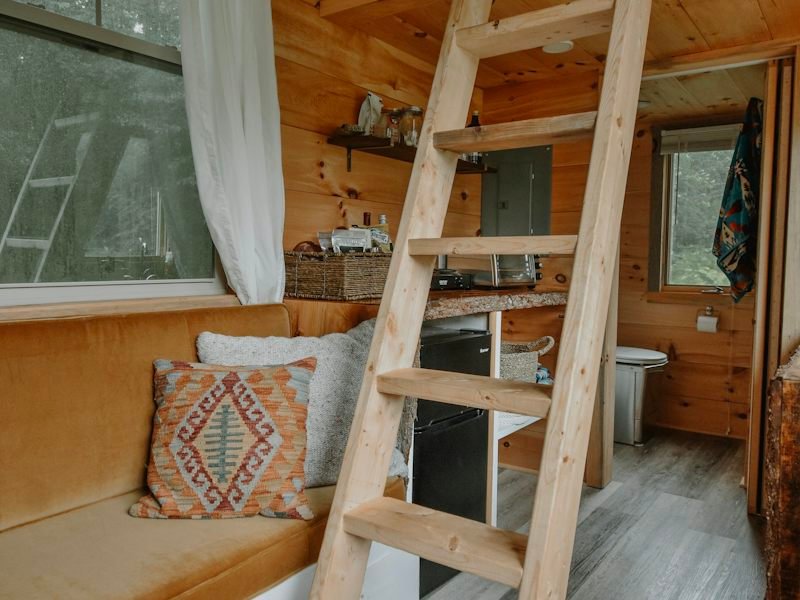
Lofts are also where square footage gets slippery. A spec sheet that reads “215 plus 76 in loft” is selling you a sleeping platform reached by a ladder or steep stair, and appraisers, insurers and local codes do not always count that space the way a brochure does. Compare houses on main-floor area first.
Buyer three: a foundation, an acre and a septic permit
A tiny house on a permanent foundation is a building, which means land, permits and a property tax bill. HomeGuide prices a finished foundation home at $33,000 to $78,000 excluding land, and the dirt work is where rural budgets drift:
- Land: $5,000 to $18,000 an acre
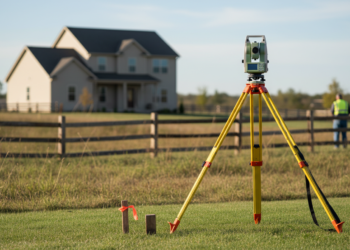
- Boundary survey: $200 to $1,200 (our land survey cost guide explains which survey you need)
- Clearing, excavation and grading on one acre: $3,000 to $10,200
- Finished house on a foundation: $33,000 to $78,000
- Water, sewer or septic, and power hookups: $4,000 to $12,000
- Permits: $1,000 to $2,000
Added up, that is roughly $46,200 to $121,400. A middle-of-the-road version, with a $10,000 acre, $4,000 of site prep, a $60,000 house, $10,000 in hookups, a $700 survey and $1,500 in permits, comes to about $86,200 by our math.
Utilities are the line to watch. Where no sewer main reaches the lot, HomeGuide prices a septic system alone at $3,500 to $8,500, and new rural power lines at $2,000 to $5,000 or more. Bob Vila’s sewer hookup range of $500 to $20,000 shows how much the distance to the nearest line matters.
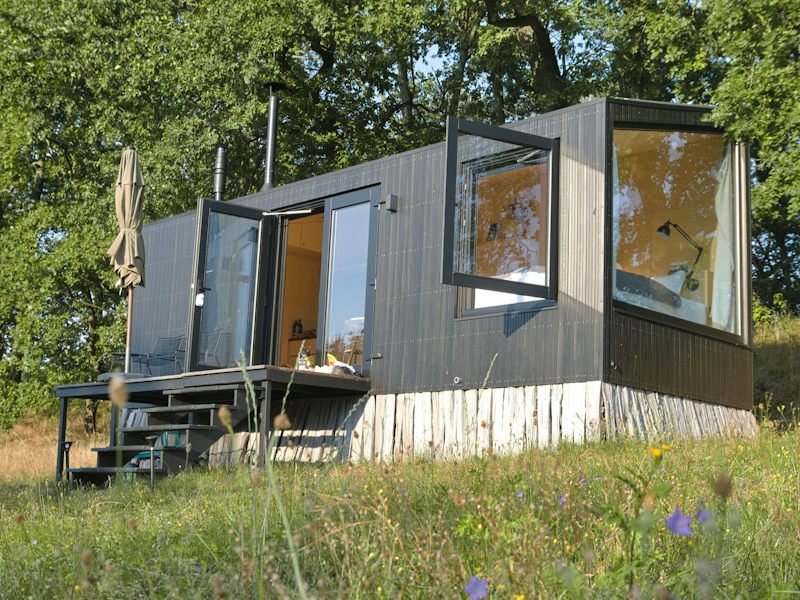
Read the parcel’s zoning before you read the listing price. Bob Vila points out that some localities enforce minimum square footage for homes, so a 250-square-foot house can be easy to build on a lot and still be illegal to live in full time.
Buyer four: the backyard cottage behind a house you already own
For a homeowner with a decent yard, the cheapest permanent tiny house may be the one built behind the main house. The land is paid for, and water, sewer and power are already on the property, a trench away. HomeGuide prices a fully finished prefab at $25,000 to $80,000.
- Finished prefab: $25,000 to $80,000
- Delivery within 250 miles: $200 to $1,500
- Foundation: $3,000 to $8,000
- Sewer line, 50 feet at $40 to $180 a foot: $2,000 to $9,000
- Electric connection: $250 to $1,500
- Permits: $400 to $2,300, per Angi
That totals about $30,850 to $102,300. A $55,000 prefab with average site work lands near $67,600 in our example. Most cities treat a backyard tiny house as an accessory dwelling unit, so expect setback, height and sometimes owner-occupancy rules, and confirm that renting it out is allowed before you count on rent to cover the payment. Rocket Mortgage says it does not offer tiny home financing and points current homeowners toward a cash-out refinance or a personal loan, which are the realistic routes for this buyer.
Why most banks pass, and who lends instead
Rocket Mortgage says most tiny homes don’t qualify for a traditional mortgage, and HomeGuide adds that most aren’t eligible for an FHA loan either. A house on wheels isn’t real estate, and a 300-square-foot house on land is hard to appraise against neighboring homes. The money comes from elsewhere:
- RV loans for houses on wheels that carry RV certification.
- Manufactured or mobile home loans for some foundation homes; our mobile home prices guide compares those loan types.
- Builder-arranged financing, which Bob Vila says some tiny house manufacturers offer through partner lenders.
- Personal loans, usually unsecured, with rates set by your credit and income.
- Land loans for the acre, which Rocket says typically need a larger down payment and carry higher rates than a mortgage.
The building code, the zoning map and a 2027 law change
The model residential code most American towns build from has an appendix for tiny houses, meaning dwellings of 400 square feet or less, with rules aimed at lofts and the steep stairs or ladders that reach them. The International Code Council’s explainer stresses that each jurisdiction still has to vote to adopt an appendix, and the 2018 version did not address houses built on trailer chassis at all. The same house can be a legal home in one county and, in the next, a recreational vehicle you are not allowed to live in year-round.
One federal change is real. Florida Realtors reports that the 21st Century ROAD to Housing Act became law on July 11, 2026, and it updates the federal definition of manufactured housing to include homes that are not built on a permanent steel chassis. HUD still has to revise its regulations, and states with their own chassis rules have to change them, so chassisless factory homes will not appear at dealers overnight. For anyone weighing a tiny house against a small HUD-code home in 2027, it is the policy to watch.
A federal law does not automatically change a local zoning ordinance.
Manufactured Housing Institute, July 2026
Three calls to make before you spend a dollar
- Your city or county planning office. Ask whether a dwelling under 400 square feet can be occupied full time on the parcel you want, whether it must sit on a foundation, and whether the local code includes the tiny house appendix.
- A lender and an insurer, the same week. Get written answers on whether they will finance and cover the specific house, on wheels or on a foundation, before you put down a deposit. Coverage typically runs $35 to $125 a month.
- A site contractor or septic installer. If land is involved, a walk-the-lot estimate for clearing, septic and power will move your total more than any upgrade inside the house.
What else tiny house buyers ask
How much does a 2 bedroom tiny house cost?
Two real bedrooms usually push a house past 400 square feet. HomeGuide prices 400 to 600 square foot models at $70,000 to $125,000 prefab and $100,000 to $200,000 or more custom. At that size many codes no longer treat it as a tiny house, which can make zoning and financing easier.
How long does it take to build a tiny house?
Angi estimates about 120 hours for a professional builder and at least 480 hours for a DIY builder. HomeGuide puts a DIY build at 500 to 1,000 hours, or six to 12 months of part-time work.
Do you pay property tax on a tiny house?
It depends on how it is built. Bob Vila notes that a tiny house on a trailer is generally personal property and may avoid real estate tax, while one on a foundation is taxed like a conventional home. Some states tax or register trailers separately, so check with your county assessor.
How much does tiny house maintenance cost each year?
Rocket Mortgage lists maintenance and repairs at $550 to $1,000 a year. Houses on wheels add trailer upkeep such as tires and brakes if they are moved.
Do tiny houses hold their value?
Not reliably. Rocket Mortgage cautions that resale value is not guaranteed, and a house on wheels tends to be valued more like an RV than a home. A tiny house on owned land in a place that permits it has the best chance of keeping its value.
Who supplied these numbers
- How much does a tiny house cost?, HomeGuide
- How much does a tiny home cost?, Rocket Mortgage (updated December 23, 2025)
- Tiny home cost guide, Angi
- How Much Does a Tiny House Cost?, Bob Vila (updated 2023)
- Cypress, Tumbleweed Houses (accessed November 2026)
- The International Residential Code has a big vision for tiny houses, International Code Council (2018)
- New federal housing law expands options in Florida, Florida Realtors (August 14, 2026)
- New MHI Resource Shows How the 21st Century ROAD to Housing Act Can Expand Manufactured Housing Opportunities, Manufactured Housing Institute (July 30, 2026)
Nearby reading on small homes, land and lots
- Insurance, real estate and legal costs in 2027: the complete guide
- Mobile home prices by size, lot and loan type
- What it costs to move a mobile home
- Land survey costs and which survey you need
- Home addition costs, from sketch to final bill
- Camper insurance costs compared with an auto policy
- House and barndominium cost calculator
Pricing method: prices were researched in November 2026 for 2027 planning and may change. Example budgets are our estimates built from the published ranges cited above, not quotes; local land, permit and utility costs vary widely. Confirm zoning, financing and insurance with your local planning office and licensed professionals. See our disclaimer.