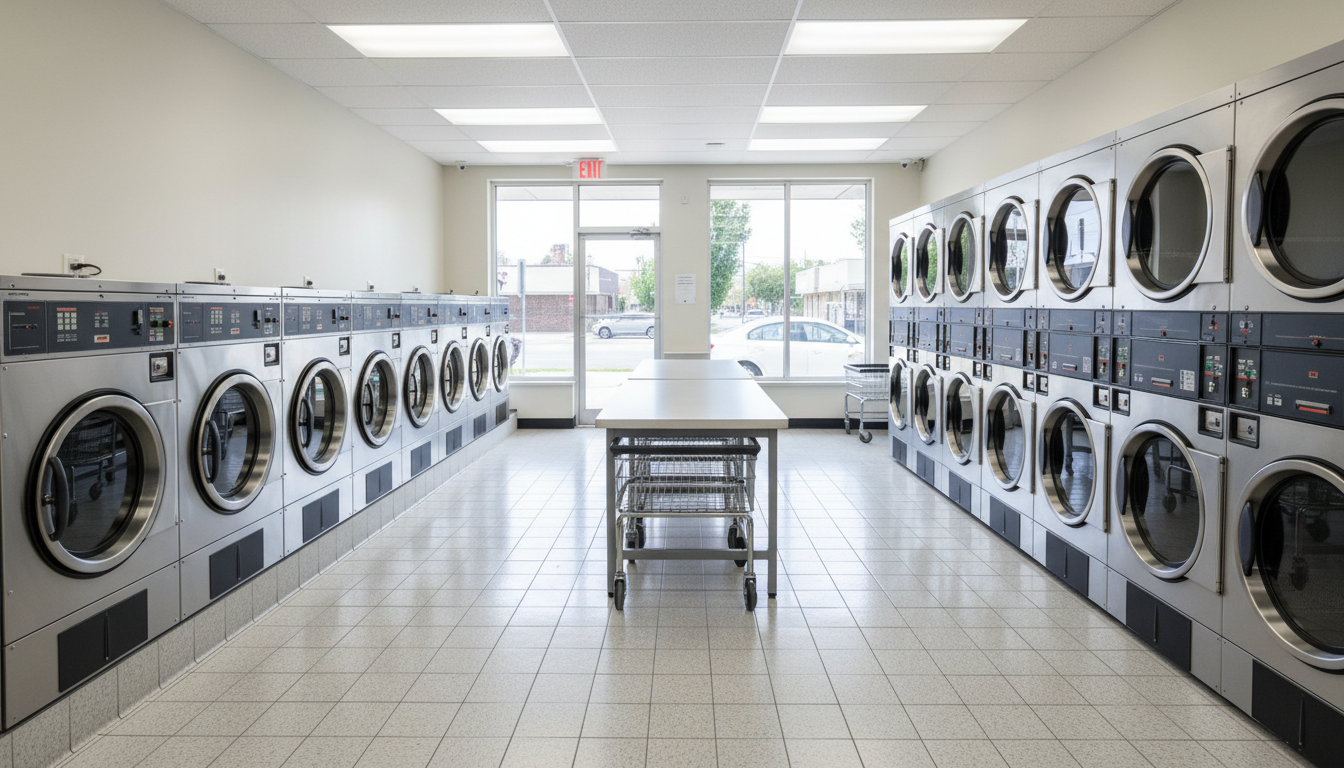
An existing laundromat sold for a median of about $250,000 across 855 recorded sales from 2021 to 2025, and building a new one usually runs $400,000 to $1 million or more before the first customer walks in. The variable that decides whether either price is fair is not the square footage or the paint. It is how many times a day each washer actually runs.

Laundry is one of the few businesses you can price machine by machine. A washer costs a known amount, it charges a posted price per load, and the store’s water meter records how often it fills. So this guide prices a laundromat the way experienced buyers do: what each pocket costs to buy or install, what it earns, and how to check the seller’s story before a lender does it for you.
Buy or build: the two price tags side by side
| Route | Typical cost | What you get on day one |
|---|---|---|
| Rundown store needing work | $50,000–$100,000 starting cash | Old machines, a lease, some existing customers |
| Typical existing store | $250,000 median sale; $300,000 median asking (2025) | Equipment, customers, utility and sales history |
| Larger or newer existing store | $500,000–$1 million+ | High volume, newer equipment, long lease |
| New build in leased space | $400,000–$1,000,000 (about $200–$300 per sq ft) | New machines and no customers yet |
| Retool of an existing store | $150,000–$250,000 small; $250,000–$400,000 midsize; $400,000–$700,000+ large | New equipment in a store that already has traffic |
Buyers paid about 90% to 93% of asking price in that sales data, so the listing number is closer to the real number than in many small-business deals. The catch is that the listing number is built on the seller’s revenue claim, and in a cash business that claim needs checking.
What a single washer or dryer costs to put on the floor
Commercial machines are priced by capacity. Small top-loaders and 20-pound front-loaders are cheap; the big 60- and 80-pound washers that comforter and family customers love cost as much as a used car.
| Machine | Price per unit |
|---|---|
| Commercial top-load washer | $1,000–$3,000 |
| 20–25 lb front-load washer | $1,500–$3,800 (a GSA-listed 20 lb softmount runs about $3,775) |
| 30–50 lb front-load washer | $3,000–$7,000 |
| 60 lb and larger washer | $11,600–$21,700+ |
| Large single dryer (50–75 lb) | $3,000–$6,000 |
| Installation, per machine | $1,000–$5,000 depending on plumbing, gas and venting |
The machines are only part of a new store. A full build also pays for water heaters ($5,000 to $50,000), an electrical panel upgrade ($2,000 to $30,000), utility connections, folding tables, seating and a payment system. A card or app-based payment setup alone has been quoted at $40,000 to $80,000 for a full store. Most stores run 60% to 70% washers and 30% to 40% dryers.
The turns-per-day math that sets a store’s value
A “turn” is one paid cycle. Operators commonly aim for about three turns per washer per day. Pair that with real vend prices and you can see what one machine brings in. In American Coin-Op’s most recent state industry survey, the most common prices were $3.00 for a top-loader, $3.50 for a 20 lb front-loader, $6.00 for a 40 lb and $8.00 for a 60 lb.
| 40 lb washer at $6.00 a load | Gross per day | Gross per year |
|---|---|---|
| Slow store: 1.5 turns a day | $9.00 | $3,285 |
| Healthy store: 3 turns a day | $18.00 | $6,570 |
| Busy store: 4 turns a day | $24.00 | $8,760 |
At three turns, a $5,000 washer grosses its own price in under a year. At 1.5 turns, it takes about 18 months of gross revenue just to cover the machine, before water, gas and rent. That gap is why two stores with the same 36 washers can sell for $150,000 and $450,000. You are not buying machines; you are buying turns.
How brokers turn cash flow into an asking price
- Seller’s discretionary earnings (SDE): median about 3.5 times, with most sales between 2.7x and 4.5x. Stores grossing over $350,000 can top 4x; stores under $150,000 often trade near 2.7x.
- Gross revenue: a median near 1.2 times annual sales.
- Weeks of gross: an equipment lender’s shorthand puts an average store near 70 weeks of revenue, older low-volume stores at 50 to 60, and high-volume stores up to 90.
- The lease and machine age move the multiple. Alliance Laundry’s valuation guide puts the most value on stores with 15+ years of assignable lease (base plus options) and equipment five years old or newer. Equipment past 15 years and a short or non-transferable lease drag a price to the bottom of the range.
Commercial washers and dryers generally last 10 to 15 years. If the store’s machines are 12 years old, part of what you pay for is a replacement bill that is coming soon, and the multiple should reflect it.
One 2,500-square-foot store, bought vs built
Hypothetical example for illustration only. Revenue, earnings and machine counts are assumptions chosen to sit near published medians; they are not a real listing or quote.
| Line | Buy the running store | Build new next door |
|---|---|---|
| Washers / dryer pockets | 36 / 28 | 36 / 28 |
| Annual gross | $260,000 (documented) | $0 on opening day |
| Seller’s discretionary earnings | $85,000 | None yet |
| Price | $297,500 (3.5x SDE) | $625,000 (about $250 per sq ft) |
| Cost per washer | About $8,260 | About $17,360 |
The new store costs more than twice as much per washer and starts with zero turns. It can still be the better bet in a fast-growing area with no nearby competition, or where existing stores are worn out, but the buyer is paying for machines and hoping for customers. The existing-store buyer pays for customers and inherits the machines. In this example, if the older store’s equipment is 13 years old, add a $150,000 to $250,000 retool to its price within a few years and the gap narrows sharply.
The water-bill test before you believe the revenue
Coin-heavy stores rarely have tax returns that match the seller’s verbal numbers. Experienced buyers rebuild revenue from records the seller cannot easily dress up:
- Get two years of water, gas and electric bills, actual copies from the utilities, not a spreadsheet summary.
- Estimate turns from water use. Take gallons used per month, divide by the water each machine uses per cycle (from the manufacturer’s spec sheet), and multiply by the vend price for that size. That gives a revenue range you can compare with the seller’s claim.
- Do supervised coin and card counts for two to six weeks, and check them against meter readings over the same weeks.
- Check the utility ratio. Operators in the American Coin-Op survey averaged 21.6% of gross on utilities, and 20% was the most common answer. A store claiming far more revenue than its utility bills support is the classic red flag.
- Look for seasonal swings. In many regions, revenue runs higher from October through April. One summer month of water bills can make a store look weaker, and one winter month can make it look stronger.
Hire a laundry-experienced accountant or consultant for this step. A professional valuation runs about $2,500 to $8,000 and is cheap next to overpaying by a year of cash flow.
New SBA loan rules that hit laundromat buyers in 2027
Most laundromat purchases are financed with SBA 7(a) loans, and the rules tightened for loans that receive an SBA loan number on or after October 1, 2026 under SOP 50 10 8.1. For a 2027 buyer, three changes matter most:
- 10% down that cannot be reduced on an initial acquisition. Standby seller debt and similar sources can cover no more than half of it.
- Debt coverage of 1.25x, up from 1.15x, measured on historical earnings. The lender may not use your projections to pass the test, so unreported cash revenue does not help you borrow.
- A 10-year amortization cap on the business portion of the loan, with no balloon. Real estate can still run up to 25 years.
Run the example store through it. Borrowing 90% of $297,500 ($267,750) for 10 years at an assumed 10.5% costs about $3,613 a month, or $43,355 a year. Against $85,000 of earnings that is 1.96x coverage, comfortable. But if the lender sets aside $40,000 for you to live on, $45,000 remains, which is only 1.04x. At that owner salary, the price that clears 1.25x is about $247,000, roughly $50,000 below asking. Lenders treat owner pay differently, so ask yours how it will be counted before you make an offer.
No 2027 equipment price lists have been announced. Expect machine and build costs similar to or slightly above late-2026 levels, and confirm current SBA terms with an SBA lender, since rates and rules can change.
Cash to have ready before you call a broker
- Down payment: at least 10% of the price for an SBA deal; 20% to 30% for a conventional loan.
- Valuation and due diligence: about $2,500 to $8,000 for a professional valuation, plus legal and accounting fees.
- Repair and replacement reserve: $20,000 to $30,000 a year is a common planning figure.
- Post-purchase upgrades: $50,000 to $141,000 is a reported range for retooling, infrastructure and cosmetic work, with utility system upgrades alone at $20,000 to $50,000.
- Rent target: rent at or below about 20% to 25% of gross sales, with triple-net costs counted.
The decision rule is simple to state: work out turns per washer from the utility bills, multiply by the posted vend prices, subtract real expenses, and only then apply a multiple. If a store’s price per washer looks cheap but its machines turn once a day, it is not cheap.
Laundromat buyer questions that come up next
Can I buy a laundromat with no money down?
Not with an SBA 7(a) loan for a first acquisition, which requires at least 10% equity. A seller note on full standby can cover up to half of that requirement, so a motivated seller can reduce, but not eliminate, the cash you bring. Private seller-financed deals outside SBA programs follow whatever terms you negotiate.
Is a laundromat really a passive business?
It is less hands-on than a restaurant, but not hands-off. Someone has to collect cash, handle repairs, clean, answer customer complaints and watch for vandalism. Owners who hire attendants pay for that time, which lowers the earnings a buyer should count.
Should I convert a coin laundromat to card or app payment?
Card and app systems cut coin handling and make revenue easier to document for lenders and future buyers, but a full-store system has been quoted at $40,000 to $80,000. Many owners make the switch during an equipment retool rather than on its own.
What permits does a laundromat need?
Expect a local business license, a certificate of occupancy, building and plumbing permits for any work, and approval for water and sewer connections. Permits and licensing commonly run $5,000 to $15,000 on a build or major retool. Check with your city or county, because sewer capacity rules vary.
Is wash-and-fold or pickup and delivery worth adding?
Services can raise revenue from the same floor space, but they add labor, insurance and scheduling. A buyer should value service income separately from self-service revenue, since it depends on staff and the current owner’s customer relationships.
Related cost guides
- Vending machine cost: let the location set your budget
- Cost to open a salon: suite, booth rent or commission?
- Cost to open a restaurant: your space sets the budget
- Cost to open a gym: budget by the members you need
- Business insurance cost: what your paperwork requires
- LLC cost: the five-year bill by state
More related guides: Cleaning business startup cost: cheap until you hire · Washer and dryer cost: spend on the washer, not the dryer
Pricing method: sale and asking medians, SDE and revenue multiples, weeks-of-gross rule, due diligence, rent, valuation, reserve and upgrade figures from LegalClarity’s laundromat buying guide (citing BizBuySell and Eastern Funding); build cost per square foot from LendingTree; retool ranges, equipment lifespan, machine mix and turns-per-day benchmark from Cents; per-machine prices from Laundroboost Marketing and The Unity Washer; water heater, panel and payment system ranges from SuperMoney; vend prices and utility ratios from American Coin-Op’s state industry survey; valuation factors from Alliance Laundry; SBA SOP 50 10 8.1 changes as summarized by Accredited and Beancount. The bought-vs-built store and loan math are hypothetical. This is general information, not financial or legal advice; confirm figures with a lender, accountant and attorney. Prices were researched in October 2026 for 2027 planning and may change. See our disclaimer.