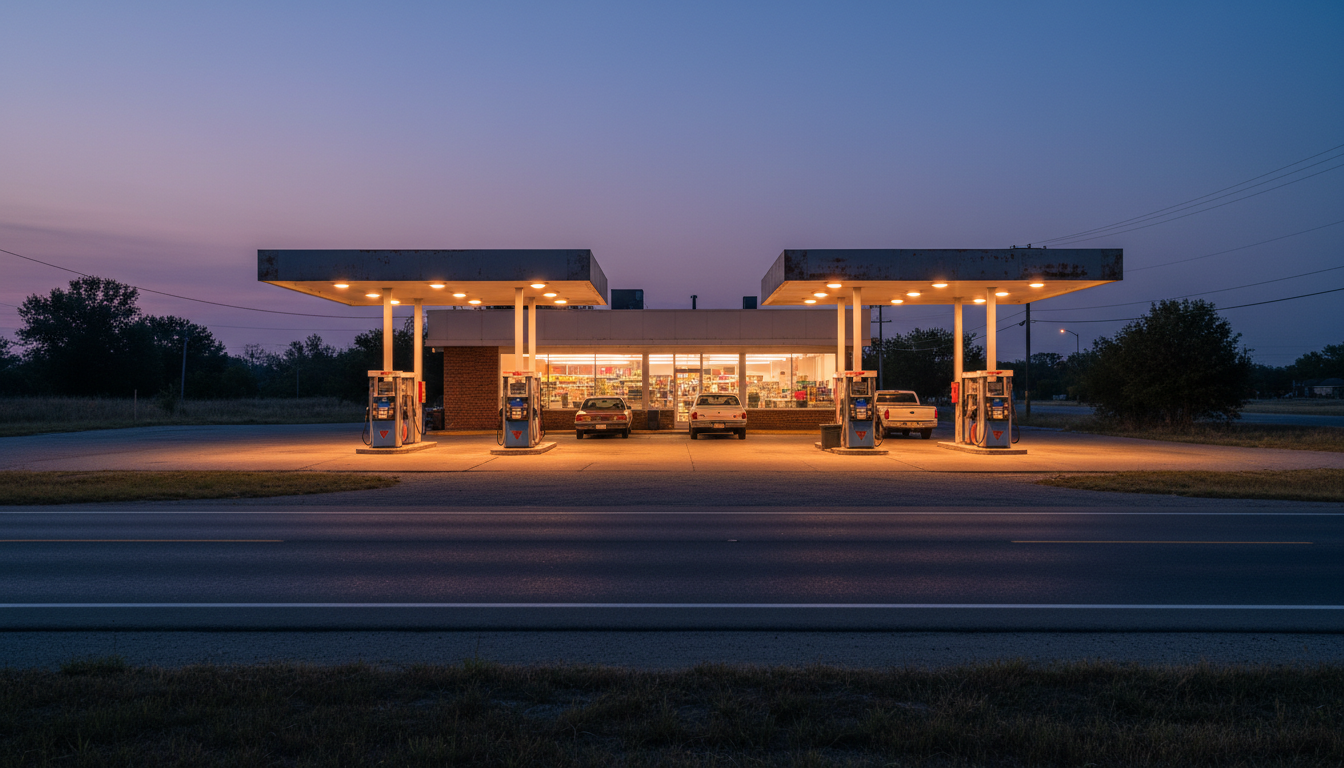
Two gas stations can sit a mile apart on the same highway, pump about the same number of gallons, and list for $450,000 and $2.4 million. Both prices can be fair. Buying a gas station costs roughly $150,000 to $700,000 for the business alone on leased land, $1.2 million to $5 million when the real estate comes with it, and $2.2 million to $5.5 million or more to build a typical new station from the ground up.

The gap between those listings is mostly the dirt and the tanks buried in it. So before comparing asking prices, figure out which of the three deals you are actually looking at, what the station really earns, and how much cash the bank will want from you on closing day.
Three ways to own a gas station, three very different checks
| What you buy | Typical price heading into 2027 | What you own | Who it suits |
|---|---|---|---|
| Business only (leasehold) | $150,000 to $700,000; BizBuySell’s median asking price is about $450,000 | The operation, equipment, goodwill and inventory; you pay rent to a landlord | First-time operators with limited cash |
| Business plus real estate (fee simple) | $1.2 million to $5 million; premium corners $4 million to $8 million | The land, building, canopy, tanks and the business | Buyers who want equity and control over the site |
| New build | $1 million to $2 million for a kiosk; $2.2 million to $2.8 million for a 3,000 sq ft store with four dispensers; $3.5 million to $5.5 million for a large store | Everything, with new tanks and equipment | Experienced operators with a proven site and deep financing |
| Travel center | $4.8 million to $14 million | Fuel, store, often a car wash and quick-service restaurant | Multi-site operators and investors |
A leasehold station is the cheapest door in, but you are buying a cash flow that depends on a lease. Read the remaining term, renewal options, rent escalators and who is responsible for the tanks before you read anything else. A cheap station with four years left on a lease and no renewal right is worth far less than its profit suggests.
How much is a gas station worth? Follow the gross profit
Fuel is the headline, but it is not where most of the money is made. NACS data for 2025 shows fuel brought in 65% of convenience store sales dollars but only 38.8% of gross profit. The store, especially food, carries the rest: foodservice alone produced 38.9% of in-store gross profit.
On the fuel side, gross margins averaged roughly 35 to 40 cents a gallon in 2025, a historically strong year (before 2020 they ran closer to 22 to 24 cents). After card fees, labor and utilities, analysts estimate only a few cents to the low teens per gallon is left. Careful buyers and lenders underwrite a more ordinary year, often in the high 20s to low 30s of cents per gallon, rather than paying for a record.
Once you know the real earnings, these are the yardsticks brokers and lenders use:
- Leasehold businesses: about 2.5 to 4 times EBITDA in strong markets.
- Fee-simple deals (land included): about 7 to 9 times EBITDA, with 8 times a common midpoint.
- Volume shortcut: every additional 10,000 gallons a month of sustainable volume adds roughly $50,000 to $90,000 to business-only value.
- Revenue multiple: BizBuySell listings show a median of about 0.35 times revenue, which is a weak guide because fuel revenue swings with pump prices.
Verify gallons from fuel supplier invoices, not the seller’s spreadsheet, and match inside sales to tax returns and point-of-sale reports. Cash-heavy stores are where listing profits most often fail to show up on paper.
One station, priced two ways
Example only: a hypothetical station with assumed figures, valued with the multiples above. Not a real listing or appraisal.
Say a suburban station pumps 80,000 gallons a month (close to the industry’s typical legacy site of about a million gallons a year) and earns an assumed 30 cents a gallon gross. Inside, it sells $1.2 million a year at an assumed 33% margin.
| Line | Leasehold version | Fee-simple version |
|---|---|---|
| Fuel gross profit (960,000 gal x $0.30) | $288,000 | $288,000 |
| Inside gross profit ($1.2M x 33%) | $396,000 | $396,000 |
| Operating costs (labor, card fees, utilities, insurance, upkeep), assumed | -$434,000 | -$434,000 |
| Ground rent, assumed | -$70,000 | $0 |
| EBITDA | $180,000 | $250,000 |
| Multiple | 3x | 8x |
| Indicated price | $540,000 | $2,000,000 |
Same pumps, same customers, nearly four times the price. The fee-simple buyer is paying for land, the building and freedom from a landlord. The leasehold buyer pays less but carries lease risk, and $70,000 of rent each year is money that never builds equity. Notice too how thin the margin for error is: if fuel margins slip from 30 to 25 cents, this station loses $48,000 of profit, more than a quarter of the leasehold EBITDA.
The cash you need on closing day
Most gas station purchases are financed with SBA 7(a) loans, which cap at $5 million, and the rules tightened for loans numbered on or after October 1, 2026 under SOP 50 10 8.1. Plan on at least a 10% equity injection. Seller notes and other standby debt can count toward it, but together they cannot exceed half of the minimum. Most change-of-ownership deals now need debt service coverage of at least 1.25 times on the station’s historical cash flow, since projected growth generally can’t cover a shortfall, and a Quality of Earnings report is required at purchase prices of $3 million or more. Owners and guarantors must be US citizens or nationals living in the US. Lenders often ask first-time operators or marginal deals for 15% to 20% down, and non-SBA real estate loans typically need 25% to 40%.
Using the $540,000 leasehold example, here is what a realistic cash budget looks like:
| Cash item | Estimate |
|---|---|
| Equity injection (10% of a $650,000 project including inventory and working capital) | $65,000 |
| Fuel and store inventory, bought at cost at closing (assumed) | Financed in the project above |
| Phase I environmental site assessment | $2,500 to $6,500 |
| Tank and line tightness or leak-detection testing (three tanks) | $9,000 to $24,000 |
| Legal, lease review, licenses and loan closing costs (assumed) | $15,000 to $30,000 |
| Personal reserve for slow months | Three to six months of your living costs |
| Likely cash out of pocket | About $90,000 to $125,000 plus reserves |
For the $2 million fee-simple version, the same math puts the minimum injection near $200,000 to $230,000 before diligence and reserves, and more if the lender asks for 15% or the appraisal comes in low.
Building a gas station from dirt: where the money goes
A ground-up build runs $150 to $350 per square foot for the store and canopy, but the forecourt and the ground underneath it often cost as much as the building. Typical line items:
| Component | Typical cost |
|---|---|
| Underground storage tank (vessel) | $20,000 to $80,000 each; a 13,000-gallon fiberglass tank about $40,000 to $65,000 supplied |
| Tank installation, excavation and piping | $40,000 to $300,000 per tank |
| Multi-product fuel dispenser | $15,000 to $30,000 each, installed |
| Canopy | $75,000 to $300,000 |
| Leak detection, overfill and spill containment | About $5,000 to $15,000 for leak detection, plus $2,000 to $8,000 per tank for overfill and spill gear |
| Permits and professional fees | $20,000 to $200,000 before vertical construction |
For a fully loaded picture, consultancy MMCG budgeted one eight-pump branded station with a 3,024 sq ft store on 5.4 acres at about $6.07 million: $3.17 million in hard costs, $1.14 million in equipment and fixtures, $750,000 for land, $554,000 in soft costs and $460,000 in financing costs. Builds also need volume to justify them. Analysts suggest a new site needs roughly 3.5 to 4 million gallons a year to pencil, several times what an average older station pumps.
The tanks can cost more than the store
Environmental risk is the line item that turns a good gas station deal into a lawsuit. Lenders require a Phase I environmental site assessment on fuel properties, and a bad Phase I leads to a Phase II with soil and groundwater sampling. Know these numbers before you make an offer:
- Phase I assessment: $2,500 to $6,500, two to four weeks.
- Phase II investigation: $15,000 to $80,000 if the Phase I flags concerns.
- Tank closure and removal: $25,000 to $60,000 per tank.
- Remediation of a former fuel site: $20,000 to well over $100,000.
- Pollution liability insurance: about $1,800 to $4,200 a year per site.
Tank age and construction matter as much as condition. California required every single-walled underground tank to be closed by January 1, 2026. The State Water Resources Control Board says about 99% of roughly 50,000 were closed in time, and remaining tanks face red tags and penalties of $500 to $5,000 per tank per day. Other states set their own rules, so ask your state’s UST program what applies to the tanks on your target site. Some analysts suggest owners set aside $200,000 to $500,000 over a seven- to ten-year hold for tank and equipment replacement. Ask the seller for the tank registration, installation dates, leak-detection records and any state cleanup fund eligibility in writing.
What gas station buyers should expect in 2027
No 2027 price index for gas stations exists, so treat current ranges as your planning baseline and expect similar or slightly higher prices for well-located fee-simple sites. A few facts are already settled. SBA’s SOP 50 10 8.1, in effect since October 1, 2026, is the lending rulebook for 2027 deals, and its focus on historical cash flow means a station’s last full year of books matters more than ever. NACS counted 122,620 stores selling fuel at the end of 2025, up 768 from a year earlier, so the number of sites is holding steady even as total convenience store count slipped.
The forecasts are less certain. Federal energy forecasters project lower gasoline prices into 2027 and national gasoline demand drifting down about 1% a year. Lower pump prices can help margins and shrink card fees, but slowly falling gallons mean the store and food program have to carry more of the profit each year. If a seller’s projections assume 2025’s margins forever, discount them.
Before you sign a letter of intent: get these documents
- Three years of tax returns and monthly profit and loss statements, reconciled to bank deposits.
- Fuel supplier invoices for 24 to 36 months to confirm gallons and cost per gallon.
- The fuel supply agreement, including remaining term, rebranding obligations and any debranding or early termination charges.
- The lease (for leasehold deals): term, renewal options, rent increases and tank responsibility.
- Tank records: registration, age, wall type, leak detection results and any past releases.
- Point-of-sale reports by category, so you can see how much profit comes from food, tobacco, beer and lottery.
- License list: tobacco, alcohol, lottery and fuel permits, and whether each transfers to a new owner.
A station that cannot produce these is not cheap at any price. Have a business attorney, a CPA and an environmental professional review the deal before you commit, since rules and costs vary by state.
Gas station buyer questions
Will electric cars make buying a gas station a bad idea?
Not quickly. EVs are only about 2% of vehicles on US roads, though their share of new sales reached 10.5% in the third quarter of 2025 before falling after the federal tax credit ended. Analysts expect gallon declines of under 1% a year at rural, diesel-heavy sites and 2% to 4% a year in dense, high-EV metros, so location matters more than the national trend.
Does a branded gas station cost more to buy than an unbranded one?
Often, because a major-brand flag can bring higher volume and a long-term supply contract that buyers value. The catch is that the contract may lock you into a supplier, require image upgrades, or carry charges if you debrand early. Read the supply agreement as carefully as the financials.
How long does it take to buy a gas station?
Plan for several months from accepted offer to closing. Environmental reports alone take two to four weeks, and SBA underwriting, license transfers, landlord consent and fuel supplier approval all add time.
Do you need special training to own a gas station?
Federal underground storage tank rules require trained operators for each regulated facility, and states run the training and certification. You will also need state and local permits plus licenses for tobacco, alcohol and lottery if the store sells them. Check with your state’s UST program and licensing agencies.
How much does it cost to buy a gas station with a car wash?
Expect a higher price, because a car wash adds equipment, water and maintenance costs, and a separate stream of earnings. New travel centers that include a car wash and quick-service restaurant run about $4.8 million to $14 million to build; for an existing site, value the wash on its own verified earnings and equipment age.
Related cost guides
- Laundromat cost: price it by what each washer earns
- Cost to start a business
- Vending machine cost
- Franchise fee and total franchise cost
- Business insurance cost
- LLC cost by state
More related guides: Cost to build a car wash: build new or buy one?
Complete guide: Small Business Startup Costs in 2027: The Complete Guide
Pricing method: purchase ranges, valuation multiples and due-diligence costs from CT Acquisitions’ 2026 gas station buyer guide (citing BizBuySell, NACS and broker data); new-build ranges from Terrapin Construction Group and component costs from iRecruit’s 2026 construction guide; the $6.07 million budget and margin, EV and demand outlook from MMCG Invest’s 2026 analyses; industry sales and store counts from NACS (April 2026); SBA lending rules from SOP 50 10 8.1 (effective October 1, 2026) as summarized by PilieroMazza; California tank deadline from the State Water Resources Control Board (January 2026). Worked examples are hypothetical calculations, not real listings or appraisals. This is general information, not financial or legal advice. Prices were researched in November 2026 for 2027 planning and may change. See our disclaimer.