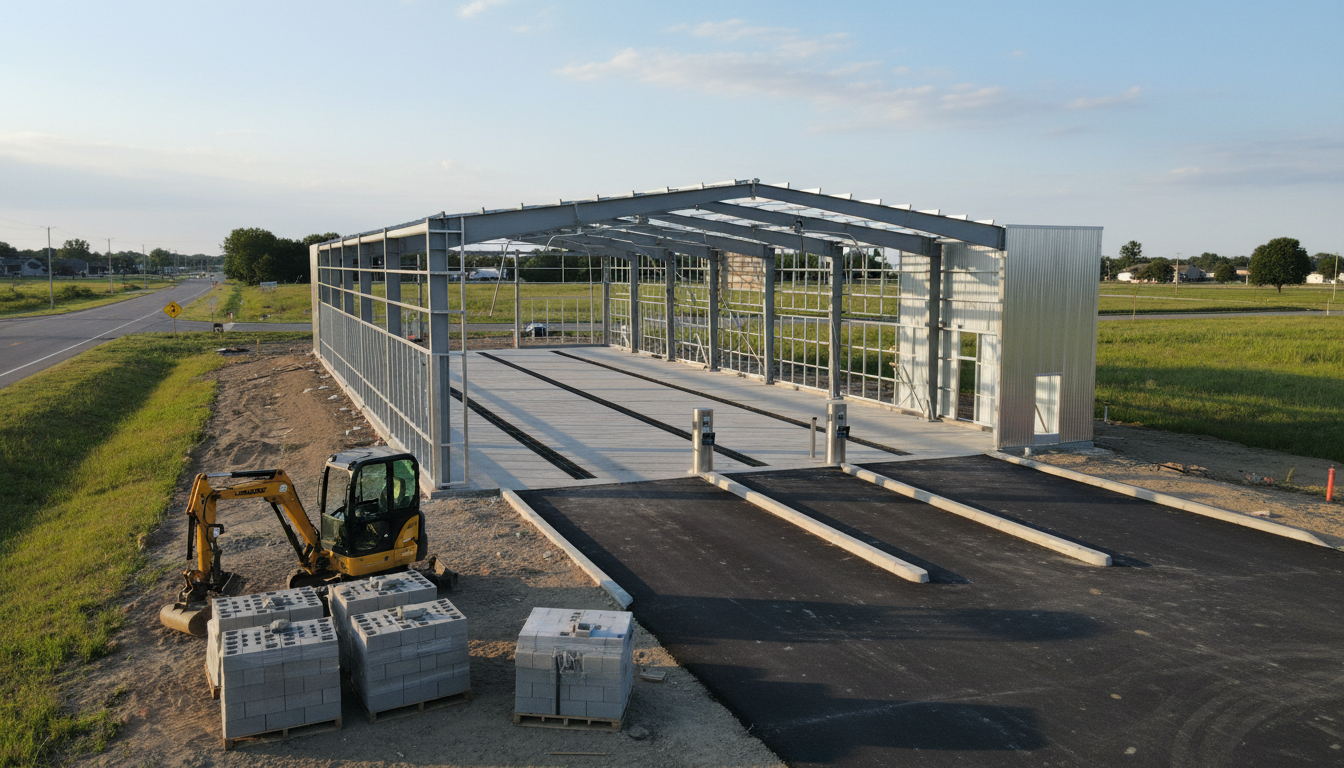
Building a car wash in the US costs roughly $150,000 to $400,000 for a small self-serve site, $500,000 to $1.2 million for an in-bay automatic, and $2.5 million to $8 million or more for an express tunnel before you buy land. Add a suburban pad site and a typical tunnel lands at $4 million to $8 million all in. The mistake first-time builders make is treating that as a construction question. It is a traffic question, and in 2027 it is also a build-or-buy question.

New tunnel openings fell from 943 in 2022 to roughly 550 in 2025, according to market researcher MMCG Invest, which expects 450 or fewer in 2026. Several cities have paused new car wash approvals, lenders want more cash down, and sale prices for existing washes have come off their peak. All of that changes what a sensible budget looks like. Below are the build costs by format, the break-even math a lender will run on yours, and what buying an existing wash costs by comparison.
Four formats, four very different checks to write
The format sets everything: the land you need, the equipment package, the staff and the number of cars you must wash. These ranges come from a 2026 construction cost guide by Terrapin Construction Group and exclude land.
| Format | Build cost, excluding land | Key equipment cost | Who it suits |
|---|---|---|---|
| Self-serve bays (wand wash) | $150,000 to $400,000; a 4-bay site about $200,000 to $350,000 | $8,000 to $15,000 per bay for pumps and wands | Owner-operators, small towns, add-ons to a gas station |
| In-bay automatic (touchless or soft-touch) | $500,000 to $1.2 million | $150,000 to $200,000 per automatic unit | Smaller lots, convenience stores, mixed self-serve sites |
| Express exterior tunnel | $2.5 million to $8 million+ | Tunnel package from about $500,000 to $2 million+ | Busy retail corridors with high daily traffic |
| Full-service or flex-serve tunnel | $3 million to $6 million+ | Tunnel plus interior finishing area | Markets that still pay for interior cleaning, with labor to staff it |
Self-serve and in-bay sites are cheap to build because they run with almost no staff, but each bay washes only a handful of cars an hour. A tunnel can push well over 100 cars an hour, which is the whole point of spending millions on it. You are paying for capacity, and capacity only pays if cars show up to use it.
Where the money goes inside an express tunnel budget
Most new money in this industry goes into express tunnels, so that is where a line-by-line view helps. The equipment people picture, the brushes and conveyor, is often only a quarter to a third of the bill.
| Budget line | Typical share of build cost (excluding land) |
|---|---|
| Tunnel and wash equipment | 25% to 35% |
| Building and hard construction | 25% to 30% |
| Site work and civil (grading, utilities, paving, drainage) | 15% to 20% |
| Water treatment and reclaim | 5% to 10% |
| Vacuums and support equipment (often 20 to 30 vacuum stalls) | 5% to 8% |
| Soft costs: design, engineering, permits, insurance, project management | 8% to 12% |
For a real-world high end, MMCG Invest published the budget for a 4,307-square-foot West Coast express tunnel with 29 vacuum stations on just over an acre. The total came to $10.47 million: $4.2 million for land, $3.2 million in hard costs, a $320,000 contingency, $1.65 million in equipment and systems, $750,000 in soft costs and $345,000 in financing costs. Land alone was 40% of the project. In the Southeast or Texas, the same building would sit on far cheaper dirt, which is why regional totals swing so widely.
Land, permits and the region you build in
An express tunnel usually needs at least an acre with strong traffic counts and easy turn-in access. Terrapin puts high-traffic suburban land at $500,000 to $2 million or more, and over $4 million in parts of the West Coast. Its regional build ranges, still excluding land, look like this:
- Southeast and Texas: $2 million to $5 million
- Midwest: $2.5 million to $6 million
- Mountain West: $3 million to $6.5 million
- Northeast: $3.5 million to $7 million+
- West Coast: $4 million to $10 million+
There is a catch hidden in that list. The cheapest regions to build are also the most crowded. MMCG reports oversupply concentrated along Sun Belt corridors in Florida, Texas, Arizona, Georgia and Tennessee, while the Northeast, the Upper Midwest and dense West Coast cores remain under-served. Some cities have responded with moratoriums or zoning overlays that limit new washes, including Cape Coral, Florida; Birmingham, Alabama; Hemet, California; and Perrysburg, Ohio. Before you pay for engineering, call the local planning office and ask whether a car wash is a permitted use on your parcel. Water discharge and environmental approvals can add two to six months on their own.
The number that decides the project: cars per day
MMCG estimates that a leveraged new express tunnel needs roughly 120 to 180 cars a day to break even. Here is how a lender gets to a number like that, so you can run it on your own site.
Hypothetical example for illustration only, built from the ranges in this guide. It is not a quote, a pro forma for any real site, or financial advice. Picture a Midwest express tunnel that costs $4.5 million including land.
| Line | Assumption | Annual amount |
|---|---|---|
| Equity down | 25% of $4.5 million | $1,125,000 (one time) |
| Loan payment | $3.375 million at 7.5% over 25 years | About $299,000 |
| Other fixed costs | Property tax, insurance, maintenance contracts, software, marketing | $250,000 (assumed) |
| Fixed costs to cover | About $549,000 | |
| Average revenue per car | Blend of members and retail washes | $12.00 |
| Variable cost per car | Water, power, chemicals, labor, card fees | $3.50 |
| Margin per car | $12.00 minus $3.50 | $8.50 |
| Break-even volume | $549,000 / $8.50 | About 64,600 cars a year, or 180 a day |
One hundred eighty cars a day just covers the bills and pays you nothing. A busy Saturday may hit 600, but a rainy Tuesday in February may not reach 80, so the yearly average is what matters. Now stress-test it. Raise the rate to 8.5% and the land price by $500,000 (financed the same way) and break-even climbs to about 200 a day. Keep the original costs but drop average revenue per car to $10, because members wash more often than you planned, and it jumps to about 235.
Memberships are what make the model work. Unlimited plans now drive about three quarters of wash sales at Mister Car Wash, the largest US operator, and one 2026 industry accounting guide uses $35 to $45 a month as a typical plan price. In the example above, 1,000 members at $40 bring in $480,000 a year, close to the fixed costs, before a single retail wash. A healthy club loses under 3% of members a month; above 5% is a warning sign. Ask any equipment dealer or consultant for their membership assumptions in writing, and check them against the washes already on your road.
How much it costs to buy a car wash instead
The softer market cuts both ways. During the 2021 to 2022 boom, large platform deals traded at roughly 18 to 20 times EBITDA, MMCG reports. Today they price in the high single digits to low double digits, and net-lease car wash cap rates have widened from the mid-5% range to about 6.2% to 6.4%. Smaller independent washes sell for less than platform deals, and the price depends heavily on whether the real estate comes with the business.
| Question | Build new | Buy existing |
|---|---|---|
| Time to first dollar | About 7 to 12 months of construction for a tunnel, plus permitting | Day one after closing |
| Proof of demand | A feasibility study and traffic counts | Years of wash counts, member numbers and tax returns |
| Equipment risk | New, under warranty | May need a $500,000+ tunnel refresh within a few years |
| Location | You pick it, if zoning allows | Fixed; a new tunnel could open next door |
| Financing | Construction loan, larger equity injection | Lenders can underwrite real cash flow |
An older self-serve or in-bay site can be the cheapest way into the business, often far below the cost of building new, but verify revenue independently. Owner-collected coin and token boxes are easy to overstate, so compare reported sales against water bills, utility bills and chemical purchases. Distress is real in this market: ZIPS Car Wash filed for Chapter 11 in 2025 and closed underperforming sites, which means some well-built tunnels are now changing hands below replacement cost.
Financing and tax rules heading into 2027
- SBA 7(a) fees for fiscal 2027 are set. For loans approved from October 1, 2026 through September 30, 2027, the upfront guaranty fee on the guaranteed portion is 2% for loans of $150,000 or less, 3% from $150,001 to $700,000, and 3.5% up to $1 million plus 3.75% above that on larger loans, per SBA Information Notice 5000-881797. The 7(a) program tops out at $5 million.
- SBA 504 for the real estate. The SBA-backed portion can reach $5 million with a 10- or 20-year fixed rate. Because a car wash is special-purpose property, and a new business adds risk, expect to put down 15% to 20% rather than the standard 10%. Many lenders now ask for more equity and a third-party feasibility study after car wash approvals under 7(a) fell from $676 million in fiscal 2021 to $272 million in fiscal 2025.
- 100% bonus depreciation is back, without a sunset. The One Big Beautiful Bill Act, signed July 4, 2025, restored 100% bonus depreciation for qualified property acquired and placed in service after January 19, 2025. A cost segregation study can move much of a wash’s non-land cost (tunnel equipment, vacuums, pay stations, reclaim systems, paving, lighting) into 5- and 15-year property that may qualify. It is a deferral, not a gift: recapture applies when you sell, and many states do not follow the federal rule.
- Construction and equipment prices for 2027 have not been announced. No major equipment maker or cost tracker has published 2027 pricing, so plan for similar or slightly higher costs than the 2026 figures above.
Tax and lending rules depend on your situation. Confirm loan terms with an SBA lender or certified development company, and run depreciation plans past a CPA who works with real estate.
Seven checks before you put a deposit on land
- Zoning: confirm a car wash is a permitted use and ask about any moratorium or overlay under discussion.
- Competition map: count every tunnel within three miles, including approved projects not yet built.
- Traffic and access: get daily traffic counts and check whether drivers can turn in from both directions.
- Break-even: run the cars-per-day math above with your real land price and today’s loan rate, then add a 20% cushion.
- Utilities: ask the water and sewer authority about tap fees, discharge rules and whether reclaim is required.
- Equipment quotes: get at least two full tunnel packages, including installation, water treatment and service terms.
- The buy option: before committing to build, look at listed washes within 30 miles. A struggling site on a good road can be the bargain of this cycle.
This is general cost information, not investment, lending or tax advice. Prices vary widely by market and site; confirm with local contractors, lenders and a licensed professional before you commit.
Car wash building and buying questions
How long does it take to build a car wash?
Construction typically takes about 3 to 5 months for a self-serve site, 4 to 6 months for an in-bay automatic and 7 to 12 months for an express tunnel. Zoning, water discharge and environmental approvals can add another 2 to 6 months before you break ground.
How much water does a car wash use per car?
Modern tunnels use roughly 90 to 200 liters (about 24 to 53 gallons) of fresh water per car, depending on equipment and whether water is reclaimed. Reclaim systems cut fresh water use and sewer charges, and some cities require them for new washes.
How much does a car wash make a year?
Industry-wide, US car washes generate about $19.2 billion a year across roughly 19,000 locations, or around $1 million per location on average, with an average operating margin near 14%, according to MMCG Invest. Results range widely, from small self-serve sites earning far less to top tunnels earning several times that.
Can I get a loan to build a car wash with no industry experience?
It is harder than it was in 2021. Lenders have tightened car wash underwriting, often asking for a larger equity injection, a third-party feasibility study and an experienced operator or management company. Partnering with an established operator or buying an existing wash can make financing easier.
What does it cost to add self-serve bays to an existing site?
Bay equipment such as pumps, wands and controls runs about $8,000 to $15,000 per bay, and new self-serve construction runs about $150 to $200 per square foot, per a 2026 construction cost guide. Site work, utility connections and permits come on top.
Related cost guides
- Gas station cost 2027
- Laundromat cost 2027
- Vending machine cost 2027
- Cost to start a business 2027
- Business insurance cost 2027
- Concrete slab cost 2027
Complete guide: Small Business Startup Costs in 2027: The Complete Guide
Pricing method: prices were researched in November 2026 for 2027 planning and may change. Figures come from Terrapin Construction Group’s 2026 car wash construction cost guide, MMCG Invest’s 2026 car wash industry and construction cost reports, SBA fee notices, Professional Carwashing & Detailing reporting on bonus depreciation, and 2026 car wash operating cost benchmarks. This site is not affiliated with any company named here. See our disclaimer.