
The most expensive bee job usually starts with a can of wasp spray. Someone sees bees slipping into a gap in the siding, empties the can into the hole, and the bees die. The comb they built does not. Weeks later the wax softens, honey seeps through the drywall, and a problem that a beekeeper might have handled for a few hundred dollars becomes a cut-out, a cleanup and a carpentry bill.

For 2027 planning, most bee calls cost $150 to $500, and This Old House’s 2026 bee removal guide puts the national average at $180. The range around that number is enormous, from nothing for a swarm a beekeeper wants to about $2,000 for a colony living inside a wall. What moves you along that range is not the company you call. It is which insect you have and where it has settled, so this guide starts there.
Find your situation in the table, then jump to the section that matches it. Each one tells you who to call first and what a fair price looks like.
Six bee and wasp situations, six different bills
| What you see | Likely insect | Call first | Typical price |
|---|---|---|---|
| A football-size cluster hanging from a branch or fence | Honeybee swarm | Local beekeeper or county extension office | $0 to $200 |
| Steady traffic in and out of siding, a soffit or a chimney | Established honeybee colony | Live-removal beekeeper who does cut-outs | $200 to $1,500, plus repairs |
| Perfect round holes in a deck rail, fascia or eave | Carpenter bees | Pest control company | $75 to $1,500 |
| Large, fuzzy bees using a hole in the ground or an old bird box | Bumblebees | Beekeeper or pest control, or wait for fall | $75 to $500 |
| A gray papery nest, or yellow-and-black insects pouring from the lawn | Wasps, hornets or yellow jackets | Pest control company | $212 to $875 |
| Bees that chase you well beyond the nest | Possibly Africanized honeybees | Pest control company; keep people and pets away | $100 to $1,000 |
Source: bee ranges by type from Angi’s bee removal cost guide and This Old House; swarm ceiling and wasp range from Lawn Love’s 2026 cost guides. Pairing each situation with a first call is our editorial guidance.
One habit saves money in every row: identify before anyone treats. Angi says a professional beekeeper typically charges about $75 an hour to identify the species, and many pest companies inspect for free. Terminix’s bee control cost page, for one, advertises a free inspection and notes that honeybees generally need relocation by a beekeeper, which adds to the price. Either is cheaper than paying for the wrong method.
A ball of bees hanging from a branch
This looks alarming and is the cheapest bee problem you can have. A swarm is a colony on the move, resting while scouts look for a permanent home. Mississippi State University Extension says swarms are not dangerous and typically stay put for anywhere from an hour to a few days. Its advice is to leave them alone, skip the pesticide (sprayed bees cannot be saved) and call the local extension office, which can put you in touch with a beekeeper.
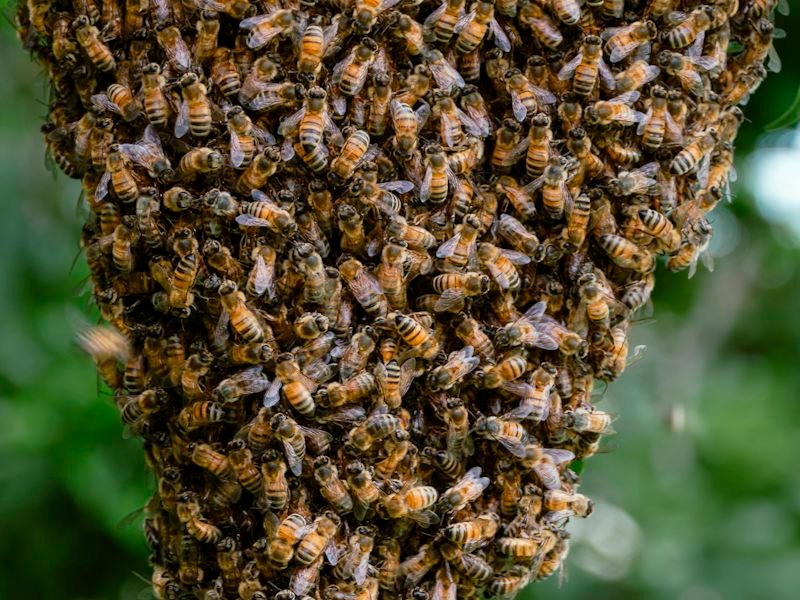
Beekeepers want swarms, which is why this is the one situation where free removal is realistic. When there is a charge, it is small: Angi and This Old House list swarm removal at $125 to $200, and Lawn Love puts the average at $140. Speed matters more than price here. A swarm that moves into your wall overnight becomes the next section’s problem.
Honeybees living inside the wall, soffit or chimney
Here the bees are no longer passing through. They have built comb, stored honey and started raising brood, and every option now involves opening the structure. Angi’s figures by nest site show how much location matters:
- Inside a wall or ceiling: $200 to $750
- Tree cavity on your property: $200 to $650
- Roof or attic: $200 to $1,100
- Chimney: $200 to $1,500
Those numbers cover the removal itself. Angi notes that a job can climb to about $2,000 once carpentry is added, and it prices typical repairs separately: $275 to $750 for drywall, $300 to $1,000 for a ceiling and $6 to $20 per linear foot for soffit.
The comb is the reason you cannot simply kill the colony and walk away. The University of Kentucky’s entomology fact sheet on nuisance honeybees warns that an abandoned nest’s wax may melt or be riddled by wax moth larvae, and that leaking honey can seep through interior walls and leave a permanent stain. Old honey also draws other insects and, eventually, a new swarm. So even when extermination is the only choice, the comb still has to come out, and that opening and closing is where most of the cost sits.
That is why live removal often costs about the same as killing the bees. Angi lists relocation at $100 to $800 and extermination at $150 to $1,000. Lawn Love’s honeybee average is $669, with a range of $88 to $1,250. Ask any company quoting a wall colony three things: does the price include removing all comb and honey, who closes the wall, and is there a warranty if bees return to the same cavity.
“If the nest is not removed, the wax may melt or be riddled by wax moth larvae and begin to leak honey.”
University of Kentucky Department of Entomology, ENTFACT-606
Perfect round holes in the deck rail or fascia
Carpenter bees drill round tunnels into bare or weathered wood and come back to the same boards year after year. They rarely sting, and they do not build a hive full of honey, so nobody relocates them. Treatment is a pest-control job: dusting the galleries, then plugging and sealing the holes.
This Old House lists carpenter bee jobs at $75 to $500. Lawn Love’s 2026 beehive removal guide reports a higher average, $794, on a range of $88 to $1,500, and says the bill gets closer to $2,000 when carpentry is needed. The spread tracks how long the bees have been there. Fresh holes in one fascia board are cheap. Several seasons of tunneling can mean replacing boards; Angi puts deck repairs at $250 to $2,500. Painting or staining exposed wood after treatment is the cheapest way to keep them from coming back.
A papery nest, or traffic from a hole in the lawn
Plenty of “bee” calls turn out to be wasps. The difference matters for the price: nobody rescues a yellow jacket nest, and HomeAdvisor’s wasp nest removal guide says free wasp removal is rare because wasps do not produce honey. It puts typical professional removal at $300 to $700, with a $525 average.
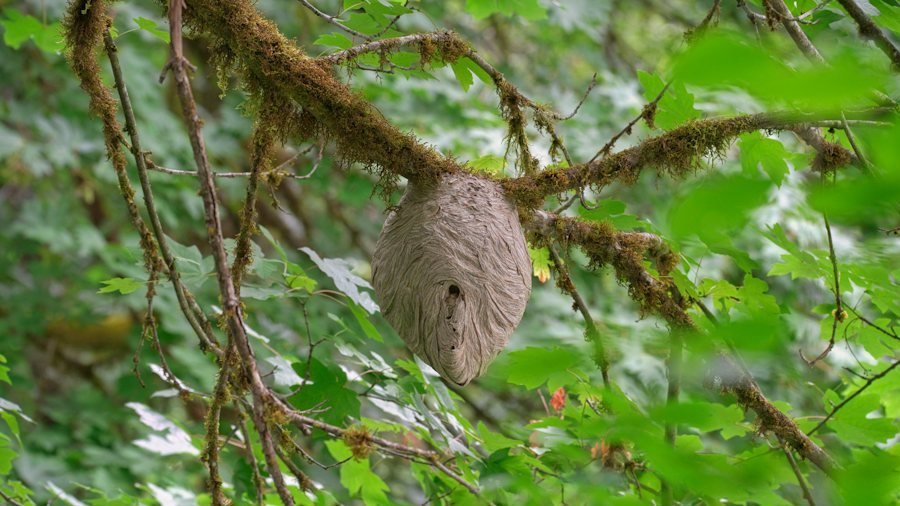
Lawn Love’s 2026 wasp nest guide breaks the price down by insect, and the order surprises people. Exposed paper wasp nests average about $385. Bald-faced hornets average $625. Yellow jackets, which often nest underground or in wall voids and defend the nest hard, average $725. A nest inside a wall runs $350 to $875 before any drywall work. HomeAdvisor’s yellow jacket range, $500 to $750, lands in the same place.
Timing is the free discount. Most wasp and yellow jacket colonies die off over winter and do not reuse the old nest, so a nest you find in late fall, away from doors and play areas, may not need a paid visit at all. A nest by the back steps in July does.
Big fuzzy bees in a ground hole or an old bird box
Bumblebee colonies are small and seasonal, and the bees are mild unless the nest is disturbed. Lawn Love puts removal at $78 to $350 with a $214 average, and This Old House lists $75 to $500. If the nest is in a corner of the yard nobody uses, the most economical answer is often patience: like wasps, bumblebee colonies do not survive the winter. When it sits under a mower path or a child’s play area, a beekeeper or pest company can move or treat it.
Bees that chase you down the driveway
A colony that pursues people well past the nest, especially in the South and Southwest, may be Africanized. This is the one bee situation where you should not wait for a free beekeeper or try anything yourself. Keep people and pets away and call a professional. Angi and This Old House both list Africanized colonies at $100 to $1,000, and Lawn Love’s average for what it calls killer bees is $513.
Same job, different city: what a visit runs where you live
Angi’s city averages for bee removal show labor markets at work more than bee behavior. Phoenix comes in at $110 and Denver at $130. Chicago and Minneapolis sit at $160. Baltimore averages $230, and Los Angeles and San Francisco both reach $240. The extra $130 for the same swarm call in California is the price of local labor, insurance and drive time, not of harder bees.
On 2027 prices: no national price change for bee removal has been announced, and none of the cost guides we checked projects one. Treat the figures here as current prices for 2027 planning, and expect quotes to follow local labor rates.
Who to call, in this order
- Your county extension office or local beekeepers’ association, for any honeybee swarm and for help identifying what you have. The University of Kentucky fact sheet notes that a list of beekeepers can come from the extension office or even a local fire station.
- A live-removal beekeeper who does structural cut-outs, for honeybees established in a wall, roof or chimney. Get the comb removal, wall repair and return warranty in writing.
- A licensed pest control company, for wasps, yellow jackets, hornets, carpenter bees and any colony that acts aggressive. Ask whether the first visit includes a follow-up treatment.
Questions people ask after the first quote
Do beekeepers always remove bees for free?
No. Angi says free removal happens in some cases but is usually not the norm. It is most likely for a swarm or an easy-to-reach honeybee hive, because the beekeeper gains a colony. Cut-outs from walls and roofs almost always carry a charge.
Is bee removal cheaper than wasp removal?
Usually. This Old House puts the average bee removal at $180, while Lawn Love’s average for wasp nest removal is $385 and HomeAdvisor’s is $525. Honeybees in a wall are the exception, because opening and repairing the wall can push a bee job well past a typical wasp visit.
How much does a beehive removal cost if the hive is large?
Angi lists $600 to $1,000 for a large nest or multiple hives, against about $180 or less for a small, single hive. Lawn Love’s size tiers run from a $118 average for small hives to about $2,000 for extra-large ones.
Will bees come back after they are removed?
They can if comb and honey stay behind, because the scent draws new swarms. Lawn Love says removal teams take out the honeycomb and residual honey for that reason. Sealing the entry gap after removal is the other half of the job.
Can I handle a wasp nest myself to save money?
Lawn Love estimates a do-it-yourself wasp removal at $57 to $227 for gear and products. That can make sense for a small, exposed nest. Nests in walls, in the ground near walkways, or anywhere someone in the home is allergic to stings are better left to a professional.
Where the bee and wasp prices come from
- How Much Does Bee Removal Cost? (2026 Guide), This Old House (updated March 30, 2026)
- How Much Does Bee Removal Cost?, Angi
- How Much Does Beehive Removal Cost in 2026?, Lawn Love (updated October 5, 2026)
- How Much Does Wasp Nest Removal Cost in 2026?, Lawn Love (updated October 9, 2026)
- How Much Does Wasp Nest Removal Cost?, HomeAdvisor
- Controlling Nuisance Honey Bees (ENTFACT-606), University of Kentucky Department of Entomology (revised January 2026)
- What To Do If You Find a Honey Bee Swarm, Mississippi State University Extension Service
- Bee control cost, Terminix (updated June 1, 2026)
More pest and home repair prices
- The complete home improvement cost guide
- General exterminator visits versus a yearly pest plan
- Terminix and Orkin prices compared
- What an ant exterminator charges, by ant
- Termite treatment: liquid, bait or tent
- Drywall repair after a wall is opened
More related guides: Raccoon removal cost, itemized
Pricing method: prices were researched in November 2026 for 2027 planning and may change. Ranges come from the published cost guides listed above; the situation-to-contact pairings are our editorial guidance, not a quote. Local prices, regulations on honeybee removal and pesticide use vary, so confirm with a licensed professional or your county extension office. See our disclaimer.