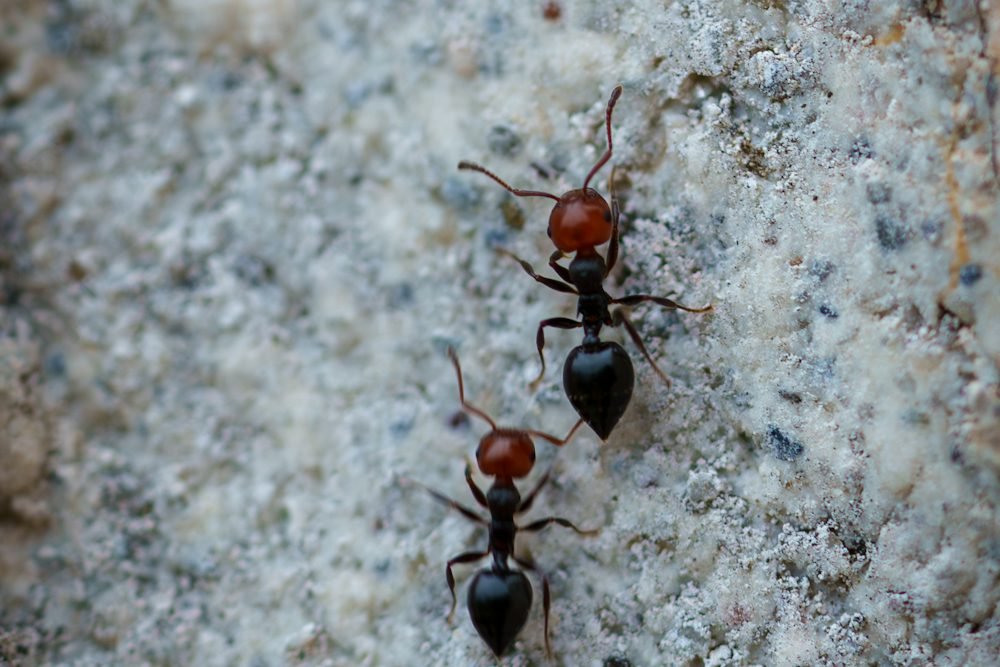
Before an exterminator quotes you anything, they will ask two questions: where are the ants showing up, and what do they look like? For an ordinary trail of small ants in the kitchen, a one-time professional treatment usually lands between $200 and $300, the planning range HomeGuide and Angi data point to for a 2,000-square-foot house. Carpenter ants run $250 to $500. A severe, whole-house problem can reach $800 to $1,200.

The spread is that wide because “ants” covers a dozen different jobs. Start with what you are seeing, find the matching row below, then jump to the section that explains what actually works and what you should pay for it.
Start with what you see, then find the price
| What you are seeing | Likely culprit | Treatment that works | Typical pro price per job |
|---|---|---|---|
| A line of small ants to the sink, sugar bowl or pet dish | Odorous house, pavement or Argentine ants | Bait stations inside, baits outdoors along the foundation | $200 to $300 |
| Large black ants after dark, small piles of sawdust | Carpenter ants | Find the nest, dust or foam the galleries, fix the moisture | $250 to $500 |
| Tiny pale ants in many rooms, often in apartments or hospitals | Pharaoh ants | Bait-only program over several months | $200 to $250 a visit, plus follow-ups |
| Fluffy soil mounds in the lawn, painful stings | Fire ants | Broadcast bait, then treat remaining mounds | $100 to $300; $600 to $900 for a two-step program |
| Ants back every spring no matter what | Outdoor colonies reinvading | Recurring service with a re-treat guarantee | $400 to $500 a year on a quarterly contract |
Fumigation, the tent-over-the-house treatment, shows up in some price lists at $1,700 to $3,150 for a 2,000-square-foot home. It is a termite and drywood-pest tool. If someone proposes tenting for ants, get a second opinion before you pack a bag.
A trail of small ants in the kitchen: try the $8 fix first
This is the most common ant call in America and the one most likely to be solved without a technician. Odorous house ants, pavement ants and Argentine ants all forage for sweets and grease, and all of them take bait back to the nest. University of California integrated pest management specialists call baits the only insecticide they recommend in most ant situations, and they are blunt about the alternative: sprays give temporary control, and perimeter spraying knocks numbers down only for the ants to rebuild quickly.
A six-pack of TERRO T300 liquid bait stations was $7.89 on Terro’s own store in November 2026. Granular baits run $10 to $20 and gel baits $20 to $30 at retail, according to This Old House. Put the stations on the trail, wipe up competing food, and do not spray the ants you see; you want them carrying bait home. UC says expect fewer ants in 5 to 10 days and full control in several weeks.
Call a pro if the trail is still there after two to three weeks of steady baiting, if ants are coming from inside a wall, or if you have tried sprays and the problem has spread to new rooms. A standard visit for these species prices at $200 to $250 on Fixr’s species list, with Argentine ants a little higher at $200 to $300 because their colonies are huge and interconnected. UC recommends refillable stations with a low-concentration liquid borate for severe Argentine infestations, which is one thing a pro can set up that the grocery-store packs do less well.
Sawdust under the windowsill: carpenter ants and the $500 tier
Carpenter ants are the most expensive common ant to treat, at $250 to $500 for a manageable case in This Old House and Fixr data. Fixr’s high end of $1,200 describes a home over 3,000 square feet that needed treatment plus remediation. The price reflects labor more than chemicals: the job is detective work.

Texas A&M’s urban entomology program lays out why. Carpenter ants do not eat wood; they excavate it to enlarge the nest, and the piles of shavings they push out are the classic sign. Moisture is what draws them into a structure, so damp or leak-damaged wood is where they settle. The nest you find indoors may be a satellite colony, with the parent colony outside in a tree, stump or woodpile. A technician who treats only the indoor nest is billing you for half a job.
A good carpenter ant visit looks like this: following foragers back to the nest, often at night when they are most active; puffing insecticide dust into wall voids and galleries so workers carry it to the colony; treating any outdoor nest directly; and pointing out the wet wood that attracted them. Ask for that last part in writing. ThePricer notes that repairs to rotten trim, leaks and framing are not part of an extermination quote, and that is where the larger bills hide. Skip the store-bought sugar baits here; Terro itself says its liquid bait is not recommended for carpenter ants.
Tiny ants in every room: why pharaoh ants punish the spray can
Pharaoh ants are small, pale yellow to light brown, and show up in kitchens, bathrooms and anywhere warm with water nearby. They are a particular headache in apartment buildings. Per-visit pricing is ordinary, $200 to $250 in both This Old House and Fixr figures, but the job rarely ends in one visit.
The reason is budding. Pharaoh ant colonies split into new colonies, and Ohio State, Texas A&M and UC extension entomologists all warn that repellent sprays, including the common pyrethroid products ending in “-thrin,” can trigger exactly that split. Spray a trail and one colony can become several, scattered through the walls. Ohio State adds that total-release foggers do not work on them. The fix is patient baiting, which Texas A&M says can take several months to a year.
“When properly used, baits are more effective and safer than sprays.”
University of California Statewide IPM Program, Pest Notes: Ants
Budget for the follow-ups. As an example, an initial $250 visit plus three $70 follow-ups, the top of This Old House’s $40-to-$70 follow-up range, comes to $460. If a company quotes pharaoh ants and mentions spraying, that is your cue to call someone else.
Mounds in the lawn: fire ants are priced by the yard, not the room
A pro visit for fire ants runs $100 to $300, per This Old House and Fixr, while a full two-step program prices at $600 to $900 on Fixr’s treatment list. The two steps are a broadcast bait across the whole yard, which reaches colonies you cannot see, followed by treating whatever mounds remain.

This is also the situation where doing it yourself is most realistic. Texas A&M AgriLife’s fire ant specialists put a recommended annual bait treatment at about $25 to $35 per acre. Their timing rules matter more than the brand: spread bait when it is about 70 degrees or warmer, not within 48 hours of rain, around the mound rather than on top of it, at the label rate of roughly 1 to 1.5 pounds per acre. Cheaper baits can take six to eight weeks to finish a colony; pricier ones often work in under a week. Broadcasting once or twice a year catches new colonies before they build mounds.
Hire out the job if someone in the house is allergic to stings, if mounds sit near a play area or an electrical box, or if your lot is large enough that a spreader and a weekend feel like a second job. Sugar-based indoor baits are no help outdoors; Terro states its liquid bait does not work on fire ants.
Square footage and severity, in dollars
Once the species is known, two things push a quote up: how much house there is to inspect and treat, and how established the colonies are. Fixr’s ranges for a one-time treatment show both effects.
| Home size | One-time treatment | Infestation level | Typical total |
|---|---|---|---|
| 1,000 sq ft | $170 to $250 | Small | $150 to $300 |
| 2,000 sq ft | $200 to $300 | Medium | $300 to $500 |
| 3,000 sq ft | $240 to $350 | Large | $400 to $700 |
| 4,000 sq ft | $300 to $500 | Severe | $800 to $1,200 |
Brand-name one-time visits fall in the same territory. Fixr lists Terminix at $200 to $350, with fire, carpenter, pharaoh and crazy ants requiring its premium treatment, and Orkin at $225 to $400 with the inspection included. No national change in ant treatment pricing has been announced for 2027, so these late-2026 figures are the best planning numbers for next year; local quotes will still vary with labor costs in your area.
Ants every spring: when a service plan pays and when it pads
If ants come back each year from outdoor colonies you cannot reach, a contract can beat paying for a fresh visit every time. Fixr’s annual totals for a 2,000-square-foot home: $100 to $200 for a once-a-year contract, $200 to $300 for a single one-time visit, $400 to $500 for quarterly service and $900 to $1,200 for monthly service. ThePricer’s illustrative first year on a quarterly plan, a $200 initial visit plus four $100 visits, comes to $600.
The trap is the billing format. Many plans bill monthly while visiting quarterly, and ThePricer warns against confusing the two. A plan that bills $50 a month is a $600-a-year commitment, whatever the visit schedule. Before signing up, ask for four things in writing:
- The annual total and the actual number of scheduled visits.
- Whether re-treatments between visits are free, and whether your ant species is covered by that guarantee. Carpenter and pharaoh ants are often carved out or priced as premium.
- Whether the inspection is free, billed separately or credited toward the treatment.
- The cancellation terms, including any fee for leaving before the contract year ends.
The rule we would use
Bait first when the ants are small, trailing and after food: an $8 pack and two weeks of patience settle most kitchen invasions. Pay for a pro on the first visit when you see sawdust, ants in several rooms of a multi-unit building, or mounds near people who react badly to stings, because those are the cases where a wrong move (spraying pharaoh ants, treating only an indoor carpenter nest) makes the next bill bigger. Sign a contract only after a second year of ants, and only for a plan whose annual total you have seen in writing.
Five more ant treatment questions, answered
Are ant foggers or bug bombs worth buying?
Usually not. Ohio State University Extension says total-release foggers are not effective against pharaoh ants, and repellent sprays can scatter colonies of that species. Baits placed on active trails do more for less money.
Does homeowners insurance pay for carpenter ant damage?
Standard homeowners policies generally exclude damage caused by insects, treating it as a maintenance issue. Coverage varies by insurer and policy form, so read your own policy or ask your agent before assuming either way.
Is a free ant inspection really free?
Often, but confirm it. Fixr reports that Orkin includes the inspection in its treatment price, while ThePricer advises asking whether an inspection is free, billed separately or credited toward the treatment before anyone arrives.
Do pet-safe ant treatments cost more?
Not always. Fixr says greener products typically carry no extra charge, though it also notes some companies quote $175 to $325 for a pet- and child-safe service. Ask, because many companies do not advertise these options.
Do exterminators guarantee ant treatments?
Many recurring plans promise free re-treatment if ants return between scheduled visits. One-time visits may carry a shorter guarantee or none. Get the terms in writing and confirm your ant species is included, since carpenter and pharaoh ants are sometimes excluded.
Other pests, other price tags
- Home improvement costs in 2027: the complete price guide
- General exterminator cost: one visit or a pest control plan
- Termite treatment cost: liquid, bait or tent
- Roach exterminator cost by species
- Rat and mouse exterminator cost: trapping, sealing and cleanup
- Flea exterminator vs DIY cost
More related guides: Bee exterminator cost by species and nest site
Pricing method: prices were researched in November 2026 for 2027 planning and may change. Treatment ranges come from Fixr, This Old House (HomeAdvisor data), Today’s Homeowner and ThePricer; product prices from TERRO’s own store; treatment guidance from Texas A&M, Ohio State and University of California extension entomologists. Local quotes vary. See our disclaimer.