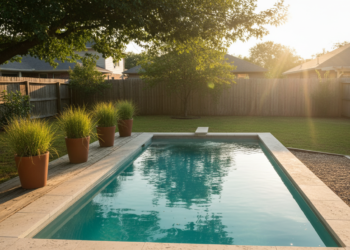
The most common money mistake with a new or freshly drained pool is calling a water truck because the hose “will cost a fortune.” For most backyard pools it works the other way. Angi’s pool-filling cost guide puts the national average cost to fill a pool at about $180, with most owners paying $90 to $270 for city or well water, while trucked water for a typical 17,000-gallon pool runs $500 to $1,700. Well owners pay mostly for pump electricity, roughly $25 to $75.

That gap explains why so much folklore grows around a simple job. Below are the six beliefs pool owners repeat most, each checked against utility rules and national cost data. The figures are current prices for 2027 planning; no national cost guide has published separate 2027 fill prices as of November 2026, though the water itself keeps getting pricier, as the first myth shows.
Hose, well or truck: the fill bill by pool size
Find your pool’s volume first, then read across. Truck prices are quoted per load, which is why a pool that needs three and a half loads pays for four. HomeGuide’s pool water delivery figures supply the truck column; the hose column uses its city-water rate of $4 to $10 per 1,000 gallons.
| Pool (typical size) | Gallons | City water by hose | Delivery truck |
|---|---|---|---|
| 15-ft round above-ground | 5,000 | $20–$50 | $200–$600 (1 load) |
| 21-ft round or 12 x 24 ft | 10,000 | $40–$100 | $400–$1,200 (2 loads) |
| 14 x 28 ft inground | 15,000 | $60–$150 | $600–$1,800 (3 loads) |
| 16 x 34 ft inground | 20,000 | $80–$200 | $600–$2,400 (3–4 loads) |
| 20 x 40 ft inground | 30,000 | $120–$300 | $1,000–$3,000 (5 loads) |
Source: HomeGuide pool water delivery and pool-fill cost guides, November 2026.
Myth one: a hose fill wrecks the water bill
Reality: it bumps one bill, and usually by less than a family dinner out. HomeGuide’s fill-cost guide notes that an average family uses about 12,000 gallons a month and an average inground pool holds 10,000 to 20,000, so expect that month’s water charge to roughly double. Double of a modest number is still a modest number: $40 to $200 for the water itself on most inground pools.
Rates are rising, though, and that is the honest caveat for 2027. A Food & Water Watch analysis covered by Inside Climate News in October 2026 found that the average large US water system raised household prices 62 percent between 2015 and 2025, charging $531 a year for 60,000 gallons in 2025. That works out to about $8.85 per 1,000 gallons by our math, near the top of HomeGuide’s range, and more than half of the 25 most expensive systems were in California. If your utility is one of the pricey ones, budget toward the upper end of the table.
Tiered pricing is the other wrinkle. Many utilities charge more per gallon once a household crosses a monthly threshold, and Angi warns that overuse fines in parts of California can reach $100, so call before you open the spigot all the way. If you are still pricing the pool itself, keep perspective: the water is a rounding error next to what an above-ground pool costs installed.
Myth two: sewer fees on pool water are unavoidable
Reality: plenty of utilities will credit them, but only if you ask, and usually only once a season. Sewer charges are typically calculated from metered water use, so a 20,000-gallon fill can show up twice on the bill: once as water, once as sewage that never went down a drain.
The rules vary but rhyme. Fond du Lac, Wisconsin’s pool-fill sewer credit applies once per season, requires beginning and ending meter readings, and is processed only when the credit exceeds $5. Greenfield, Massachusetts grants a sewer abatement for pools of 2,000 gallons or more, but only for a complete fill of a new pool or one with a replaced liner, and never for topping off. That last condition matters if you are budgeting what a new vinyl liner costs installed, since the refill that follows it is often the one that qualifies.
How to ask your utility for a pool-fill sewer credit
- Call or check the utility’s website before filling; some want notice in advance.
- Photograph the meter reading at the start and the end of the fill.
- Note the pool’s dimensions and gallons, and keep the liner or construction invoice if the fill followed work on the pool.
- Make sure your account is current; Fond du Lac, for one, requires it.
- Expect the credit on a later bill, not the one in hand.
Myth three: the water truck is the smart premium
Reality: you are paying about ten times more to save a day or so. HomeGuide says a hose takes 12 to 36 hours or more on a larger pool, while a delivery truck finishes in under an hour. Haulers charge $200 to $600 a truckload, or $30 to $100 per 1,000 gallons, and trucks range from 1,200-gallon units to 8,000-gallon tankers, with about 6,000 gallons the norm.

Extras stack quickly. HomeGuide lists surcharges for same-day, emergency or after-hours delivery, extra hose to reach a backyard, mileage for remote addresses, and pre-chlorinated water, which it calls the most expensive option. Regional per-load prices are tighter than you might expect, from $200 to $500 in the Southwest to $300 to $600 in the Northeast.
The truck still earns its fee in a few situations: a weak well that cannot keep up, a utility under drought restrictions, a rural lot with no municipal service, or a schedule where waiting two days costs more than the delivery. Ask every hauler where its water comes from and whether its tanks ever carry anything else; HomeGuide’s advice is to get three quotes and never pay in full before the water arrives.
Myth four: well water is free water
Reality: the water is free; the pump and the chemistry are not. The electricity bill is the small part. The big risk is the pump. Angi’s well-water guide treats 600 gallons an hour as a high flow rate and 150 or less as low, and it recommends running the tap at half flow for an hour, then letting the well recover for an hour. At those rates a 20,000-gallon pool needs somewhere between about 33 and 133 hours of pumping by our math, spread across several days.
Push harder and the bill changes category. Angi prices a replacement well pump at $1,500 to $6,500, which can top the cost of trucking in the entire pool. Test the well for metals and minerals before filling, too: trace metals can discolor the water and clog filters and pipes, and correcting them means sequestering agents and extra chemicals on day one. If the test comes back high in metals, a truckload or two blended with well water can be cheaper than fighting stains all summer.
Myth five: the fire department will fill it for nothing
Reality: fire crews are rarely in the pool business, and tapping a hydrant yourself is usually illegal. Hydrants belong to the water system, not the neighborhood, and using one without the utility’s permission is off-limits. The legitimate version, where it exists, is a metered connection run by public works and billed like any other water.
Greenfield’s public works department shows what that looks like. A homeowner whose lot is on the same side of the street as a hydrant can request a fill at least three working days ahead; the city installs a meter, turns the water on and off itself, and bills the usage at the current water rate plus a $30 labor surcharge, or $60 outside normal hours. It is a convenience, not a discount, and the city can refuse any request.
Myth six: once the pool is full, the water spending stops
Reality: you will buy a slice of that pool again every summer. HomeGuide says pools lose about a quarter inch a day to evaporation, roughly an inch a week in summer or about 2,000 gallons a month depending on size, and it prices seasonal top-offs at $20 to $500. A level that drops more than half an inch a day points to a leak, not the weather.

The cheapest fix is a lid. The EPA’s WaterSense program says a pool cover can prevent up to 95 percent of evaporation, and covers hold heat as well, which matters if you are also running a gas or heat pump pool heater. Top-off water rarely qualifies for a sewer credit, so every gallon a cover saves is billed at the full combined rate.
Full drains come around eventually, too. HomeGuide suggests draining and refilling an inground pool every five to seven years and an above-ground pool every three to five, so the fill in the table is a recurring line, just a slow one. Folding it into a realistic yearly pool upkeep budget keeps it from feeling like a surprise.
Filling a pool: questions the myths leave out
How do I figure out how many gallons my pool holds?
For a rectangular pool, multiply length by width by average depth in feet, then by 7.5. For a round pool, Angi’s shortcut is diameter times diameter times depth times 5.9. Use the average of the shallow and deep ends for depth.
How much does it cost to fill a hot tub?
Very little. HomeGuide prices a 300- to 500-gallon hot tub at about $2 to $50 to fill, with the low end from a garden hose and the high end from a delivery truck.
Does pool water delivery cost more in some regions?
A little. HomeGuide lists average per-truckload prices of $200 to $500 in the Southwest, $250 to $500 in the Northwest, $350 to $550 in the Southeast, $350 to $600 in the Midwest and $300 to $600 in the Northeast.
How much water does a partial drain and refill use?
Angi estimates that refilling after a partial drain below the skimmer takes about 1,000 to 3,000 gallons for every 20,000 gallons of pool capacity, or roughly 15 percent.
Is pre-chlorinated delivered water worth paying for?
Rarely for a homeowner. HomeGuide calls pre-chlorinated water the most expensive delivery option, and you will balance and shock the pool after filling either way. Plain potable water plus your own startup chemicals is usually cheaper.
Who supplied these numbers
- How much does it cost to fill a pool with water?, HomeGuide
- How much does pool water delivery cost?, HomeGuide
- How much does it cost to fill a pool with water?, Angi (2026 figures)
- Can You Fill a Pool with Well Water? What You Need to Know, Angi (updated July 9, 2026)
- Pool Water Efficiency, US EPA WaterSense (updated March 6, 2026)
- Sewer Credit (Pool Fill), City of Fond du Lac, Wisconsin (September 2026)
- Water for Swimming Pools, City of Greenfield, Massachusetts
- Water Bills Surged More Than Other Costs in US Homes Over 10 Years, Inside Climate News (October 6, 2026)
Keep pricing the pool
- Home improvement costs in 2027: the complete price guide
- Screen cage vs glass pool enclosure cost
- What a plunge pool costs installed
- Cost to fill in a pool, from permit to new lawn
- Pool liner replacement cost and overruns
- Yearly pool maintenance cost
The bottom line: if you are on city water, fill with a hose, call the utility about a sewer credit before you start, and buy a cover for the summers that follow. Pay for a truck only when a weak well, drought rules or the calendar make waiting the more expensive choice, and never tap a hydrant without the water department running the meter.
Pricing method: prices were researched in November 2026 for 2027 planning and may change. Figures come from national cost guides, a federal agency and municipal utility pages; your local water, sewer and delivery rates will differ. See our disclaimer.