Most people choose deck boards by comparing a stack of lumber at the store, and that comparison points the wrong way. A professionally built deck generally runs $30 to $60 a square foot, according to Angi, with typical projects between about $4,300 and $12,500. Remodeling magazine’s 2025 Cost vs. Value report prices its model wood deck at $18,263 and the composite version at $25,096. That $6,833 gap is the number to beat, and very little of it comes from the boards.

The actual decision is whether composite’s higher price at the start pays for itself through staining you skip, a resurfacing you never need and a better showing at resale. The answer depends on two things you already know: who will hold the stain brush, and how long you plan to stay. If a ground-level patio is also on the table, run the numbers through our concrete slab cost calculator before you commit to framing.
Where the $6,833 gap between wood and composite comes from
Cost vs. Value surveys contractors on the same deck built two ways. Its national averages show composite costing more and holding slightly less of its value at sale, though it still recovers more dollars.
| Same deck, two materials | Pressure-treated wood | Composite | Difference |
|---|---|---|---|
| Job cost, national average | $18,263 | $25,096 | $6,833 more for composite |
| Value added at resale | $17,323 | $22,199 | $4,876 more for composite |
| Share of cost recouped | 95% | 89% | 6 points better for wood |
| Rough cost per sq ft (320 sq ft) | About $57 | About $78 | About $21 |
Angi’s material ranges explain part of the spread: pressure-treated lumber at $2 to $5 a square foot against $12 to $22 for composite, with installed composite at $25 to $54. The rest is labor and the parts that come with a composite system. Builders usually set joists closer together for composite (TimberTech’s guidance is 12 inches on center ideally and never more than 16), use hidden fasteners instead of screws through the face and add matching fascia and railing. Each of those adds hours as well as material.
The boards themselves cost less than you would guess
Here is a 320-square-foot deck surface priced from Home Depot listings in November 2026, with 10 percent added for cuts and waste (352 square feet of coverage). These are boards only: no framing, posts, fasteners, railing or labor.
| Board | Shelf price | Per sq ft covered | Boards for 352 sq ft |
|---|---|---|---|
| WeatherShield 5/4 x 6 x 8 ft ground-contact treated pine, standard | $6.88 ($6.19 each for 48+) | About $1.88 | About $600 to $660 |
| WeatherShield 5/4 x 6 x 8 ft ground-contact treated pine, premium grade | $9.38 ($8.44 each for 48+) | About $2.56 | About $810 to $900 |
| Trex Enhance Naturals 1 x 6 x 16 ft grooved composite | $41.58 | $5.67 | About $2,000 |
That is a difference of roughly $1,100 to $1,400 in decking for the whole job, about a fifth of the gap in finished price. When a builder’s composite bid comes in thousands higher, the boards are not the reason, so ask for the fasteners, joist spacing, railing and labor to be listed separately.
One reason wood prices deserve a second look for 2027: the average U.S. duty on Canadian softwood lumber jumped from 14.38 percent to 35.19 percent in August 2025, and a 10 percent Section 232 tariff followed that October, according to the market analysts at Fastmarkets, which expected higher lumber prices through 2026. No retailer has posted 2027 prices for these boards, so get a dated quote and ask how long the builder will hold it. The framing under a composite deck is the same treated lumber, so duties touch both bids.
Twenty years of the same deck, priced two ways
The case for composite rests on maintenance, so here is a hypothetical example that counts it. It starts from the Cost vs. Value job costs, assumes professional staining every three years at Angi’s average of $850 (Angi recommends restaining every two to three years), and assumes the wood surface needs replacing once around year 15. TimberTech says wood decks typically need a new surface every 10 to 15 years, and Advantage Lumber estimates resurfacing at 40 to 60 percent less than a full rebuild. Figures are in today’s dollars, with no inflation.
| Example: 16×20 deck over 20 years | Pressure-treated wood | Composite (25-year board) |
|---|---|---|
| Build | $18,263 | $25,096 |
| Professional stain and seal, about six times | $5,100 | None needed |
| Washing | Included in stain prep | Soap and a hose, once or twice a year |
| New deck surface, around year 15 | $7,300 to $11,000 | Not expected within the board warranty |
| Twenty-year total | About $30,700 to $34,400 | About $25,100 |
On those assumptions, composite comes out $5,600 to $9,300 ahead over two decades. Change one assumption and the picture moves fast. If you stain the deck yourself, that $5,100 line shrinks to the cost of stain and a few weekends, and the two decks land close to even. If you keep a wood surface sound past 20 years with diligent care, wood stays cheaper outright.
Moving soon flips the math too. Sell a few years after building and the Cost vs. Value numbers leave you about $940 out of pocket on the wood deck ($18,263 minus $17,323) and about $2,900 on composite ($25,096 minus $22,199). Composite’s premium only starts paying off once you have skipped a few staining cycles.
The frame is the weak link under either surface
Composite boards carry long warranties. Trex backs its Enhance line for 25 years against fading, staining and structural defects, Select for 35 and Transcend for 50, per a dealer summary from Advantage Lumber. The pressure-treated joists underneath carry no such promise. Advantage Lumber says treated frames often last 10 to 20 years with good maintenance.
That mismatch is where composite buyers lose money. Fifty-year boards on a frame that rots out in year 18 means pulling up good decking to fix what is beneath it. Three inexpensive habits close most of that gap:
- Joist and ledger tape. A butyl or flashing tape over the tops of joists and the ledger keeps water out of the screw holes, where rot starts.
- Ground-contact lumber for framing. Treated lumber is rated for above-ground or ground-contact use. Ask that joists and beams be ground-contact rated, especially on low decks with little airflow.
- A flashed ledger. The board bolted to your house carries half the deck. Advantage Lumber lists a compromised or improperly attached ledger among the signs that a deck needs a full rebuild, not just new boards.
Some builders also offer steel framing, which does not rot. It costs more up front, and it makes the most sense when you are paying for 35- or 50-year boards and plan to stay long enough to collect.
Already have a tired deck? Resurface, or rebuild to the footings
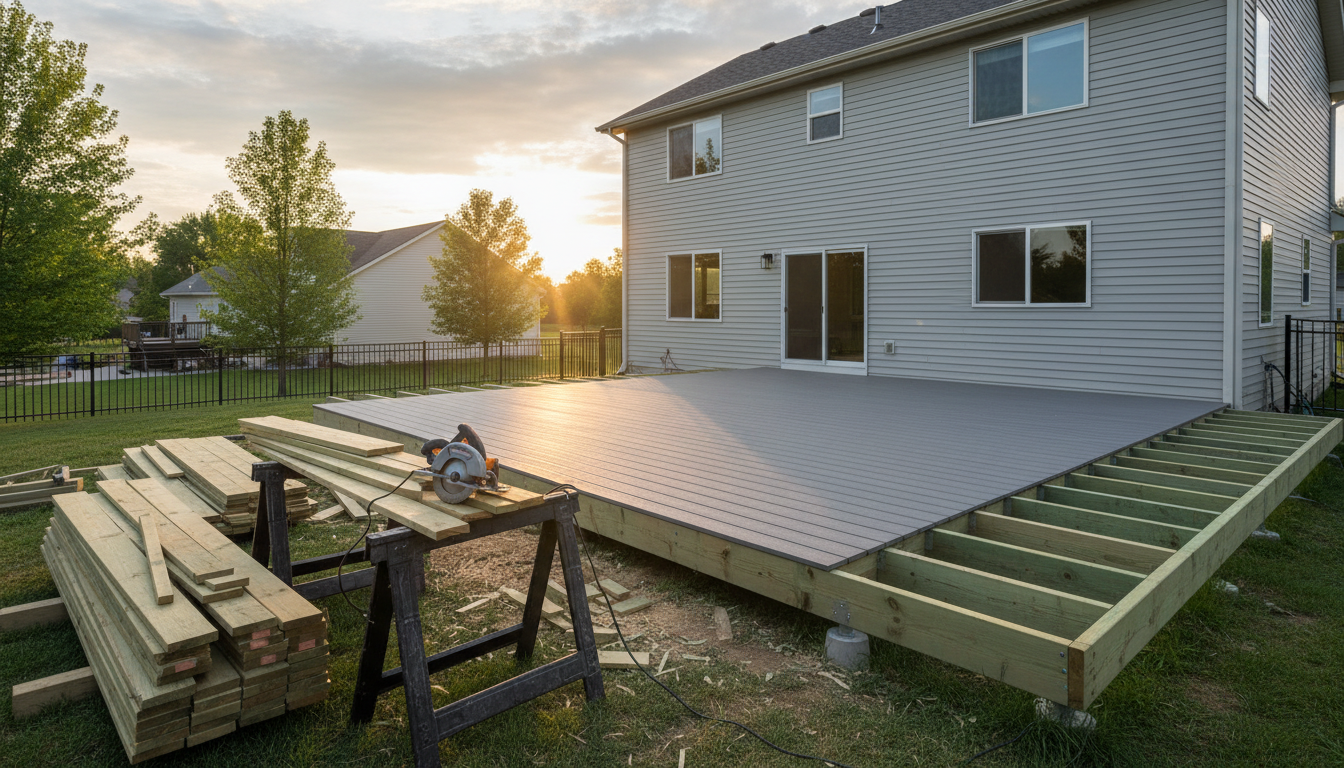
Deck replacement cost depends almost entirely on what is under the boards. If the joists, beams, posts and footings are sound and meet current code, new decking over the existing frame typically costs 40 to 60 percent less than a full rebuild. Composite can go over an existing frame, but only if the joist spacing fits the manufacturer’s rules, so a 24-inch-on-center frame built for thick wood boards may need extra joists first.
Plan on a full rebuild when you find any of these: soft or crumbling wood where joists meet the ledger, footings that have heaved or settled, posts that sit directly on soil and have rotted at the base, or a frame you would like to enlarge. Inch Calculator estimates tearing out an old deck at $500 to $1,000 before any new work begins. For general repairs short of a rebuild, Angi lists $800 to $3,500.
Cedar, PVC and the boards in between
Pressure-treated pine and capped composite cover most American decks, but they are not the only options.
| Material | Material cost per sq ft | Who picks it |
|---|---|---|
| Pressure-treated pine | $2 to $5 (Angi) | Lowest first cost; owners willing to stain |
| Cedar | $3 to $7 (Angi) | Buyers who want real wood that looks better than treated pine and weathers to silver gray |
| Redwood | $5 to $35 (Angi) | Buyers who want premium natural wood; grade drives the wide range |
| PVC | $5 to $13 (NerdWallet) | Pool decks and wet sites; contains no wood fiber |
| Composite | $12 to $22 (Angi) | Low-maintenance buyers planning to stay for a decade or more |
Cedar and redwood still need finishing to hold their color, so they sit with pressure-treated wood on the maintenance side of the ledger. Composite can also get very hot in direct sun, which matters on a south-facing deck you plan to cross barefoot. Lighter colors help.
Deck questions that come up after the first bid
Do I need a permit to build a deck?
Usually, yes, for an attached or raised deck. Angi puts typical deck permits at $230 to $500. Small, low, freestanding decks under about 200 square feet may be exempt in some places, so check with your local building department before you buy materials.
What does it cost to maintain a wood deck each year?
Angi estimates $700 to $1,600 a year for professional power washing and resealing. Doing it yourself costs much less, mainly cleaner, stain and your time. Composite needs only regular cleaning.
Is a floating deck cheaper than an attached deck?
Not by as much as people expect. Angi lists floating decks at $20 to $60 per square foot, close to the range for attached decks. You skip the ledger connection to the house, but you still pay for framing, footings or blocks and decking.
How much does deck replacement cost compared with a new deck?
A full replacement costs about the same as a new deck plus demolition, which Inch Calculator estimates at $500 to $1,000. If the existing frame is sound, resurfacing with new boards typically costs 40 to 60 percent less than a full rebuild.
Can I finance a deck?
Many contractors offer financing, and homeowners also use home equity loans, HELOCs, personal loans or 0% intro APR credit cards for smaller jobs. Home equity products use your house as collateral. Compare the total interest cost before you choose.
The decision, reduced to two columns
Build with pressure-treated wood if
- You expect to sell within about five years.
- You will stain it yourself every two or three years.
- The budget is firm and the extra $6,800 would mean a smaller deck.
- The deck is shaded and low, where you would want a fresh frame in 15 to 20 years anyway.
Pay for composite if
- You plan to stay 10 years or longer.
- You would hire out every staining job.
- You will also pay for joist tape and ground-contact framing so the frame keeps pace with the boards.
- The bid itemizes fasteners, joist spacing and railing, so you can see where the premium goes.
More outdoor projects, priced
- Fence cost per foot and per year, by material
- Hot tub cost, from plug-and-play to premium
- Concrete slab cost for patios and pads
- Inground pool cost, shell to finished yard
- Siding cost across five materials
- Concrete slab cost calculator
Complete guide: Home Improvement Costs in 2027: A Complete Price Guide
Pricing method: prices were researched in November 2026 for 2027 planning and may change. Project costs come from Remodeling magazine’s 2025 Cost vs. Value report and Angi; board prices are Home Depot listings in November 2026; warranty terms are summarized from Trex dealer material; lumber duty figures are from Fastmarkets. Local labor rates, permits and lumber prices vary widely, so get several written bids. See our disclaimer.