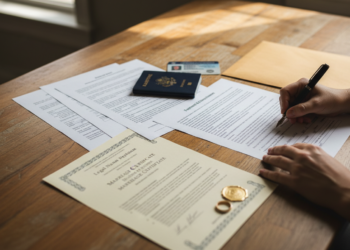

In June 2026 the Department of Homeland Security proposed raising the price of American citizenship by as much as 80 percent. The proposed rule in the Federal Register would lift the Form N-400 fee from $710 to $1,280 for online filers and from $760 to $1,330 on paper. For now, nothing has changed: file today and you pay $710 online or $760 by mail, and as of early November 2026 Ashoori Law’s USCIS fee roundup reported that the increase had not been finalized.

That gap between today’s price and a possible 2027 price is why timing now matters as much as the number itself. The sections below take the seven questions applicants ask about the citizenship application fee, in roughly the order they ask them.
What does USCIS charge to file Form N-400 right now?
Five prices apply, depending on how you file, what your household earns and whether you served in the military. The fingerprint appointment no longer costs extra: Brooks Law Firm notes that the old $85 biometrics charge has been folded into the filing fee since April 2024.
| How you file | Fee | Who it applies to |
|---|---|---|
| Online | $710 | Most applicants paying full price |
| Paper | $760 | Anyone who mails the application |
| Paper, reduced fee (Form I-942) | $380 | Household income at or below 400% of the federal poverty guidelines |
| Paper, fee waiver (Form I-912) | $0 | A means-tested benefit, income at or below 150% of the guidelines, or financial hardship |
| Military (INA sections 328 or 329) | $0 | Qualifying current and former service members |
Source: CitizenPath’s N-400 filing fee guide (updated September 2026) and Ashoori Law’s November 2026 fee schedule.
The $50 online discount is the easiest money you will save in the whole process, and the proposed rule would keep it. Paper makes sense mainly when you are asking for the reduced fee or a waiver, because those requests have to travel with a paper application.

Is the N-400 really going to cost $1,280 in 2027?
Possibly, but not yet. The proposal, published June 23, 2026 under docket USCIS-2026-0265, is a notice of proposed rulemaking rather than a final rule. Its comment period closed August 24, 2026, after roughly 2,250 public comments, and DHS has not announced an effective date. If it is finalized as written, the changes look like this:
| Fee | Today | Proposed | Change |
|---|---|---|---|
| N-400, online | $710 | $1,280 | +80% |
| N-400, paper | $760 | $1,330 | +75% |
| N-400, reduced fee | $380 | Eliminated | Full fee applies |
| N-400, fee waiver | $0 | Eliminated | Full fee applies |
| N-336 hearing on a denial, paper | $830 | $1,475 | +78% |
| Military exemption | $0 | $0 | Kept |
Source: DHS proposed rule “Naturalization Application Fee Adjustments,” 91 FR 37500, June 23, 2026, as published in the Federal Register.
There is no confirmed effective date for the increase at this time.
Brooks Law Firm, September 2026
One 2027 fee change has already arrived, and it is a different one. On October 16, 2026, USCIS raised four fees created by H.R. 1 for inflation, including the annual asylum fee ($102 to $105) and the immigration parole fee on Form I-131 ($1,020 to $1,050). The USCIS announcement lists no change to Form N-400, so headlines about “2027 USCIS fee increases” do not apply to the citizenship application.
Does filing before a final rule lock in today’s price?
Generally, yes. Immiva’s summary of the USCIS Policy Manual explains that the postmark on your envelope decides whether you sent the correct form edition and fee, with a courier’s shipping-label date playing the same role. A case already pending is not repriced when fees change later.
The arithmetic is blunt. An eligible permanent resident who files online this winter pays $710; the same person filing after a final rule takes effect would pay $1,280, a $570 difference. For someone who qualifies for the $380 reduced fee today, the jump to the proposed $1,330 paper fee is $950 (our calculation from the figures above).
The catch is eligibility. Filing early helps only if you already meet the residence and other requirements. A rushed application that gets denied costs the full filing fee, and contesting the denial through Form N-336 costs $830 on paper today, or $1,475 under the proposal.
Who can still pay $380, or nothing at all?
The reduced fee is requested on Form I-942 and is available only on paper. CitizenPath puts the income line at or below 400 percent of the federal poverty guidelines; Brooks Law Firm frames it as income between 150 and 400 percent, since households below 150 percent usually qualify for the full waiver instead.
A full waiver uses Form I-912. Ashoori Law lists three grounds: receiving a means-tested public benefit, household income at or below 150 percent of the poverty guidelines, or documented financial hardship. The waiver request must be mailed together with the N-400 itself.
Current and former members of the armed forces who naturalize under INA sections 328 or 329 pay no filing fee, and the proposal would keep that exemption. The reduced fee and the waiver, on the other hand, are exactly what the proposal would remove, so lower-income applicants who are eligible now have the most to lose by waiting.
Why USCIS will not cash your check
USCIS moved to electronic payments on October 28, 2025, and a paper money order is no longer the default. According to Ashoori Law, paper filers now pay one of three ways:
- Credit or debit card, authorized on Form G-1450 and mailed with the application.
- ACH bank debit, authorized on Form G-1650.
- Check or money order, only if you qualify for an exemption from electronic payment and include Form G-1651.
USCIS does not take cash, and Brooks Law Firm notes there are no installment plans. Online filers simply pay at submission. If a card is declined, the application can be rejected, so check your limit before you mail a $760 authorization.
What does an immigration lawyer add to the bill?
Usually more than the government fee itself. CitizenPath’s September 2026 cost index estimates the all-in cost of a straightforward naturalization three ways:
| Route | Estimated total, government fee included |
|---|---|
| File it yourself | $802 |
| Online guided preparation service | $1,175 |
| Immigration attorney | $2,902 |
Brooks Law Firm’s October 2026 cost breakdown puts attorney fees for naturalization at $1,000 to $3,000 and the total with a lawyer at roughly $2,000 to $4,000. It also prices the small extras: certified translations at $25 to $75 a page and photos at $10 to $20.
Those DIY figures assume a clean history. A lawyer earns the fee when your file raises questions an officer will ask, such as an arrest, long stretches abroad or an earlier immigration problem. Nonprofit legal clinics and DOJ-accredited representatives also prepare N-400s, often for far less. For hourly versus flat-fee pricing, see our guide to what lawyers charge.
The costs that come after the oath
Naturalization ends with a certificate, not a travel document. A first adult passport book costs $165 in 2026, a $130 application fee plus a $35 execution fee, according to Brooks Law Firm. Our passport cost guide prices expedited service if you have a trip booked.

Guard the certificate. Replacing a lost or damaged one on Form N-565 costs $555 on paper or $505 online, per Ashoori Law’s schedule. Children under 18 who become citizens through a naturalized parent do not file an N-400 at all; if they want a certificate as proof, Form N-600 costs $1,385 on paper or $1,335 online, which is more than their parent’s application.
A filing plan for the months before any final rule
- Confirm you are eligible today, using USCIS guidance or an accredited representative, not a rough calendar count.
- Pick your fee lane: $710 online if you pay full price, or paper with Form I-942 ($380) or Form I-912 ($0) if you qualify.
- Line up payment USCIS accepts: a card or bank debit, not a personal check.
- File and keep proof of your postmark, courier label or online submission date.
- Set aside about $165 for the passport you will want once you take the oath.
If DHS publishes a final rule before you file, the notice will state the date the new fees begin. Anything postmarked before that date pays today’s price.
Smaller questions applicants ask about the N-400 fee
Is there a separate biometrics fee for the citizenship application?
No. Since April 2024 the old $85 biometrics charge has been included in the N-400 filing fee, so the $710 online or $760 paper fee covers your fingerprint appointment.
How much does it cost to request a hearing if my N-400 is denied?
A hearing request on Form N-336 costs $830 on paper or $780 online today. The June 2026 proposal would raise those fees to $1,475 and $1,425 and end fee waivers for the form.
Can I pay the U.S. citizenship application fee in installments?
No. USCIS does not offer payment plans for naturalization. Paper filers pay in full by card on Form G-1450 or by bank debit on Form G-1650, and online filers pay at submission.
How much does US citizenship cost in total?
CitizenPath estimates about $802 for a do-it-yourself filing and about $2,900 with an attorney. Brooks Law Firm puts the total with a lawyer at roughly $2,000 to $4,000. Add about $165 for a first passport afterward.
Did the October 2026 USCIS inflation increase change the US citizenship fee?
No. The October 16, 2026 increase covered four H.R. 1 fees tied to asylum, parole, work permits for certain groups and Temporary Protected Status. Form N-400 was not on the list.
Where the fee figures come from
- Naturalization Application Fee Adjustments (proposed rule), Federal Register / Department of Homeland Security, June 23, 2026
- USCIS Announces FY 2027 Inflation Increase for Certain Immigration-Related Fees, U.S. Citizenship and Immigration Services, September 30, 2026
- N-400 Filing Fee Guide & Citizenship Cost Calculator, CitizenPath, September 2026
- How Much an Immigration Lawyer Costs in 2026, CitizenPath, September 17, 2026
- How Much Does It Cost To Become a US Citizen in 2026?, Brooks Law Firm, October 12, 2026
- Citizenship Application Fee: What To Expect in 2026, Brooks Law Firm, September 2026
- USCIS Fees 2026: Fee Schedule and How to Pay, Ashoori Law, November 5, 2026
- N-400 Fee Increase 2026: $1,330 Proposed, Should You File Now?, Immiva, August 2026
Other government and legal fees we have priced
- The complete 2027 guide to insurance, legal and real estate costs
- Green card renewal fees for 2027
- Passport costs by situation and deadline
- Every fee in a legal name change
- Hourly vs flat-fee lawyer costs
- REAL ID costs by state
Pricing method: fees were researched in November 2026 for 2027 planning and may change, especially if DHS finalizes its proposed naturalization fee rule. This is general information, not legal advice; confirm current fees with USCIS, a licensed immigration attorney or a DOJ-accredited representative before you file. See our disclaimer.