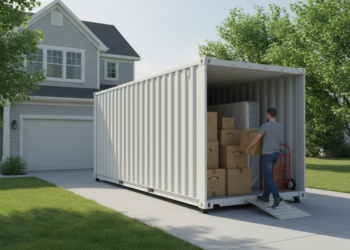
A used 40-foot shipping container holds twice the floor space of a 20-footer, yet at the depot it sells for only about $485 more. In the Shipping Container Price Index for November 2026, used 20-foot boxes carried a national median asking price of $1,684 and used 40-footers $2,169, while a new (one-trip) 20-footer was $2,737. Add delivery, a level pad and sometimes a permit, and most buyers who want one storage box on their own land spend roughly $2,100 to $4,700 in total for 2027, by our estimate.

Those numbers surprise people, because the folklore around containers runs in two directions at once: that they are nearly free, and that a bigger box costs proportionally more. Neither holds up. Below we test seven common beliefs about the cost of a shipping container against current asking prices, retailer listings and cost surveys, and show where the money actually goes. If you are comparing a container with a rented moving pod, our moving cost calculator prices the alternative.
Myth 1: A 40-footer costs twice what a 20-footer does
Reality: length is the cheapest thing you can buy. Steel boxes are priced by supply at the depot, and 40-foot units are the workhorses of ocean shipping, so yards hold plenty of them. The table below uses national medians across roughly 40 US metro areas, as asking prices at the depot before delivery and sales tax.
| Container | Wind and watertight | Cargo worthy | New (one trip) |
|---|---|---|---|
| 20 ft standard | $1,443 | $2,050 | $2,737 |
| 40 ft standard | $2,126 | $2,500 | $5,256* |
| 40 ft high cube | $2,374 | $2,638 | $3,840 |
| 20 ft high cube | n/a | n/a | $3,926 |
Source: national median asking prices from the Shipping Container Price Index, updated November 8, 2026. *The new 40-foot standard median is based on few sellers; most new 40-footers sold today are high cubes.
Two oddities stand out. A new 40-foot high cube, with an extra foot of headroom, has a lower median price than a new standard 40, simply because far more high cubes are being built. And a new 20-foot high cube costs more than a new 40-foot high cube in the same index. If your site has room, the per-square-foot math favors the longer box almost every time.
Myth 2: Used is used, so buy the cheapest grade
Reality: “used” covers boxes that are two years old and boxes that crossed oceans for fifteen. HomeGuide’s shipping container cost guide lays out the grades sellers use:
- One trip: made overseas and shipped once, effectively new. HomeGuide prices them at $1,700 to $8,500 depending on size and delivery.
- IICL: typically 2 to 7 years old and inspected to a leasing-company standard, $1,750 to $7,200.
- Cargo worthy: typically 5 years or older and still certified to carry freight, $1,300 to $4,500.
- Wind and watertight: typically 10 to 15 years old, retired from shipping but sealed against weather, $1,300 to $4,300.
For a 20-footer, the index puts the gap between wind and watertight and cargo worthy at about $607. For backyard storage, wind and watertight is usually enough, since you will never stack it on a ship. Cargo worthy earns its premium if you plan to ship the box, or if you want straighter walls and fewer patches before you cut in doors and windows. “As-is” boxes sit below both grades and can leak; buy one only after seeing it in daylight.
Myth 3: Container prices are national
Reality: geography can more than double the price of the same box. Containers pile up where imports arrive, and inland yards pay to truck or rail them in. In the November 2026 index, a used 20-footer asked $1,250 in Houston and $2,921 in El Paso, a $1,671 spread for identical steel.

Cheapest used 20-footers
Houston: $1,250
Chicago: $1,299
Charleston: $1,303
Savannah: $1,314
Detroit: $1,391
Priciest used 20-footers
El Paso: $2,921
Salt Lake City: $2,900
Denver: $2,775
Boston: $2,324
Phoenix: $2,278
Eveon Containers’ 2026 price report sees the same pattern, with Newark, Houston, Los Angeles and Savannah well below the national average and Denver, Salt Lake City and Phoenix several hundred dollars above it. If you live between two metros, price both: a cheaper yard 150 miles away can still win after delivery. As for 2027, no industry-wide price change has been announced. Prices are drifting up slowly: the index moved $12 for used 20-footers between October and November, and Eveon measured used 20-foot prices up about 2.6% over the year to May 2026.
Myth 4: Delivery is a rounding error
Reality: getting the box onto your land can cost a fifth of its price or more. Online sellers often quote a flat local fee; Boxhub’s listing for a used 20-foot container shows $1,225 plus a $400 tilt-bed delivery fee, with pricing confirmed by ZIP code. Longer hauls are billed by distance. Angi’s shipping container cost data puts domestic transport around $2.50 per mile, and its overall transport range of $1,400 to $9,100 includes long-distance and international moves.
The truck is only part of it. Angi warns that bare soil lets a container sink or tilt over time, and recommends a leveled, compacted base such as gravel, concrete piers, timber beams or a slab, at anywhere from a few hundred dollars to over $1,000. Many towns also want a permit for a container that stays, which Angi prices at about $15 to $500. Here is one example of a landed price for a used 20-footer bought in Dallas-Fort Worth (our illustration, not a quote):
- Container, local median asking price: $1,608
- Tilt-bed delivery at a typical flat local fee: $400
- Gravel pad and leveling beams: $500
- Local placement permit: $200
- Example total: $2,708, about 68% more than the depot price
Measure before you order. A tilt-bed truck slides the box off its back, so the driver needs a long, clear, firm approach and overhead room to raise the bed; ask the seller for its exact clearance requirements. If you plan a poured slab, our concrete slab cost calculator will size it.
Myth 5: Renting is the cheap way to try one out
Reality: renting wins for a season and loses within about a year. Angi lists container rentals at $50 to $500 a month depending on size and condition, and rental companies charge to drop off and pick up as well. Take $150 a month as an example rate inside that range. A used 20-footer at the national median plus a $400 delivery comes to $2,084, which equals roughly 14 months of rent, and the box you bought still has resale value afterward.
So the rule of thumb is simple: under six months, rent or use a portable storage pod; over a year, buy. In between, ask the rental company whether any rent can be credited toward a purchase. Our guides to PODS moving costs and storage unit prices cover the short-term options.
Myth 6: A container home is a $25,000 house
Reality: the box is the cheap part of a container home. HomeGuide’s container home cost data puts a finished single-container home at $25,000 to $80,000 and a multi-container house at $80,000 to $250,000 or more, or about $150 to $350 per square foot. The containers themselves account for just $1,200 to $10,000 each. HomeGuide prices a traditional site-built house at $178,000 to $416,000, so a container home saves money mainly by being small, not by being made of steel.
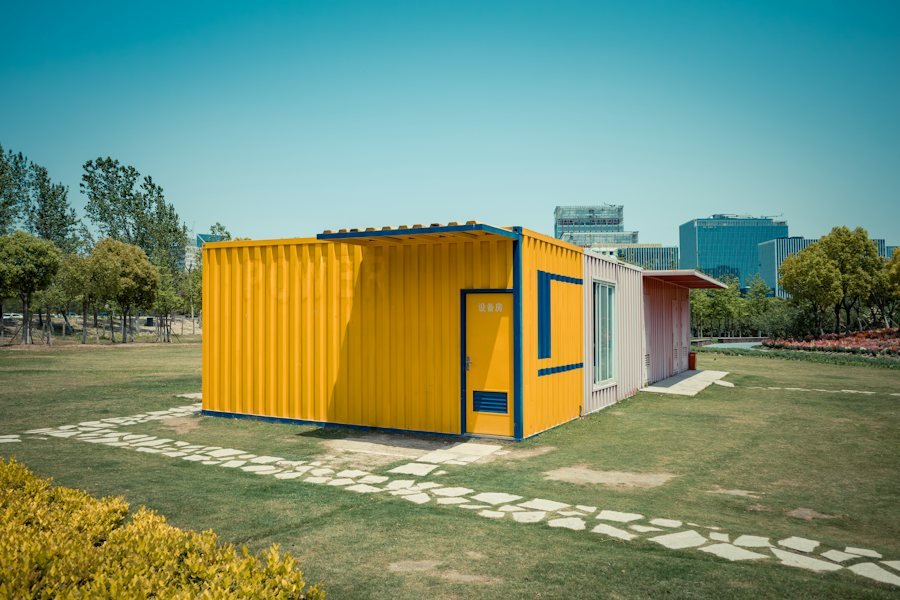
Steel walls conduct heat and cold, so every livable container needs insulation, and the add-ons pile up fast. Angi prices insulation at $4 to $16 per square foot, a new door at $500 to $1,600, wiring at $600 to $2,300 and HVAC with ventilation at $5,000 to $12,500. By our estimate, insulating the walls and ceiling of one 40-footer (roughly 1,100 square feet of surface) runs about $4,400 to $17,600 alone. Add a foundation, septic or sewer, permits and land, and our tiny house cost guide is the more honest comparison.
Myth 7: The lowest online price is the best deal
Reality: a container listed far below the local median is more likely to be bait than a bargain. The Better Business Bureau’s shipping container scam alert describes fake sellers who run polished websites, list the street address of a real container yard, take payment upfront and then go silent. Buyers who drive to the address find a legitimate business that has never heard of them.
Warning signs the BBB flags
- A price well below what nearby yards ask
- Full payment demanded before you can see or pick up the box
- A phone number that does not match the one map listings show for that address
- An address that turns out to be an empty lot or a house
- Pressure to pay today to hold the price
Use the city medians above as your sanity check. If a used 20-footer near Denver is listed at $900 when the metro median is $2,775, assume the worst until you have stood next to the container.
Before any money moves, get these five things in writing
- The grade and age, in the seller’s words: one trip, IICL, cargo worthy, wind and watertight or as-is.
- The container’s ID number, plus photos of the doors, floor and roof of that exact box.
- The delivered price, including truck type, mileage, fuel and any wait-time charges.
- Site requirements for the truck: clear length, width and overhead room.
- The return or guarantee terms, and a payment method that lets you dispute the charge.
Shipping container price questions the myths don’t cover
How much does a 10-foot shipping container cost?
HomeGuide prices a one-trip 10-foot container at $1,700 to $3,000 with delivery. Ten-footers are less common than 20s and 40s, so they rarely cost proportionally less; per square foot, a 20-footer is usually the better buy.
How much more is a high cube shipping container?
A high cube adds about a foot of interior height. In the November 2026 price index, a used 40-foot high cube had a median asking price of $2,260 versus $2,169 for a used standard 40, a difference of under $100. New 20-foot high cubes are scarcer and cost more, at a $3,926 median.
What does a refrigerated shipping container cost?
Refrigerated containers, or reefers, cost far more than dry boxes. HomeGuide puts them at $4,000 to $22,000 depending on condition, and Angi says a new one runs around $18,000. Running the refrigeration unit also needs a suitable power supply on site.
How much do side-door or open-top containers cost?
Specialty containers carry a premium over standard dry boxes. Angi says side-door containers start around $4,000 for a 20-footer and open-top containers around $4,900, with flat racks starting around $6,000 new.
How much do basic container modifications add to the shipping container price?
HomeGuide says modifications typically add $500 to $3,000 or more to a container’s price, for items like extra doors, vents, shelving or locks. Livable conversions with insulation, wiring and HVAC cost far more, as the container home section above shows.
Where these container prices come from
- Shipping Container Price Index: US Prices November 2026, Shipping-Containers.com (updated November 8, 2026)
- How Much Does a Shipping Container Cost?, Eveon Containers (June 2026)
- 20ft Standard Used Shipping Container, Boxhub
- How much does a shipping container cost?, HomeGuide
- How Much Does a Shipping Container Cost?, Angi
- How much does a shipping container home cost?, HomeGuide
- BBB Scam Alert: In the market for a shipping container? Watch out for this con, Better Business Bureau (February 26, 2025)
More storage, moving and small-building costs
- The complete 2027 guide to travel and moving costs
- Storage unit cost for 2027
- PODS moving cost and the 30-day clock
- Steel building prices by size, region and season
- Wood vs steel garage build cost
- Tiny house cost, path by path
- Moving cost calculator
Pricing method: prices were researched in November 2026 for 2027 planning and may change. Container prices are depot asking prices or published ranges from the sources listed and exclude sales tax unless noted; the Dallas-Fort Worth landed price and insulation figure are our own estimates built from those ranges. Local quotes will differ. See our disclaimer.