For every six fleas you spot on the dog or the rug, entomologists at Oklahoma State University estimate there are about 300 more in the carpet, the bedding and on the pet, most of them eggs, larvae and cocoons you will never see. Pricing a flea exterminator starts with that ratio. A single professional visit runs $75 to $400 and averages about $270, according to Angi’s 2026 data, and Thumbtack puts the typical job at $127 to $306. Most infestations need a second visit, which is where the budgets diverge.

So the question most owners are really asking is not what the exterminator charges. It is whether they can break the flea life cycle themselves for less, and at what point paying a pro stops being optional. Below we price three paths, do-it-yourself, full professional service and a one-visit hybrid, for the same example house, then give a rule for choosing.
Why the cocoon stage drives every flea quote
A flea egg hatches in one to 10 days and the larva develops in about five to 12, per Oklahoma State’s extension service. Then it spins a cocoon, and that is the stage that defeats both homeowners and professionals. The extension fact sheet calls pupae resistant to “any and all insecticides,” and Texas A&M AgriLife notes an adult can wait inside its cocoon for up to five months until vibration or body heat tells it a host is near.
That is why the usual failure is not a bad product. New adults hatch one to two weeks after treatment, the owner assumes the spray did nothing, and the cycle restarts. Three facts from the extension guides shape what you should pay for:
- Fleas are concentrated. About 95% of an infestation sits in 5% of the house or yard, usually where the pet sleeps. Treating those spots well matters more than treating every square foot.
- Pet and home go together. Both extension services say the animals and their living areas should be treated at the same time. Every pet in the house counts, including the cat that never goes outside.
- One round rarely ends it. Texas A&M says a follow-up is usually needed seven to 10 days after the first application, and up to two or three follow-ups at five- to 10-day intervals with short-lived pyrethrin sprays.
Path one: breaking the cycle yourself
The do-it-yourself route is cheap in cash and expensive in hours. Its core is not a spray but a vacuum. Texas A&M found vacuuming removes up to 60% of flea eggs and up to 30% of larvae from carpet, and the vibration coaxes adults out of cocoons so a treatment can reach them. Oklahoma State recommends a beater-bar vacuum, getting under furniture, and emptying the bag or canister outside right away.
- Pet treatment: $40 to $200 a year for flea control from your vet or a retailer, per Angi. This is the one line no path skips.
- Indoor spray: $5 to $30 a bottle over the counter, per HomeAdvisor. Look for one that pairs a quick adult kill with an insect growth regulator such as methoprene or pyriproxyfen, which stops eggs and larvae from maturing.
- Laundry and vacuuming: no cash cost, but daily vacuuming for two to three weeks and hot washing of pet bedding is the work that makes the spray succeed.
Be clear about what growth regulators do. Oklahoma State notes they do not kill adult fleas, and Texas A&M says topical IGR control on a pet takes four to six weeks. DIY works best on a light problem caught early, in a house with one or two pets and mostly hard floors.
Are flea bombs a cheap substitute for an exterminator?
Usually not. A fogger’s mist settles on open, upward-facing surfaces, while flea larvae live deep in carpet fibers, under furniture and along baseboards, exactly the 5% of the house where the infestation concentrates. University guides favor targeted sprays and vacuuming over foggers. If you use one, follow the label’s warnings on pilot lights, pets and re-entry time exactly.
Path two: paying a flea exterminator to finish the job
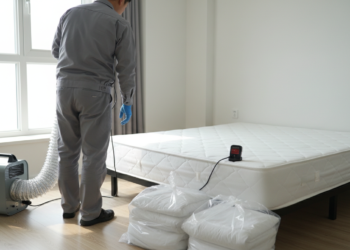
A professional brings stronger residual products, a sprayer that reaches under furniture and into cracks, and usually a guarantee. Expect the first visit to include an inspection, an interior treatment with an adult insecticide and a growth regulator, and instructions to vacuum before and after. Severity sets the price more than square footage does.
| Infestation | Angi range | HomeGuide range | What it usually looks like |
|---|---|---|---|
| Light | $100 to $175 | $50 to $200 | A few fleas on one pet, bites near the pet’s bed |
| Moderate | $175 to $300 | $200 to $400 | Fleas in several rooms, bites on people |
| Severe | $325 to $550 | $400 to $800 or more | Fleas jumping onto ankles, multiple pets, yard involved |
The national chains sit inside those ranges. HomeGuide lists Orkin flea treatment at $200 to $400 and Terminix at $100 to $400, though both quote by inspection and neither posts a flat flea price. Follow-up visits cost $75 to $200 at companies that charge for them, per HomeAdvisor and HomeGuide, while Angi notes that some firms re-treat free within 30 days. That single clause in the service agreement can be worth $200, so ask about it before you compare first-visit prices.
Method matters too. Angi prices exterior spraying at $150 to $300 as an add-on and heat treatment at $300 to $500, and HomeGuide quotes heat at $300 to $500 per room. Heat is a bed bug tool that a flea job rarely needs, and HomeGuide’s $1,500 to $4,000 for tented fumigation belongs to termites and extreme cases, not a typical flea problem.
Path three: one pro visit, then the follow-up is yours
Plenty of owners split the work. The exterminator does the heavy first treatment, with professional residual products and a growth regulator laid down where the larvae live, and the owner handles the weeks after: daily vacuuming, laundry, the pet’s preventive and spot-spraying the pet’s resting areas when the next wave hatches. Done carefully, this replaces the paid follow-up rather than the first visit, which is the part a pro does best.
The hybrid only saves money when the company charges for follow-ups. If the contract includes a free re-treat within 30 days, take it; you have already paid for it.
Three paths priced for the same three-bedroom house
To compare the routes, we priced a hypothetical household from the published ranges above: a three-bedroom house with one dog and a moderate infestation found in late summer. These are examples built from national ranges, not quotes.
| Line | DIY | Full pro | Hybrid |
|---|---|---|---|
| Dog’s flea control (a year) | $40 to $200 | $40 to $200 | $40 to $200 |
| First home treatment | $15 to $90 (three bottles of IGR spray) | $175 to $300 (moderate visit) | $175 to $300 (moderate visit) |
| Follow-up treatment | Included above | $0 to $200 | $10 to $60 (two bottles) |
| Total | $55 to $290 | $215 to $700 | $225 to $560 |
| Your time | Highest | Lowest | Moderate |
The arithmetic favors DIY by a few hundred dollars, but only if it works the first time. A DIY attempt that fails and ends in a pro visit anyway costs the sum of both columns, plus another month of bites. That is the trade you are making, and it is why severity, not thrift, should decide the path.
Service plans, guarantees and the upsells worth questioning
Many flea calls end with a pitch for a recurring plan. Angi puts a year of monthly service at $950 to $2,500 and quarterly service at $500 to $1,600. HomeGuide’s figures run lower, $50 to $100 a month or $75 to $150 a quarter, with an initial fee of $125 to $250. A general pest plan can make sense if you also fight ants, roaches or spiders; our guide to one-time visits versus pest control plans runs those numbers. For fleas alone, a pet on year-round preventive is the cheaper long-term defense.
- Ask what the guarantee covers. A 30-day free re-treat is common and valuable; a guarantee voided because the pet was not treated is also common, so get the pet sorted first.
- Ask whether a growth regulator is included. An adult-only spray sets up exactly the two-week rebound the extension guides warn about.
- Question whole-house pricing for a one-room problem. Angi lists a single bedroom at about $150 against $400 for the entire house, and the infestation is usually concentrated.
- Skip the yard unless the pet spends time there. Fleas outdoors live in shaded, moist spots where pets rest, not in open, sunny lawn.
For 2027, we found no announced national price changes from Orkin or Terminix and no new federal rules on household flea products. The ranges above, researched in November 2026, are the best planning numbers for next year; local quotes will move with labor costs in your area.
Flea treatment questions owners ask after the truck leaves
Can fleas live in a house with no pets?
For a while. Texas A&M AgriLife says adult fleas without a host live a few days to two weeks, but a flea can wait inside its cocoon for up to five months. That is why people moving into a house a previous owner’s pets left behind sometimes get bitten in the first days, once foot traffic wakes the cocoons.
How much does flea treatment cost for an apartment?
Usually less than a house, because fewer rooms need treatment. Angi lists about $150 for a bedroom and $175 for a living room, against $400 for an entire house. Check your lease and tell your landlord, since fleas can travel between units and some leases assign pest control to the owner.
Does a flea exterminator treat the yard?
Only if you ask, and it costs extra. Angi lists yard treatment at about $75, and HomeGuide puts a small yard at $75 to $80 and a large outdoor space at $100 to $125. It is worth it mainly when pets rest in shaded outdoor spots, under decks or in crawl spaces.
Does homeowners or renters insurance pay for a flea exterminator?
Generally no. Standard policies typically exclude damage and costs from insects and vermin as a maintenance issue. Read your policy or ask your agent, and in a rental, ask the landlord who is responsible.
Do we have to leave during a flea treatment?
Usually, for a few hours. People and pets typically stay out until sprayed surfaces are dry, and the exterminator should give you a specific re-entry time based on the products used. Ask in advance so you can plan for pets, fish tanks and anyone with asthma.
The decision rule: match the path to what you are seeing
Treat the pet first in every case, then use the row that fits. If you start with DIY, set a deadline: still seeing fleas after three weeks of daily vacuuming and two rounds of IGR spray means it is time to call.
| If this describes your house | Choose | Budget for 2027 |
|---|---|---|
| One pet, fleas on the animal, few or no bites on people, mostly hard floors | DIY | $55 to $290 |
| Fleas in several rooms, wall-to-wall carpet, you can vacuum daily for three weeks | Hybrid, or full pro if follow-ups are free | $225 to $560 |
| Several pets, bites on family members, fleas jumping onto ankles, or a DIY attempt that already failed | Full pro with a written re-treat guarantee | $215 to $700, more for severe cases |
| Moving into a vacant home where the last owner had pets | One pro visit before the furniture arrives | $75 to $400 |
If a pet has hair loss, scabs or seems unwell, see a vet before buying any product. Flea medications are dosed by species and weight, and some dog products are dangerous to cats.
More pest and pet bills worth knowing
- Home improvement costs in 2027: the complete price guide
- General exterminator cost: one visit or a plan
- Bed bug treatment cost, heat vs spray
- Roach exterminator cost by species
- What pushes carpet cleaning prices up
- Vet visit cost by clinic type and problem
More related guides: Ant exterminator cost, by ant
Pricing method: prices were researched in November 2026 for 2027 planning and may change. Treatment ranges come from Angi (updated July 2026), Thumbtack (updated July 2026), HomeGuide and HomeAdvisor; flea biology and treatment guidance come from Oklahoma State University Extension and Texas A&M AgriLife Extension. The three-path comparison is a hypothetical example, not a quote. Local prices vary; confirm with licensed pest control companies and your veterinarian. See our disclaimer.