Most people judge a deep cleaning quote by its quadrant price, and that turns out to be the smaller half of the bill. Scaling and root planing, the procedure behind the nickname, is billed one quadrant of the mouth at a time, and Aspen Dental’s 2026 pricing page puts the average at $289 per quadrant, with a range of $210 to $435. All four quadrants at that average come to $1,156. Antibiotic add-ons and the pricier cleanings that follow for years can push the first-year total past $2,000, and the numbers your hygienist reads out while probing your gums decide how much of it you actually need.

The quadrant fee is rarely the only line, though. Below, we take a sample quote apart the way you would at the front desk: what each code means, what it typically costs, and which lines deserve a second question before you book the first appointment. For a rough number on other dental work in the same plan, our medical and dental cost estimator covers the common procedures.
The sample quote: six lines, one year
This is a hypothetical cash-pay plan for an adult with moderate gum disease in all four quadrants, built from published averages, not a real patient’s invoice. Quadrant prices use Aspen Dental’s average; the antibiotic and maintenance lines use the midpoints of the ranges in Pearl’s periodontal treatment cost data, which is based on ADA fee survey figures. Exam and X-ray fees are left out because offices bill them in very different ways.
| Line | Code | What it is | Sample price | Our read |
|---|---|---|---|---|
| 1 | D4341 | Scaling and root planing, upper right | $289 | Fair if pockets support it |
| 2 | D4341 | Scaling and root planing, upper left | $289 | Fair if pockets support it |
| 3 | D4341 | Scaling and root planing, lower left | $289 | Fair if pockets support it |
| 4 | D4341 | Scaling and root planing, lower right | $289 | Ask how many teeth are involved |
| 5 | D4381 | Local antibiotic (such as Arestin), 6 sites at $75 | $450 | Ask which sites and why |
| 6 | D4910 | Periodontal maintenance, 4 visits at $225 | $900 | Expect it; check plan limits |
| First-year total | $2,506 |
Read the bottom line carefully. The deep cleaning itself is less than half of the first-year bill. The add-on and the follow-up visits make up the rest, and the follow-up visits do not stop after year one.
Lines 1 to 4: four quadrant charges and the pocket chart behind them
Those numbers the hygienist called out are pocket depths in millimeters, the space between gum and tooth. The American Dental Association’s coding guidance says a pocket depth of 4 mm or more is the indicator most often recognized for scaling and root planing, though each insurer sets its own criteria. Ask for a copy of your periodontal chart. It is your record, and it is the single best check on whether each quadrant line belongs on the quote.
If most of your readings are 3 mm or under with some bleeding, you may be a candidate for a regular or gingivitis-level cleaning instead; compare the plan with what a standard cleaning costs without insurance before agreeing to four quadrants of root planing.
Now look at the count. Aspen Dental reports that its average deep cleaning patient needs treatment on 2.5 quadrants, not four. At $289 a quadrant, that is about $723 instead of $1,156. A full-mouth quote is not automatically wrong, because advanced disease often is everywhere, but it should match a chart with deep pockets in every quadrant.
Then check the code on each line. D4341 is the full-quadrant code; D4342 covers a partial quadrant with one to three affected teeth. The price gap is real: PayorMap’s analysis of insurer price-transparency files shows an average negotiated rate of $228 for D4341, while the same data puts D4342 at an average of $108. A lower-right quadrant with two deep pockets billed as a full quadrant costs you roughly $120 more for the same work.

Why one office says $150 a quadrant and the next says $435
Published ranges overlap but never quite agree. Aspen Dental’s $210 to $435 is its own chain’s internal data. Pearl’s deep cleaning cost page shows a national range of $220 to $570 for D4341, with an average of $335. Insurer-negotiated rates sit lower still, at a $160 median in the PayorMap data, because a network discount is already baked in.
Geography explains a lot of the rest. In PayorMap’s state averages for D4341, Vermont tops the list at $248 and Wyoming sits near the bottom at $93. Who does the work matters too: a general dentist’s hygienist and a periodontist will often price the same code differently, and a chain with its own savings plan can undercut both for cash patients. None of that changes what the procedure is, which is why the pocket chart travels well between offices when you want a second quote.
Line 5: the antibiotic add-on few patients ask about
After scaling, some offices place a slow-release antibiotic, most often the brand Arestin, into the deepest pockets. Pearl prices it at $50 to $100 each, and its deep cleaning page notes it is billed separately by site. Six sites is $300 to $600, which can add half again to a two-quadrant cleaning.
Reasonable to accept
- A short list of named teeth that stayed deep after earlier treatment
- Sites charted at the deepest readings in your mouth
- A clear per-site price written on the plan
Reasonable to question
- Antibiotic in every pocket on a first-time cleaning
- A site count that does not match your chart
- A “package” price with no breakdown by site
Many plans treat local antibiotics differently from the cleaning itself, so call your insurer about D4381 separately. If you decline it, the scaling still happens; you are simply skipping an optional extra.
Line 6: the cleaning bill that never drops back to the old price
This is the line people miss. Once you have had scaling and root planing, your regular cleanings usually switch from a standard prophylaxis to periodontal maintenance, D4910. The ADA’s D4910 guidance describes it as a procedure that follows periodontal therapy and continues for the life of the dentition. In plain terms: probably for good.
Pearl puts each maintenance visit at $150 to $300, usually three or four times a year, so $450 to $1,200 a year at cash prices. Insurance does not always keep up. The ADA notes that most payers require a waiting period of 8 to 12 weeks after root planing, and where a plan limits D4910, many will pay only what they would for an adult cleaning, leaving you the difference.
What a PPO typically leaves you to pay
Deep cleaning usually falls under a plan’s basic services. Pearl reports that most PPO plans cover scaling and root planing at 50 to 80 percent after the deductible when periodontal disease is documented. Run the four-quadrant example through the PayorMap average negotiated rate of $228 and the network price is $912. At 80 percent coverage you owe about $182; at 50 percent, $456, plus whatever is left of your deductible and anything above your annual maximum.
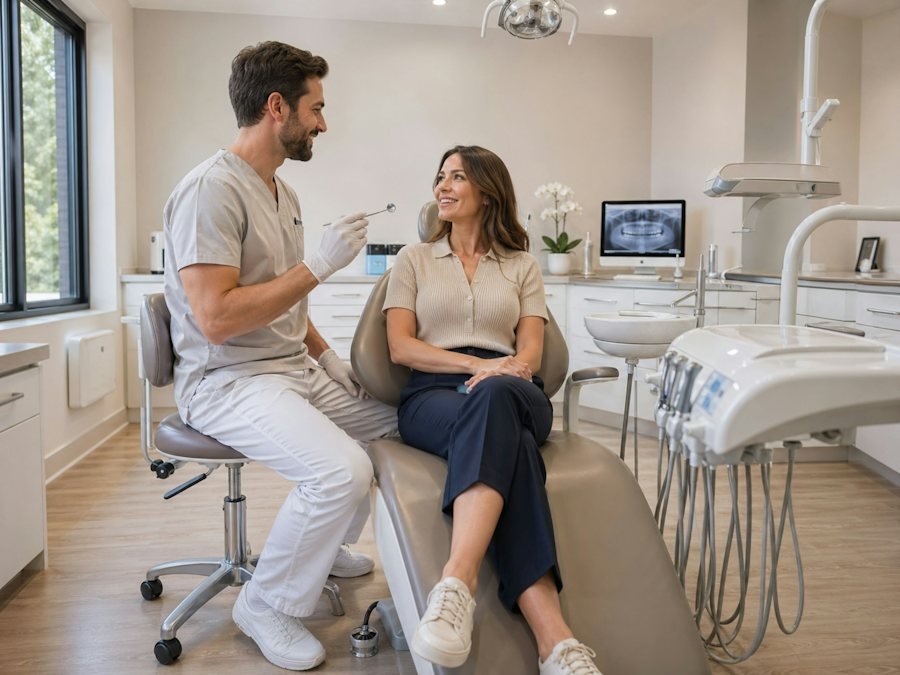
Expect the office to split the work. The ADA’s coding guidance says billing more than two quadrants on the same day usually triggers a request for more information from the insurer, and recommends sending full-mouth charting, X-rays, a diagnosis and the treatment plan. That is why many offices schedule two visits of two quadrants each. Two visits is normal; a request to pay for all four up front before the claim is decided is worth a pause.
Code changes for next year will not move this math. The ADA announced 67 changes to its CDT code set taking effect January 1, 2027, and the highlights it published cover implants, orthodontics and other areas rather than these cleaning codes. No insurer or survey we checked has announced 2027 prices for the procedure, so treat the 2026 figures here as your planning numbers for 2027.
The bill for saying no
About 47% of U.S. adults aged 30 and older, roughly 65 million people, have periodontitis.
CDC, Morbidity and Mortality Weekly Report
Gum disease is common, and the CDC’s national estimate rises to about 70 percent among adults 65 and older. The point is not to scare you into a four-quadrant plan you may not need. It is that untreated periodontitis is the kind of problem that gets cheaper the earlier it is handled.
Pockets that keep deepening loosen teeth over time. Once a tooth cannot be saved, the next quote is for removal, and our breakdown of what each kind of extraction costs shows that even a simple one is only the first charge.
The charge after that is filling the gap. Set a single quadrant of root planing beside the price of replacing one tooth with an implant and the math on the deep cleaning starts to look modest, provided the pocket chart says you need it.
Who to call before the first quadrant is booked
Your insurer. Read them the codes from the plan: D4341 or D4342 for each quadrant, D4381 for the antibiotic, D4910 for maintenance. Ask what percentage each is covered at, how much of your deductible and annual maximum is left, and how many D4910 visits a year the plan pays for.
A second office. Send your periodontal chart and X-rays and ask for a written quote on the same codes. If the chart shows 5 and 6 mm pockets throughout, a second dentist will likely agree, and you will know the price is the only thing to shop. If it shows mostly 3s, you have learned something more valuable.
The billing coordinator. Ask whether you can stage the quadrants across two plan years if your maximum is close, whether the antibiotic line is optional, and whether a cash or membership discount applies. Aspen Dental, for one, says its savings plan members get 20 percent off select periodontal treatments, while stating plainly that the plan is not insurance.
Questions patients ask after the treatment plan
Does Medicare pay for a deep dental cleaning?
Original Medicare does not cover most routine dental care, including cleanings. Some Medicare Advantage plans add dental benefits, so check your plan’s evidence of coverage for scaling and root planing and periodontal maintenance before booking.
What is D4346, and is it a deep cleaning?
D4346 is a full-mouth scaling code for gums with generalized moderate or severe inflammation, typically used when there is no bone loss. It sits between a regular cleaning and scaling and root planing, and it is billed once for the whole mouth rather than per quadrant.
Can a dental school lower my scaling and root planing cost?
Often, yes. Dental and dental hygiene schools treat patients at reduced fees under faculty supervision. Appointments take longer and openings can be limited, so call ahead and ask what they charge per quadrant.
Will I need another deep cleaning every year?
Not usually. Scaling and root planing is active treatment; periodontal maintenance visits take over afterward. A repeat in a quadrant is typically recommended only if pockets deepen again, which your dentist checks at each maintenance visit.
Can I finance a deep dental cleaning cost?
Many offices accept medical credit cards or offer in-house payment plans, and some chains sell membership savings plans. Read the terms of any deferred-interest card closely, since interest can apply retroactively if the balance is not paid in full by the deadline.
Price sources
- Deep Cleaning Teeth Cost (Scaling & Root Planing Cost), Aspen Dental (2026 internal data)
- How much does a deep cleaning cost?, Pearl (updated May 2026)
- Periodontal Treatment: National Cost, Pearl (updated May 2026)
- Scaling and Root Planing, 4+ Teeth (D4341): National Rates, PayorMap (March 2026)
- Scaling and Root Planing, 1 to 3 Teeth (D4342): National Rates, PayorMap (March 2026)
- D4341, D4342 Coding for Periodontal Scaling and Root Planing, American Dental Association
- D4910 Coding for Periodontal Maintenance, American Dental Association
- Periodontitis Among Adults Aged 30 Years and Older, United States, 2009 to 2010, CDC MMWR (2013)
If the gums are only part of the plan
- Healthcare costs in 2027: the complete guide
- Medical and dental cost estimator
- Regular dental cleaning cost without insurance
- Root canal cost, front tooth to molar
- Dental bridge cost in four real-world cases
- What dentures cost over 10 years
Pricing method: prices were researched in November 2026 for 2027 planning and may change. Figures are published averages, ranges and insurer-negotiated rates from the sources listed above; the sample quote is a hypothetical example, not a real invoice. Dental fees vary by office, region and plan, so confirm prices and coverage with your dentist and insurer. See our disclaimer.