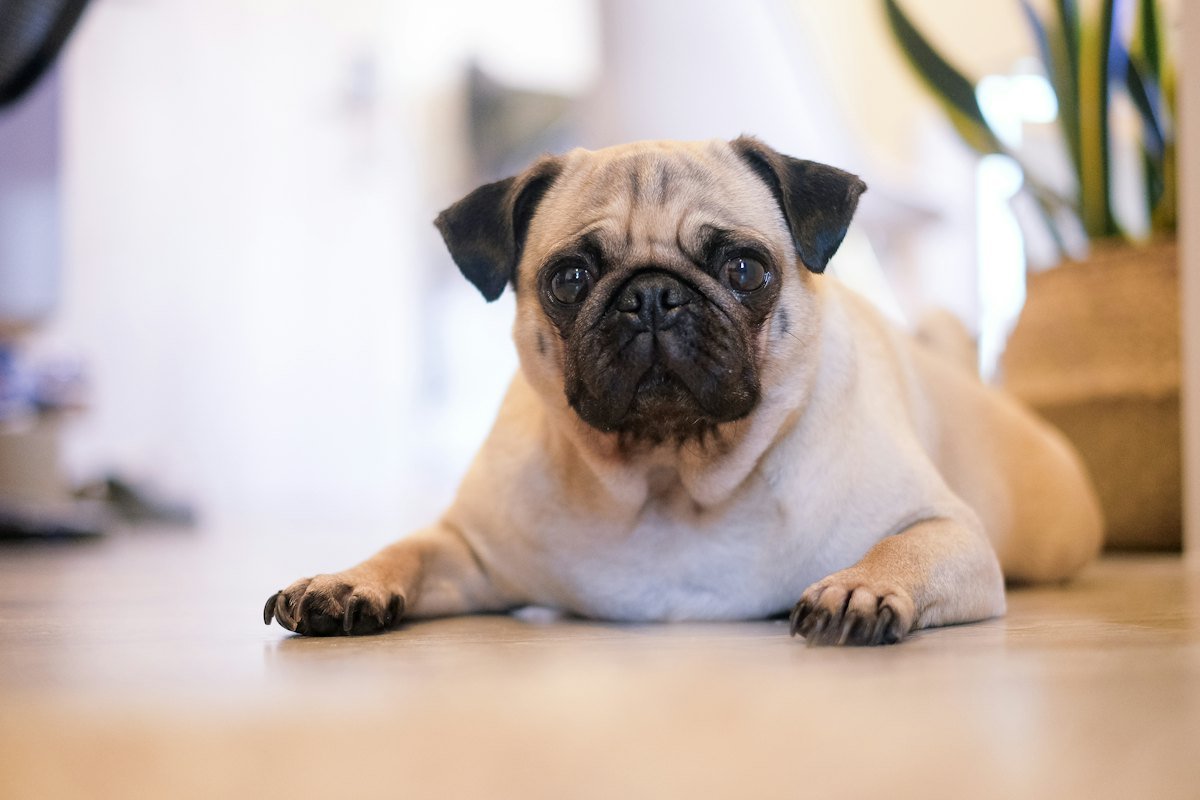
Fifty-four. That is how many times more likely a pug was to be diagnosed with a breathing disorder than other dogs in a large study of UK veterinary records. Keep it in mind when you see the price on a pug puppy, because the listing is the smallest number you will pay. In 2027, a pug from a breeder usually costs $1,000 to $3,000, a rescue pug about $100 to $400, and keeping one runs roughly $120 to $300 a month, according to Dogster’s 2026 pug cost breakdown. Surgery to open up a pug’s airway, which many pugs need, adds $2,000 to $5,000 or more.

Pugs have a reputation as the easy small dog: compact, calm, happy on a couch. Several beliefs about what they cost grew out of that reputation. We checked five of them against vet records, insurer claims data and published fee ranges.
| When you pay | What it covers | Typical range |
|---|---|---|
| Up front | Puppy from a breeder | $1,000 to $3,000 |
| Up front | Rescue or shelter adoption fee | $100 to $400 |
| First month | Crate, bed, bowls, toys and other supplies | $175 to $370 |
| Every month | Food, routine care, insurance and extras | $120 to $300+ |
| Once, if needed | Airway (BOAS) surgery | $2,000 to $5,000+ |
Myth: a $400 pug puppy is a lucky find
Reality: a purebred pug puppy listed far below the $1,000 floor is more often a red flag than a bargain. Small, popular breeds are favorite bait for online puppy scams, where the “breeder” collects a deposit and a shipping fee for a dog that does not exist. The Better Business Bureau’s puppy scam study update logged nearly 4,000 reports in 2020 alone, with a median loss of $750, and its advice is blunt: think twice when a purebred is offered free or at a deep discount.
The cheap puppy that does exist carries a quieter risk. Breeders who skip health screening can sell for less because they spend less, and the savings come back as vet bills. A reputable breeder should let you meet the mother, show you where the puppies are raised, and talk openly about the parents’ breathing and eyes. Insist on seeing the puppy in person, or at least on a live video call, before money changes hands, and run the listing photos through a reverse image search.
Myth: a small dog means small vet bills
Reality: size is not the variable that matters here. The Royal Veterinary College’s VetCompass study of 4,308 pugs found the breed 1.9 times as likely as other dogs to have at least one disorder in a given year, with higher risk for 23 of the 40 most common conditions. The gaps are wide: about 13 times the risk of eye ulcers, 11 times the risk of skin-fold infections and 3.4 times the risk of obesity.
Insurers price exactly those conditions. Lemonade’s pug insurance page lists typical treatment costs that would make a budget for a “small” dog look naive:
| Condition common in pugs | Average treatment cost |
|---|---|
| Back disc disease (IVDD) | $2,500 to $8,000 |
| Heat stroke | $1,500 to $4,500 |
| Slipping kneecap | $500 to $2,500 |
| Rolled-in eyelids (entropion) | $500 to $2,000 |
| Skin allergies | $400 to $1,500 |
| Dental disease | $400 to $1,500 |
| Dry eye | $600 to $1,200 |
Teeth deserve a line of their own. Pugs pack a full set of adult teeth into a very short jaw, and the RVC data shows them 4.3 times as likely to have retained baby teeth. Crowding means tartar, so budget for professional dental cleanings under anesthesia every year or two rather than treating them as a rare event.
Myth: the snoring is just part of the charm
Reality: loud breathing at rest is the most common sign of brachycephalic obstructive airway syndrome, or BOAS, and in the RVC study pugs were almost 54 times more likely than other dogs to be diagnosed with it. Narrowed nostrils alone were 51 times more common. It is the single biggest wild card in what a pug costs.

Surgery usually combines up to three fixes: widening the nostrils, trimming an overlong soft palate and removing tissue that has been pulled into the larynx. PetMD’s veterinarian-reviewed guide to BOAS puts the full correction at $2,000 to $5,000 or more, notes it can be done as early as 4 months old, and says dogs typically spend one to two days in a 24-hour ICU afterward.
How clinics price each part of airway surgery
Insurify collected quotes from seven clinics in four states. Nostril widening ran $620 to $1,187, a soft palate resection $1,217 to $1,728, and removal of everted laryngeal saccules $1,787 to $2,046. A dog that needs all three, done separately, lands near the top of the PetMD range. Doing them in one anesthetic event is usually cheaper than staging them.
If you are torn between a pug and another flat-faced breed, the airway math barely changes; our look at why a French bulldog’s puppy price is the cheap part runs into the same surgery and the same insurance questions.
Myth: pet insurance will pay for the breathing surgery
Reality: it might, but only if you buy the right policy before anyone writes “BOAS” in your dog’s chart. Insurify’s review of BOAS coverage spells out the traps. Accident-only plans never cover it, because it is classed as an illness. Signs that show up before the policy starts, or during a waiting period of typically 10 to 30 days, make it pre-existing. Some insurers exclude congenital conditions outright, and Insurify names Nationwide as one that does not cover BOAS procedures.
Premiums for a pug are not outrageous at the start. Embrace says most of its pug customers pay $37 to $55 a month, and Lemonade’s illustrative averages run $40 to $45 a month for a 1- to 3-year-old pug, climbing to $65 to $70 by age 7. The timing is the lesson: enroll the week your puppy comes home, which is the same reasoning behind why insuring a pet young pays off. We found no announced 2027 rule change for pet insurance; expect premiums to keep rising with your dog’s age rather than with the calendar.
Myth: a rescue pug is always the cheap way in
Reality: the adoption fee is cheap, usually $100 to $400, and many rescues vaccinate and fix dogs before placing them, which can save you the bill for a separate spay or neuter surgery. That is real money. The catch is that adult pugs from rescues sometimes arrive with breathing, eye or skin problems already on record, and any condition diagnosed before your policy starts will not be covered.
That does not make rescue a bad deal. It makes the questions different. Ask whether the dog has already had airway surgery, whether it has a history of eye ulcers, and what its current weight is. A pug that has been through BOAS surgery at the rescue’s expense can be cheaper to own than a puppy that still has it ahead.

What the everyday pug bill looks like
Here the reputation holds up better. A pug eats little, and Dogster puts food at $20 to $50 a month. Routine vet visits run $50 to $100 each, insurance $20 to $100 a month depending on the plan, and the total lands between about $120 and $300 a month for most owners. Over a lifetime, the American Kennel Club’s lifetime cost estimate puts a typical small dog at about $15,051 over a 15-year life, before any breed-specific surgery.
Two pug habits move that number. Pugs gain weight easily, and extra pounds make every breathing problem worse, so measured meals are cheaper than a diet plan later. Their facial folds also need cleaning a few times a week to head off the skin-fold infections that showed up 11 times as often in the RVC data. Both cost minutes, not money, and both are cheaper than the vet visit they prevent.
Five questions to answer before you put down a deposit
- Have I seen this puppy and its mother in person or on a live video call, and does the price sit inside the normal $1,000 to $3,000 range?
- Will the breeder or rescue share the parents’ or dog’s breathing history and any eye problems?
- Do I have $2,000 to $5,000 available, in savings or insurance, if the vet recommends airway surgery?
- Have I picked an illness policy that does not exclude BOAS, and will it start before the first vet exam?
- Can I keep this dog cool, lean and its folds clean for the next 12 to 15 years?
Three yeses and two maybes is a reason to wait, not a reason to bargain-hunt.
Pug price questions we hear most
What should a pug puppy price include?
A breeder’s price should normally cover the puppy’s first vaccinations and deworming, a vet check, a written sales contract and registration papers if the puppy is sold as purebred. Ask for the vet records in writing. A price that excludes basics a reputable breeder would normally include is worth questioning.
Is a pug mix cheaper than a purebred pug?
Pug mixes are often listed for less, and some have a slightly longer muzzle. But a mixed pedigree does not guarantee an open airway, so budget for the same breathing, eye and skin checks you would for a purebred pug.
Do black pugs and fawn pugs cost the same?
Coat color does not change a pug’s health risks or care costs. Be cautious with breeders charging a premium for unusual ‘rare’ colors; the breed standard recognizes fawn and black, and a rare-color markup pays for marketing, not a healthier dog.
Can I finance a pug’s BOAS surgery?
Many vet hospitals accept medical credit cards or offer payment plans. Read deferred-interest terms carefully, since interest can apply to the full balance if it is not paid off by the deadline, and get a written estimate before the procedure.
How much is a pug harness, and does my pug need one?
Vets commonly recommend a harness rather than a neck collar for flat-faced breeds, because pulling against a collar presses on an already narrow airway. A basic harness is an inexpensive part of your setup budget and worth buying on day one.
Where these prices come from
- How Much Does It Cost to Own a Pug?, Dogster (updated September 23, 2026)
- New research shows Pugs have high health risks, Royal Veterinary College VetCompass (May 2022)
- BOAS in Dogs: Everything You Need To Know, PetMD (updated June 9, 2026)
- Does Pet Insurance Cover BOAS Surgery?, Insurify (updated May 27, 2025)
- Pet Insurance Pug, Lemonade (updated October 5, 2026)
- Pug Pet Insurance, Embrace Pet Insurance
- Puppy Scam Study Update, Better Business Bureau
- How Much Will You Spend on Your Dog in Their Lifetime?, American Kennel Club (updated June 24, 2026)
More on what dogs cost
- Family costs in 2027: the complete guide, from pets to funerals
- Vet visit cost by clinic type, pet and problem
- What each Havanese price level gets you
- What it costs to board a dog
- The Farmer’s Dog cost vs topper and kibble
- French bulldog price and ownership costs
Pricing method: prices were researched in November 2026 for 2027 planning and may change. Figures are published ranges and averages from the breeders’ market, insurers and veterinary sources listed above, and actual costs vary by region, breeder and clinic. This article is general information, not veterinary advice; ask your vet about your own dog. See our disclaimer.