
The most expensive line on an attic insulation quote is sometimes one you never needed: tearing the old stuff out. If your existing insulation is dry, clean and free of droppings, Angi’s guidance on old insulation is blunt that in most cases you can lay new material right on top. When removal is justified, a plain vacuum-out runs $1 to $2 per square foot, or about $600 to $1,200 for a typical job with a $900 average, according to Angi’s attic insulation removal cost data. Removal plus new insulation lands between $3,200 and $10,800.

Contamination is what blows those numbers up. Rodent cleanup, mold and asbestos can each add thousands. So rather than another price list, we built a hypothetical quote for a common job and took it apart one line at a time: what each item should cost in 2027, which lines earn their keep and which deserve a hard question. If new insulation is part of a bigger heating or cooling decision, our HVAC replacement cost calculator helps you see the full picture.
Does the old insulation really have to come out?
Answer this before you look at a single number. Angi lists the cases where removal makes sense: insulation that is wet, moldy, fire-damaged or fouled by rodents; faced batts that would trap moisture under a new layer; and attics headed for spray foam, which cannot form its air seal over loose material. Batts that were installed badly can also justify pulling them out, or a “lift and fill” fix.
Everything else is usually a top-up job. Thin, dusty but dry fiberglass from 1995 is not a reason to spend $1,500 on removal. It is a reason to blow more on top. If a contractor recommends removal, ask which of those conditions they saw, and ask for photos.
The $8,140 quote we are taking apart
Picture a 1,200-square-foot attic over a 1980s ranch in a cold northern state. The blown-in fiberglass has settled, and mice have left droppings along the eaves. The quote below is our example, not a real invoice; the line prices are set inside or near the ranges published by HomeGuide, Angi and HomeAdvisor so you can see how a typical bid is assembled.
| Line on the example quote | Quoted | Published range | Our read |
|---|---|---|---|
| 1. Vacuum removal, 1,200 sq ft | $1,800 | $1 to $2 per sq ft ($1,200 to $2,400) | Fair |
| 2. Haul-away and disposal | $350 | Usually included in removal | Question it |
| 3. Droppings cleanup and sanitizing | $850 | $600 to $1,000 | Fair, if droppings are confirmed |
| 4. Rodent-proofing entry points | $650 | $100 to $800 | Fair, ask what gets sealed |
| 5. Attic air sealing | $1,400 | $350 to $3,000 | Worth it |
| 6. New blown-in insulation, 1,200 sq ft | $2,640 | $1.00 to $2.80 per sq ft | Fair |
| 7. Asbestos test | $450 | $250 to $850 | Only if vermiculite is present |
| Total | $8,140 | $7,340 without lines 2 and 7 |
Source: ranges from HomeGuide’s attic insulation removal cost guide. The rodent-proofing and air sealing ranges also match HomeGuide’s attic cleaning cost guide. The quote itself is a hypothetical example.
Line 1: the vacuum-out, $1,800
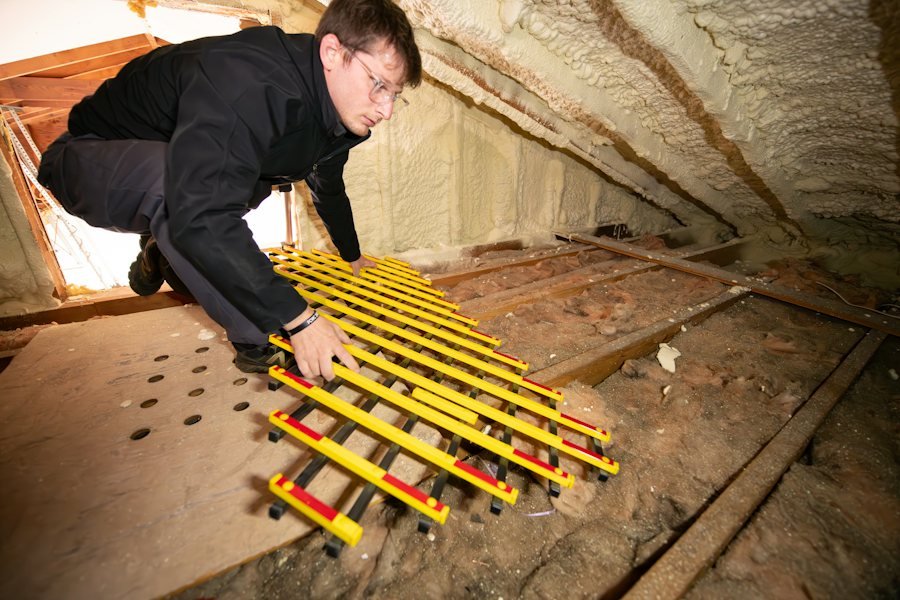
This is the core of the job, and $1.50 a square foot sits squarely in the middle of the national band. Crews run a high-powered vacuum hose from a truck-mounted or trailer unit into the attic and suck loose fill into large bags. Batts are rolled and bagged by hand, which is slower. Angi puts average removal at $600 to $1,000 for blown-in material, $800 to $1,100 for batts and rolls and $900 to $1,200 for rigid board, with labor billed at $35 to $85 an hour when a crew prices by time.
Size moves the total in a straight line, which makes it easy to sanity-check any bid. These are removal-only figures for dry, non-hazardous insulation, set next to the price of removing and replacing it.
| Attic size | Removal only | Remove and replace |
|---|---|---|
| 500 sq ft | $500 to $1,000 | $1,000 to $3,000 |
| 800 sq ft | $800 to $1,600 | $1,600 to $4,800 |
| 1,000 sq ft | $1,000 to $2,000 | $2,000 to $6,000 |
| 1,500 sq ft | $1,500 to $3,000 | $3,000 to $9,000 |
| 2,000 sq ft | $2,000 to $4,000 | $4,000 to $12,000 |
Those size bands match across HomeAdvisor’s removal cost page and HomeGuide. Two things push a bid above them. Tight, low-slope attics where crews must crawl can add up to $1 per square foot, per Angi. Region matters a little too: Angi’s averages run $600 to $1,000 in Southern states and $700 to $1,200 in the North.
Line 2: a haul-away fee that is usually built in
Both HomeGuide and HomeAdvisor say their removal prices typically include labor and disposal of ordinary insulation. Old fiberglass and cellulose go out in bags and to a landfill like other construction debris. A separate $350 disposal line on top of a full-price vacuum-out is the item on this quote most likely to be padding.
The exception is hazardous material. HomeAdvisor notes that safe disposal of contaminated insulation can run as high as $25 per square foot, and asbestos-bearing waste has its own handling rules. If the contractor names a real reason, fine. If the answer is “dump fees,” ask for that line to be folded into line 1 or dropped.
Lines 3 and 4: droppings, sanitizing and closing the doors
Rodent waste is the most common legitimate reason to pull insulation, and the two lines that follow it are where quotes vary most. HomeGuide prices rodent and droppings cleanup with disinfecting at $600 to $1,000, rodent-proofing at $100 to $800 and rodent removal at $150 to $600. Our example lands inside each range.
Watch for two things. First, some companies sell a bundled “attic restoration” or sanitation package with a minimum charge; HomeGuide reports minimums of $1,500 to $3,000. That can be fair for a badly fouled attic and steep for a few nests along one eave. Second, sealing is only worth paying for if the quote names the entry points: gable vents, soffit gaps, plumbing stacks, the gap around a chimney. Vague “exclusion work” at $650 deserves a written list.
Mold is the bigger escalator. HomeGuide puts mold removal and sanitizing at $1,500 to $6,000 on average, rising past $15,000 with structural damage or tough access. If a bid suddenly includes mold work you did not expect, ask for photos and moisture readings, and consider an independent mold inspection, which HomeGuide prices at $300 to $650.
Line 5: air sealing, the best $1,400 on the page
With the attic floor stripped bare, every gap around light fixtures, top plates, wiring holes and the attic hatch is exposed. That makes this the cheapest moment the house will ever offer for air sealing. HomeGuide’s range is $350 to $3,000. Skipping it to save money is the false economy on this quote: warm, moist air leaking into a cold attic is what wets insulation and invites mold in the first place.
Line 6: new insulation, and how deep to blow it
HomeGuide prices installed blown-in insulation at $1.00 to $2.80 per square foot, batts at $0.80 to $2.60 and spray foam at $1.00 to $4.50. At $2.20 a square foot, our example is reasonable for a deep blown layer in a cold climate. The depth is the part to check. ENERGY STAR’s recommended R-values call for R-49 in an uninsulated attic in the warm zones 2 and 3 and R-60 across zones 4 through 8, which covers most of the country. Ask the bid to state the target R-value and installed depth in writing, not just “blown-in insulation.”
Line 7: the asbestos test, and the attic that changes everything
If your attic holds pebbly, gray-brown or gold loose fill rather than fluffy fiberglass, you may have vermiculite. The EPA’s vermiculite guidance says a mine near Libby, Montana, supplied more than 70% of the vermiculite sold in the U.S. from 1919 to 1990, much of it as Zonolite, and that homeowners should assume it contains asbestos and leave it undisturbed. The agency says not to remove it yourself and to hire a professional asbestos contractor if work will disturb it.
That is why the $450 test line is a judgment call. The EPA notes that attic testing can be expensive and can return misleading results, and that you do not need a test to take precautions. In an attic of plain fiberglass, the line does not belong. In a vermiculite attic, the whole quote changes: HomeGuide puts asbestos insulation removal at $1,000 to $11,000 or more, or $10 to $25 per square foot, and HomeGuide’s attic cleaning guide reports that the Zonolite Attic Insulation Trust may reimburse up to 55% of qualifying removal costs.
No federal tax credit to soften a 2027 job
Older guides still promise 30% back on insulation. That is out of date. The IRS page for the Energy Efficient Home Improvement Credit says it applies to improvements made through December 31, 2025, so insulation installed in 2027 does not qualify. Even when it applied, the IRS excluded labor for installing insulation. Check your state energy office and electric or gas utility instead; some still run their own insulation rebates, and the rules vary by program.
Doing the vacuum-out yourself
For a dry, accessible attic with ordinary loose fill and no droppings, DIY is realistic. HomeGuide puts an insulation vacuum rental at $200 to $350 a day, and Angi says a 1,500-square-foot removal takes four to 24 hours. Add heavy contractor bags, a good respirator, goggles and disposable coveralls. Do not try it with vermiculite, visible mold or heavy rodent contamination; those are the jobs where professional containment is the point.
Three calls to make before you say yes
- A second insulation contractor. Ask them to bid the same scope line by line: removal per square foot, cleanup, sealing, air sealing and new insulation with a stated R-value. Matching lines make padding obvious.
- Your utility or state energy office. With the federal credit gone, a local rebate or free energy audit is the only discount left on the table, and some programs require approval before work starts.
- A licensed asbestos professional, if the fill looks like vermiculite. Do this before any insulation crew touches it, and ask about a claim to the Zonolite trust if the material qualifies.
More questions about pulling out old insulation
How long does attic insulation removal take?
Angi estimates four to 24 hours for a standard 1,500-square-foot attic. Loose fill in an open attic is fastest; batts in a tight, low-slope attic take longest.
Is old insulation removal billed by the hour or by the square foot?
Most contractors quote by the square foot, typically $1 to $2. Some bill time instead; Angi and HomeAdvisor put removal labor at $35 to $85 an hour.
Do I have to remove old insulation before spraying foam?
Yes. Angi notes that spray foam cannot expand into the gaps and form an air seal if old insulation is in the way, so existing material is removed first.
What is the highest attic insulation removal cost I might see?
HomeAdvisor says jobs involving hazardous materials or large attics can reach $15,000, and disposal of hazardous insulation alone can run up to $25 per square foot.
Is insulation removal cheaper in the South?
Slightly. Angi’s averages run $600 to $1,000 in Southern states and $700 to $1,200 in Northern states, though attic size and contamination matter far more.
Where the quote ranges come from
- How much does attic insulation removal cost?, HomeGuide
- How much does attic cleaning cost?, HomeGuide
- How Much Does Attic Insulation Removal Cost? [2025 Data], Angi
- How Much Does Attic Insulation Removal Cost in 2025?, HomeAdvisor
- Should I remove old insulation when I upgrade?, Angi
- Protect Your Family from Asbestos-Contaminated Vermiculite Insulation, U.S. Environmental Protection Agency (updated April 17, 2026)
- Energy Efficient Home Improvement Credit, Internal Revenue Service (reviewed April 28, 2026)
- Recommended Home Insulation R-Values, ENERGY STAR
Keep pricing the attic and the rest of the envelope
- Attic insulation cost: topping up, sealing or starting over
- What blown-in insulation costs installed
- Spray foam insulation priced by the inch
- Crawl space insulation: what it costs and what to skip
- Whole-house dehumidifier costs, by symptom
- HVAC replacement cost calculator
- Home improvement costs in 2027: the complete price guide
More related guides: Raccoon removal cost, itemized
Pricing method: figures were researched in November 2026 for 2027 planning and may change. Ranges come from the cost-data and government pages listed above; the line-by-line quote is a hypothetical example, not a real invoice. Confirm prices with local contractors, and confirm asbestos handling with a licensed professional. See our disclaimer.