The most expensive crawl space insulation job is usually the second one. A homeowner pays to staple fiberglass under the floor, the crawl space stays damp, and a few years later the batts are sagging, soggy or lying in the dirt. Doing it right the first time is cheaper: HomeGuide’s cost survey puts a typical crawl space insulation job at $500 to $3,700, or $1 to $4.50 a square foot installed, with a national average near $1,800. Full encapsulation, which adds a sealed liner and moisture control, is a different purchase at $3,000 to $15,000.

Most of the gap between those numbers comes from avoidable decisions, not from the insulation itself. Below are the seven traps that inflate crawl space bills, what each one costs, and what to buy instead. If the goal is lower heating and cooling bills, our HVAC replacement cost calculator helps you weigh insulation against equipment upgrades.
| Approach (1,000 sq ft crawl space) | Typical installed cost | What it solves | What it leaves alone |
|---|---|---|---|
| Fiberglass or rockwool batts in the subfloor | $900 to $1,400 | Cold floors in a dry, vented crawl space | Ground moisture, air leaks, pests |
| Blown-in insulation in the subfloor | $1,000 to $2,800 | Better coverage than batts between joists | Ground moisture |
| Rigid foam board on the foundation walls | $500 to $1,600 | Insulates a sealed, unvented crawl space | Needs a ground liner and drying plan |
| Rigid foam board in the subfloor | $1,200 to $3,700 | Moisture-tolerant floor insulation | Air leaks at the rim and vents |
| Closed-cell spray foam, walls and subfloor | $850 to $6,700 | Insulation and air sealing in one pass | Standing water, drainage |
| Full encapsulation (liner, sealing, dehumidifier) | $3,000 to $10,000 | Humidity, musty air, ground moisture | Flooding, which needs drainage first |
1. Insulating over a moisture problem
Insulation is not a moisture fix, and in a wet crawl space it becomes a sponge. The Department of Energy’s Building America guidance on unvented, insulated crawlspaces tells builders to assess the moisture potential first, cover the ground and walls with a polyethylene vapor retarder, and give the space a drying mechanism. Skip that step and you are buying insulation twice.
The fixes that should come first are not cheap, which is exactly why contractors sometimes leave them off a low quote. HomeGuide lists crawl space cleaning or repairs at $500 to $8,000 when needed and mold remediation at $15 to $30 a square foot, or about $1,500 to $4,000 for a typical job. Water pooling after rain is a drainage job: an interior drain with a pump runs $800 to $3,000. Look under the house after a heavy storm before you collect any insulation quotes.
2. Trusting cheap batts to stay up
Fiberglass batts between the floor joists are the lowest bid on almost every job, at roughly $0.90 to $1.40 a square foot installed. The trouble is gravity. Building scientist Allison Bailes listed the three standard failures in a post at Energy Vanguard: batts falling down, batts not touching the subfloor, and batts compressed by too-tight supports, which cuts their R-value. An inch of air between the batt and the floor lets cold air wash right over the wood you were trying to warm.
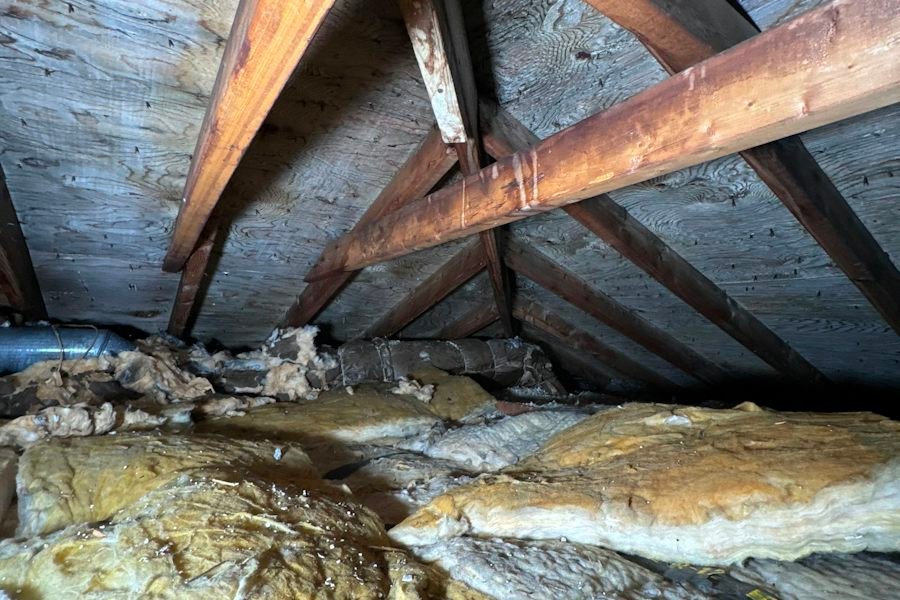
Failed batts are expensive to undo. Fixr’s crawl space data prices removing damaged insulation alone at $300 to $1,000, and a full replacement in an 800-square-foot crawl space at $1,000 to $3,500 including removal. If batts are still your choice for a dry, vented space, ask how they will be supported (wire supports or netting spaced to hold them flush without squeezing) and get that detail written into the quote.
3. Paying to insulate the floor and the walls
A crawl space gets insulated in one of two places. In a vented crawl space, the insulation goes in the floor above you. In a sealed, unvented crawl space, it goes on the foundation walls, and the floor needs none. The Building America guidance is blunt about the second case:
“No insulation is needed in the crawlspace ceiling.”
Building America Solution Center, U.S. Department of Energy
Some quotes include both anyway, especially spray foam packages priced for “walls and subfloor.” Pick one strategy. It matters for price because the walls are a much smaller surface than the floor. HomeGuide’s figures by crawl space size show how wide that gap gets:
| Crawl space size | Insulate the walls | Insulate the subfloor |
|---|---|---|
| 700 sq ft | $330 to $1,500 | $700 to $3,150 |
| 1,000 sq ft | $420 to $1,900 | $1,000 to $4,500 |
| 1,500 sq ft | $480 to $2,200 | $1,500 to $6,800 |
| 2,000 sq ft | $540 to $2,400 | $2,000 to $9,000 |
Wall insulation looks like a bargain on this table, but it only works in a sealed crawl space. Close the vents without a liner and a drying plan and you trap humidity under the house. That makes wall insulation the cheaper half of a bigger project, not a stand-alone shortcut.
4. Buying full encapsulation when a liner would do
Encapsulation is the biggest upsell in this trade, and sometimes it is the right call. This Old House puts the average encapsulation at about $5,500, with most jobs between $1,500 and $15,000, or $3 to $7 a square foot, and up to $10 where moisture damage is extensive. Labor makes up 50% to 70% of the bill.
Here is a hypothetical example for a 1,200-square-foot crawl space that is dry but has bare dirt on the floor. Quote A lays a vapor barrier on the ground and hangs supported batts in the floor. Quote B encapsulates. Using HomeGuide’s ranges, Quote A comes to roughly $2,300 to $5,700 ($1,200 to $4,000 for the barrier plus $1,080 to $1,680 for batts). Quote B, at $3 to $10 a square foot, runs $3,600 to $12,000. If your crawl space has no musty smell, no visible mold and no standing water, the extra money in Quote B buys protection against a problem you may not have. If it does have those signs, Quote A is the false economy.
Liner thickness is a common padding point. HomeGuide prices vapor barrier material at $0.30 to $0.35 a square foot for 6-mil sheeting and $0.60 to $0.70 for 20-mil, with installation bringing the total to about $2 to $4 a square foot. Thicker liners resist tears if you store things down there or need regular access. If nobody crawls under the house except the occasional inspector, a mid-weight liner with taped, overlapped seams does the job.
5. Forgetting the dehumidifier is a permanent appliance
A sealed crawl space needs something to keep it dry. Building America notes that code calls for a drying mechanism such as a continuously running exhaust fan or a supply of conditioned air, sized at 1 cfm for every 50 square feet of floor area or 50 cfm total, whichever is greater. Many encapsulation contractors meet that with a dedicated dehumidifier instead.
The unit is a meaningful line on the quote. HomeGuide’s encapsulation price breakdown lists a crawl space dehumidifier at $300 to $2,000 for the unit alone and $1,000 to $3,000 installed, while This Old House cites $800 to $2,000 with wiring. It also runs year after year, so ask the installer for the unit’s rated power draw and multiply by your local rate, then budget for a replacement at some point. Ask whether a small supply duct from your existing HVAC system would satisfy code in your house, since that can cost less up front than a standalone machine.
6. Paying spray foam prices for R-value your climate does not need
Closed-cell spray foam is excellent at sealing rim joists and odd gaps, and it shrugs off humidity. It also costs the most. Angi’s insulation figures put spray foam at $3 to $8 a square foot installed, against $0.55 to $2 for batts and $0.50 to $2.50 for rigid foam board. Fixr recommends about R-19 for most of the country, with R-13 or R-15 acceptable in mild climates.

The price climbs with every step up in R-value. HomeGuide’s figures for closed-cell foam run $2 to $3.80 a square foot at R-12 to R-14 and $4 to $5.50 at R-22 to R-30, while foam board at R-12 to R-14 runs $1.50 to $2.50. In a Gulf Coast or Southern California crawl space, the top tier rarely earns back its premium. A common middle path: spray foam only at the rim joist, where air leaks are worst, and foam board on the walls.
7. Budgeting around a tax credit that has expired
Older contractor pages still advertise a federal credit for insulation, and some quotes net it out of the price. Do not count on it in 2027. The IRS page on the Energy Efficient Home Improvement Credit says it covers qualifying property placed in service before December 31, 2025. When it was available, it paid 30% of the cost of insulation materials, capped at $1,200 a year, and labor never qualified. For a project next year, check your state energy office and your electric or gas utility instead, since rebate programs vary widely by region and some require a pre-approval visit before work starts.
Crawl space questions homeowners ask before hiring
Can I insulate a crawl space myself, and what does DIY cost?
Many homeowners can. HomeGuide puts DIY crawl space insulation at about $150 to $700 in materials. The work is cramped and dirty, so plan on a respirator, gloves and a way to support batts without compressing them. Hire out spray foam, which needs professional equipment.
What R-value should crawl space insulation have?
Fixr recommends about R-19 for most US homes, with R-13 or R-15 acceptable in mild climates and R-21 or more for spray foam. Your local energy code sets the minimum, so ask the installer which value applies where you live.
Do I need a permit to encapsulate a crawl space?
Sometimes. This Old House lists permits at about $100 to $250 where they are required. Rules vary by city and county, especially when the job adds wiring for a dehumidifier or changes drainage, so check with your local building department.
Should I buy faced or unfaced batts for a crawl space floor?
Faced batts cost about $0.10 to $0.25 more per square foot than unfaced ones, according to both Fixr and HomeGuide. The right choice depends on your climate and whether there is a ground vapor barrier, so ask the installer to explain which side the facing goes on and why.
How much does it cost to remove old crawl space insulation?
Plan on about $1 to $2 a square foot, based on HomeGuide and Angi figures, or $300 to $1,000 just to pull out damaged material in a smaller space, per Fixr. Moldy or contaminated insulation can push the total higher.
Who to phone first, second and last
First, a moisture check. A home inspector or a crawl space contractor who will give you a written moisture assessment, including standing water, mold and wood moisture readings. It tells you if you need drainage or repairs before anything else.
Second, two installers who propose different strategies. Get one quote for a vented approach (ground liner plus supported floor insulation) and one for a sealed approach (liner, wall insulation and a drying plan). Compare them line by line against the tables above, and strike any quote that insulates both the walls and the floor.
Third, your utility or state energy office. With the federal credit gone, local rebates are the only discount left for most homeowners, and some require approval before work begins. Make this call before you commit to a contractor.
Where these prices come from
- How much does crawl space insulation cost?, HomeGuide
- How much does crawl space encapsulation cost?, HomeGuide
- How Much Does Crawl Space Encapsulation Cost?, This Old House (updated March 13, 2026)
- Crawl Space Insulation Cost, Fixr (updated August 29, 2025)
- How Much Does Crawl Space Insulation Cost? [2025 Data], Angi
- Energy Efficient Home Improvement Credit, Internal Revenue Service (updated April 28, 2026)
- Unvented, Insulated Crawlspaces, Building America Solution Center, U.S. Department of Energy
- 3 Problems with Fiberglass Batt Insulation in Floors, Energy Vanguard (2011)
More ways to cut heating and cooling costs
- Home improvement costs in 2027: the complete price guide
- Attic insulation cost: top up, seal or tear it out
- How much blown-in insulation costs
- Spray foam insulation cost by the inch
- Mistakes that inflate foundation waterproofing cost
- Average cost of electricity per month
- HVAC replacement cost calculator
More related guides: Whole-house dehumidifier cost
Pricing method: prices were researched in November 2026 for 2027 planning and may change. Figures are national ranges from the cost guides and official sources listed above; your local quotes may differ. Read our disclaimer for details.