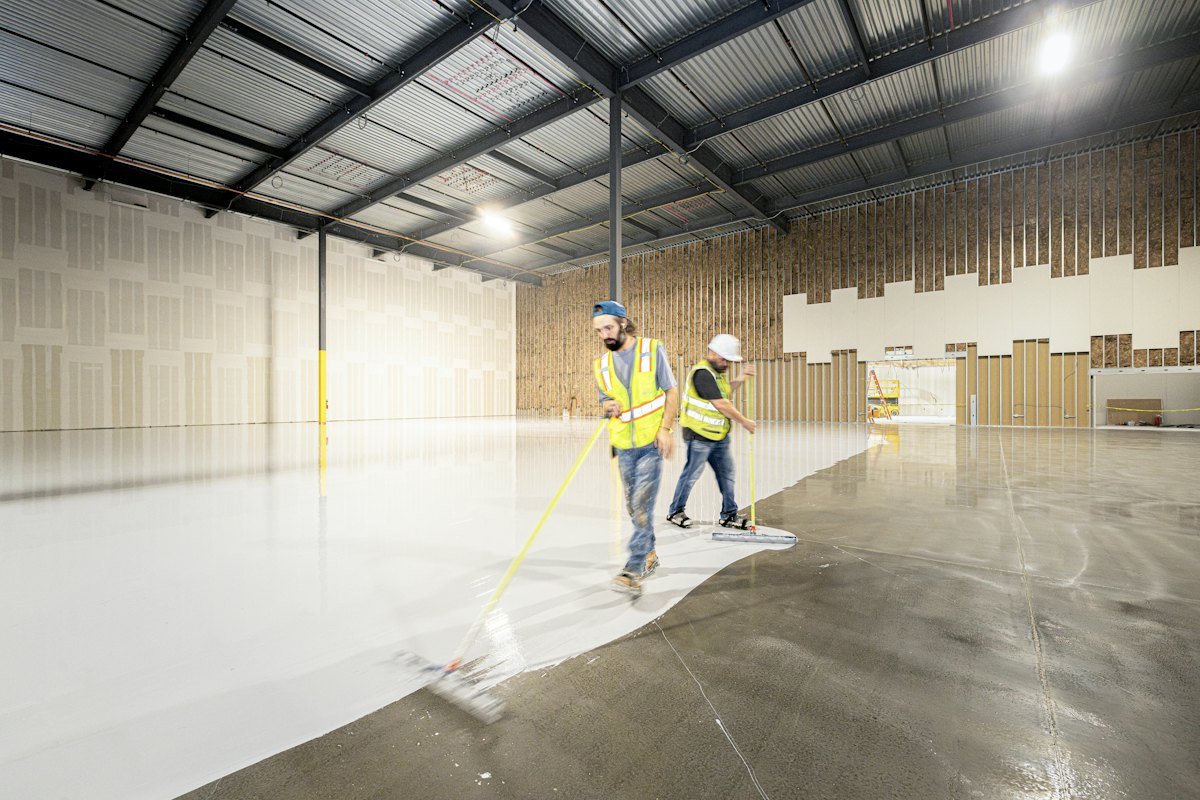
A $1,200 epoxy floor and a $9,000 epoxy floor can cover the same 600-square-foot basement, and neither bid has to be padded: they are different floors sold under one name. Installed, epoxy flooring generally runs about $4 to $10 per square foot, according to HomeGuide’s epoxy flooring cost guide, with thin epoxy paint dipping to about $2 and thick commercial systems climbing to $15.

The useful question is which rung of that ladder your room needs, and where paying more stops buying you anything. This guide covers interior floors: basements, kitchens, laundry rooms, shops and commercial spaces. If your slab is a garage, our separate guide on what a two-car epoxy garage floor costs deals with hot tires and road salt, which a basement never sees.
One word, five different floors
The table puts each system on the same 600-square-foot basement so the jumps are easy to see. Per-foot ranges come from the national cost guides linked in each row’s section below; the 600-square-foot totals are our arithmetic, and the flake row is our estimate built from This Old House’s note that high-grade coatings add 20% to 30% to a standard job.
| Rung | What you get | Installed, per sq ft | 600 sq ft basement |
|---|---|---|---|
| 1. Epoxy paint | Thin, often water-based, one or two coats | $2 to $4 | $1,200 to $2,400 |
| 2. Two-part solid color | Solvent-based or 100% solids epoxy, rolled on | $4 to $10 | $2,400 to $6,000 |
| 3. Flake with clear topcoat | Rung 2 plus broadcast chips and a polyaspartic or urethane top | About $5 to $13 (our estimate) | About $3,000 to $7,800 |
| 4. Metallic | Pearlescent pigments swirled into a self-leveling coat | $5 to $12 | $3,000 to $7,200 |
| 5. High-build commercial | Thick 100% solids systems for heavy traffic | $10 to $15 | $6,000 to $9,000 |
Source: per-square-foot ranges from HomeGuide, This Old House, HomeAdvisor and Fixr, cited in each section below. Room totals are our calculation.
Rung 1: epoxy paint, the cheapest floor to buy twice
The bottom rung is mostly what hardware stores sell as epoxy floor paint: a thin, water-based product with a little epoxy in it. Fixr prices this thin-epoxy concrete paint at $2 to $4 per square foot installed, with the product itself at $15 to $30 a gallon. Premade DIY kits run $200 to $700, per HomeGuide.
The catch is lifespan. HomeGuide and Angi both put water-based coatings at about three to five years before they need redoing, and This Old House warns that busy floors may need a fresh coat every one to three years. On a storage basement that sees a few boxes and a treadmill, that can be fine. On a playroom, it means paying for the floor again before the kids are out of grade school.
Rung 2: a true two-part system, where most homes should land
This is the floor most people picture: a resin and a hardener mixed on site, rolled out in a solid color at real thickness. HomeGuide’s $4 to $10 per square foot range sits here, split roughly into $1 to $5 for materials and $3 to $5 for labor. Labor is the big variable; Angi’s epoxy flooring guide puts it at 33% to 60% of the total, or $50 to $150 an hour.
Material grade explains most of the rest. Angi lists water-based resin at $30 to $50 a gallon, solvent-based at $40 to $55 and 100% solids at $45 to $150. Solids cost more per gallon and go on thicker, so they eat more gallons per room, but they are the version that holds up for a decade or more. For a basement family room or a laundry room, this rung buys nearly all the durability a house will ever use.
Keep the floor in proportion to the project. In a full remodel, the coating is a modest line next to framing, drywall and egress windows, so check it against what finishing a whole basement costs before spending extra on finish upgrades the furniture will cover anyway.
Rung 3: flake and a clear topcoat, cheap chips and a pricey lid
The colored vinyl chips scattered into wet epoxy look like the upgrade, but they are close to free. HomeAdvisor prices decorative flakes at about $0.04 per square foot, with a pound covering up to 250 square feet. What raises the bill is the clear coat that locks them in. This Old House lists polyaspartic topcoat at around $150 a gallon and says high-grade coatings add 20% to 30% to the job.
Flake earns its premium in two places: it hides dust, scuffs and small slab flaws, and the textured surface is less slick when wet. That makes it a sensible pick for a mudroom, a basement entry from the yard or a home gym. In a quiet den, it mostly buys a look.
Rung 4: metallic, the floor you buy with your eyes
Metallic epoxy swirls pearlescent pigment through a self-leveling coat, which produces the lava, marble or poured-water look that fills design feeds. This Old House prices metallic work at $5 to $12 per square foot. It is no tougher than a good rung 2 floor; the money goes to an installer who can control the pattern, and results vary a lot by hand.
Ask every metallic bidder for photos of finished floors in real rooms, not sample boards. Under raking light from a basement window, a glossy metallic coat shows every roller mark and every bump in the slab it was poured over. If the room will hold a sectional and a rug, much of the pattern you paid for will sit underneath them.
Rung 5: high-build commercial systems, priced for forklifts
Fixr prices thick epoxy at $10 to $15 per square foot and puts a thick-coat 1,000-square-foot basement at $10,000 to $15,000; HomeAdvisor says industrial and commercial 100% solids systems start at about $12. Those floors are built for pallet jacks, chemical spills and constant washdowns.
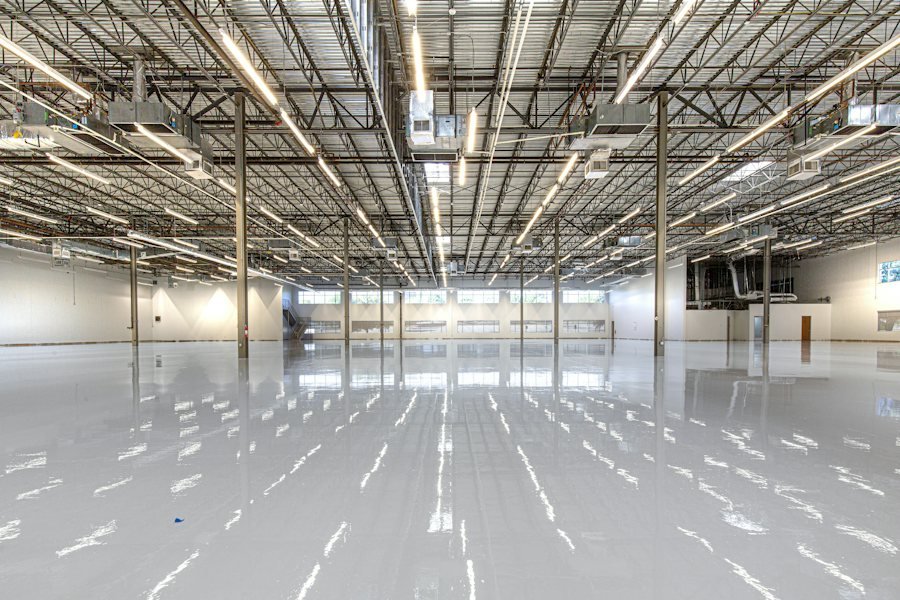
In a home, this rung is almost always overkill. In a restaurant kitchen, brewery or shop, it is often the right call, because a floor that can be hosed and squeegeed daily is a working tool. If you are pricing one for a food business, the floor is a small line in a bigger budget; see how it fits into a full pizza shop build-out.
The slab decides whether any rung holds
Epoxy rarely fails because the product was cheap. It fails because moisture pushes up through the concrete and lifts the coating off in blisters, which is why basements are the riskiest rooms on this list. Family Handyman calls the taped-plastic-sheet test unreliable and recommends calcium chloride test kits instead, about $40 for the three a typical floor needs. Its rule of thumb: if the result tops 3 pounds of vapor per 1,000 square feet, do not apply epoxy, and get a professional test if you land near that line.
A slab that fails the test usually points to a water problem outside the floor. Pricing the waterproofing fixes that stop a wet basement comes before any coating bid, because no topcoat can outlast water pushing from below.
Prep is the other line that moves quotes. Angi and This Old House put crack and chip patching at $25 to $250, HomeGuide prices full concrete resurfacing at $3 to $7 per square foot, and Fixr adds $2 to $4 per square foot when a primer coat is needed. New concrete also has to wait: This Old House says at least 60 days, and Fixr advises six months.
Polished concrete, the rival that skips the coating
Grinding and polishing the slab itself costs about the same as mid-ladder epoxy. Concrete Network’s polishing cost guide puts it at $3 to $12 per square foot and says epoxy compares with basic or mid-range polished floors in both price and durability. The trade-offs are different, though.
Choose epoxy when
- The slab is stained, patched or ugly and needs covering
- You want color, flake or a metallic look
- Spills need a sealed, non-porous surface
- The moisture test passes cleanly
Choose polished concrete when
- The slab is sound and you like its natural look
- You never want to recoat; Concrete Network says polish can last a lifetime
- The space is large and simple, where basic polish starts near $3
- Moisture readings are borderline for a coating
If neither hard finish appeals for a living space, a floating floor sidesteps the slab question; compare vinyl plank installation, labor and all, which tolerates a basement better than wood.
Nothing has been announced that would reset epoxy prices for 2027. Resin, pigment and labor costs move with the wider construction market, so treat the ranges here as current figures for planning next year’s project and get dated, written quotes.
Where to stop climbing, room by room
- Storage or utility basement: rung 1 is defensible if you accept recoating every few years; rung 2 if you would rather do it once.
- Finished basement living space: rung 2, and spend the difference on the moisture test and crack repair instead of a fancier finish.
- Mudroom, laundry or home gym: rung 3, where flake’s grip and its knack for hiding dirt pay off.
- Open-plan room you want to show off: rung 4, but only with an installer whose finished floors you have seen in person.
- Commercial kitchen, brewery or shop: rung 5, specified to what your health inspector and equipment require.
Epoxy floor questions the ladder does not settle
How long does a 100% solids epoxy floor last?
HomeGuide and Angi put solid and solvent-based epoxy at about 10 to 20 years, and This Old House says up to two decades. Traffic, UV exposure and slab moisture all shorten that.
How much does a gallon of epoxy cost, and how far does it go?
Angi lists water-based epoxy at $30 to $50 a gallon, solvent-based at $40 to $55 and 100% solids at $45 to $150. HomeGuide says one gallon covers about 80 to 200 square feet, depending on how thick it goes on.
How much does epoxy flooring cost in a kitchen?
HomeGuide puts a kitchen epoxy floor at roughly $400 to $2,000, since most kitchens are small. Any existing tile or vinyl has to come up first, which adds removal cost.
Can epoxy go on brand-new concrete?
Not right away. This Old House says concrete should be at least 60 days old, and Fixr recommends waiting six months so the slab can cure and dry before it is sealed.
Is epoxy flooring cheaper than tile?
Usually. Concrete Network says tile typically costs about four times as much as basic polished concrete, and it compares epoxy to basic or mid-range polished floors in price. Tile still wins on repairability, since one cracked tile can be swapped out.
Sources for these prices
- How much does epoxy flooring cost?, HomeGuide
- How Much Does Epoxy Flooring Cost?, This Old House (updated March 13, 2026)
- Epoxy flooring costs, advantages and installation, Angi
- How Much Does Epoxy Flooring Cost?, HomeAdvisor (2025)
- Cost of Concrete Floor Coating, Fixr (updated January 31, 2025)
- Polished Concrete Floor Cost, Concrete Network (reviewed January 10, 2023)
- Do This Before Using Epoxy Floor Paint in Your Garage, Family Handyman (updated March 4, 2024)
More floor and slab projects, priced
- Epoxy garage floor cost
- Laminate flooring installation cost by room and grade
- Whole-house dehumidifier cost
- Foundation repair cost
- Concrete patio cost, from broom finish to stamped
- Home improvement costs in 2027: the complete guide
Pricing method: prices were researched in November 2026 for 2027 planning and may change. Ranges are national figures from the sources listed; room totals and the flake estimate are our calculations. Get written quotes for your own slab. See our disclaimer.