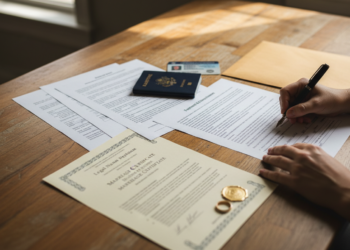
Most people walk up to The UPS Store counter assuming UPS sets its notary price, the way it sets the price of a box. It doesn’t. Every location is an independently owned franchise, and the most any notary there can charge is fixed by your state’s law: usually $5 to $15 per signature, as little as $2 in New York and Georgia, and up to $20 in California starting January 1, 2027. So the useful question is not what UPS charges, but what your state allows and how many signatures your paperwork needs.

Find your state in the table below, count your signatures, and you will know the bill within a dollar or two before you leave the house.
Every state’s ceiling, grouped by price
These are the maximum fees for a standard acknowledgment, the most common notarization for deeds, powers of attorney, affidavits of identity and similar forms, as compiled by the National Notary Association in its September 2026 update. A store may charge less than its state’s cap. It may not charge more for the notarization itself.
| Legal maximum per acknowledgment | States |
|---|---|
| $2 | Georgia; New York ($2 per person signing) |
| $2.50 to $25, by transaction | New Jersey ($2.50 for most documents, $15 and $25 for certain real estate signers) |
| $5 | Delaware, District of Columbia, Hawaii (per signer), Idaho, Illinois, Minnesota, Mississippi, Missouri, Nebraska, New Mexico, North Dakota, Ohio, Oklahoma, Pennsylvania (plus $2 per additional name), South Carolina, Wisconsin |
| $8 | Maryland |
| $10 | Alabama, Arizona, Connecticut, Florida, Indiana, Michigan, Montana, New Hampshire, North Carolina, Oregon, Utah, Virginia, West Virginia, Wyoming; Texas ($10 first signature, $1 each additional) |
| $15 | California (through December 31, 2026), Colorado, Washington; Nevada ($15 first signature, $7.50 each additional) |
| $20 | California, from January 1, 2027 |
| $25 | Rhode Island |
| No set maximum | Alaska, Arkansas, Iowa, Kansas, Kentucky, Louisiana, Maine, Massachusetts, South Dakota, Tennessee, Vermont |
In practice, NotaryLive’s 2026 survey of UPS Store pricing found most locations charging $5 to $15 a signature, with $10 the most common figure. That lines up with the table: the bulk of the country sits in the $5 and $10 rows, and franchisees in those states tend to charge the cap.
Where a stamp still costs less than a coffee
New York’s $2 limit is charged per person, not per page or per stamp. A married couple signing one document in a Manhattan UPS Store should pay $4 for the notarization, though the store can still bill separately for printing or copies. Georgia’s cap is also $2.
Texas is worth reading closely. State law, Government Code section 406.024, allows $10 for the first signature on an acknowledgment but only $1 for each additional signature. The Texas Secretary of State adjusts those amounts for inflation every five years, so check the current schedule if your document has many signers. Pennsylvania works in a similar way: $5 for the act, plus $2 for each additional name on it.
Short answer for Texas: one signer on one acknowledgment, up to $10. Three signers on the same certificate, up to $12. The store’s printing charges are extra.
California’s $20 ceiling starts on New Year’s Day
The one confirmed price change for 2027 is in the country’s largest notary market. Governor Gavin Newsom signed Assembly Bill 1597 on June 30, 2026. It amends Government Code section 8211 and raises the maximum for an acknowledgment, a jurat (a sworn statement) and a certified copy of a power of attorney from $15 to $20 per signature, effective January 1, 2027. Deposition-related fees rise as well.
It is only the second increase since 1994. The last increase, from $10 to $15, took effect in 2017. Lawmakers cited higher costs for supplies, insurance, travel and continuing education.
Two practical consequences for California signers. First, if a document can be notarized in December, doing it then may save $5 a signature at stores that move to the new cap. Second, the law sets a ceiling, not a price; plenty of notaries will keep charging $15. Notarizing vote-by-mail ballot envelopes and veterans’ benefit claims stays free under state law.
Eleven states let the notary name the price
In Alaska, Arkansas, Iowa, Kansas, Kentucky, Louisiana, Maine, Massachusetts, South Dakota, Tennessee and Vermont, there is no statutory fee for a standard notarization. The NNA notes that in several of these states the notary must tell you the fee before performing the act. Without a cap, UPS Store prices in these states can vary more from one location to the next, so a quick phone call to two nearby stores is the cheapest research you will do all week.
Counting signatures: one visit, several fees
Fees are charged per notarial act, which usually means per signature on a notarial certificate, not per document or per page. That is how a $10 errand becomes $40. Here is an example, not a real receipt: two spouses each sign a durable power of attorney and an accompanying affidavit, and each signature gets its own certificate. That is four notarizations. At each state’s legal maximum:
| State | Cap per signature | Four notarizations, at the cap |
|---|---|---|
| New York | $2 | $8 |
| Ohio or Illinois | $5 | $20 |
| Florida | $10 | $40 |
| Washington or Colorado | $15 | $60 |
| California, through Dec. 31, 2026 | $15 | $60 |
| California, from Jan. 1, 2027 | $20 | $80 |
Ask the notary how many certificates your packet needs before you start. Sometimes one acknowledgment certificate can cover more than one signer, depending on the document and your state, which cuts the count. The notary cannot decide what kind of certificate a document needs if it is blank, though; that choice belongs to you or whoever drafted the paperwork.
What the counter will and won’t do
Most wasted trips come from the same few problems. The UPS Store’s own location pages tell customers to bring a valid government-issued photo ID, to call ahead to confirm a notary is on site, and to arrive with documents complete and ready for signature, because the notary is prohibited from helping prepare them.
Arrive with
- An unexpired driver’s license, passport or state ID for every signer
- Every blank filled in except the signature lines
- The document unsigned; signing early can force you to reprint it
- Your own witnesses if the document requires them
- A call made that morning to confirm the notary’s hours
Expect a no on
- Advice on which form to use or how to fill it in
- Choosing the certificate wording for you
- Supplying witnesses, at many locations
- Wills, I-9 forms and real estate deeds, which NotaryLive reports many franchises turn away
- Notarizing a signature for someone who isn’t present
Because each store is independently owned, policies on document types and witnesses differ even within the same city. If your paperwork is a will, a deed or anything for a court, phone first.
Four other places to get the same stamp
The UPS Store’s advantage is hours and walk-in convenience, not price. If you are not in a hurry, these alternatives are often cheaper.
| Option | Typical cost | The catch |
|---|---|---|
| Your bank or credit union | Often free for account holders | Chase notes banks “may offer complimentary notary services to their customers,” but availability varies by branch and non-customers may pay or be refused |
| AAA branch | Free for members at many clubs, such as AAA Hoosier | Membership card and appointment usually required; offered by some regional clubs, not all |
| Online notary (Proof, formerly Notarize) | $25 first seal, $15 each additional seal, $10 per extra signer | Some agencies and states won’t accept electronic notarizations; your state’s online fee cap may apply |
| Mobile notary | The state’s per-signature fee plus a travel fee | Travel fees are set by statute in some states, by mileage in others, and left to the notary in the rest |
Online notarization is the one option that can cost more than a UPS Store visit in a low-cap state. In New York, a $2 in-person stamp and a $25 online session are very different errands. In California next year, the gap narrows to about $5 for a single signature.
UPS notary questions the price list doesn’t cover
Can a UPS Store notary get my document apostilled?
No. A notary can notarize the signature, but an apostille for use abroad is issued by your state’s secretary of state or a similar office, which charges its own fee. Some stores will ship the document to that office for you at regular shipping rates.
How much does UPS charge for notary on a power of attorney?
The same per-signature fee as any other acknowledgment in your state, for example up to $10 in Florida or $15 in California until January 1, 2027. Some powers of attorney also require witnesses, so confirm whether the store can provide them or bring your own.
Is a UPS Store notarization valid in another state?
A properly performed notarization from one state is generally recognized in others. The agency or company receiving the document may still have its own form or certificate requirements, so ask them before your visit.
Can I pay the notary fee with a card?
Most UPS Store locations accept cards for notary services, according to NotaryLive’s 2026 review, but each franchise sets its own payment policies. Ask when you call to confirm the notary is on site.
How much does a notary cost if I need one at home or the hospital?
You pay your state’s notarial fee plus a travel fee. Some states set travel fees in law and others leave them to the notary, so get the total in writing before the appointment.
The short version for your trip to the counter
Your UPS Store notary bill is your state’s cap multiplied by the number of signatures that need a certificate, plus whatever the store charges for printing. In most of the country that means $5 to $10 a signature; in New York and Georgia, $2; in California, $15 for the rest of 2026 and up to $20 after. If your bank or AAA club notarizes for free and you can wait for an appointment, that is the cheaper door. If you need it done at 6 p.m. on a Tuesday, the UPS Store is fairly priced by law, and the only way to overpay is to show up with a document that isn’t ready.
More fees for paperwork and government errands
- UPS passport photo cost, prints vs digital
- Passport fees by situation and deadline
- Every fee in a legal name change
- Divorce cost by how much you still disagree on
- Who pays which closing costs, buyer or seller
Complete guide: Insurance, Real Estate and Legal Costs in 2027: A Complete Guide
Pricing method: prices were researched in November 2026 for 2027 planning and may change. Fee caps come from the National Notary Association’s state fee chart (updated September 2026), Texas Government Code § 406.024 and California AB 1597; typical UPS Store pricing from NotaryLive’s 2026 review; alternative pricing from Proof, Chase and AAA Hoosier. The UPS Store locations are independently owned and set their own prices within state law; this site has no affiliation with UPS. This is general information, not legal advice; confirm requirements with your secretary of state or a licensed attorney. See our disclaimer.